
DHR vs eDHR — What FDA Actually Requires
820.184 is gone, the record is not. What a device production record must show under QMSR, and what changes when it goes electronic.
In short
- QMSR relies on ISO 13485 records of production; the old DHR list is still a good checklist.
- An electronic record is written as each step is signed, so it can be queried and reviewed by exception.
- Part 11 applies once required records are electronic: audit trail, signatures, access, validation.
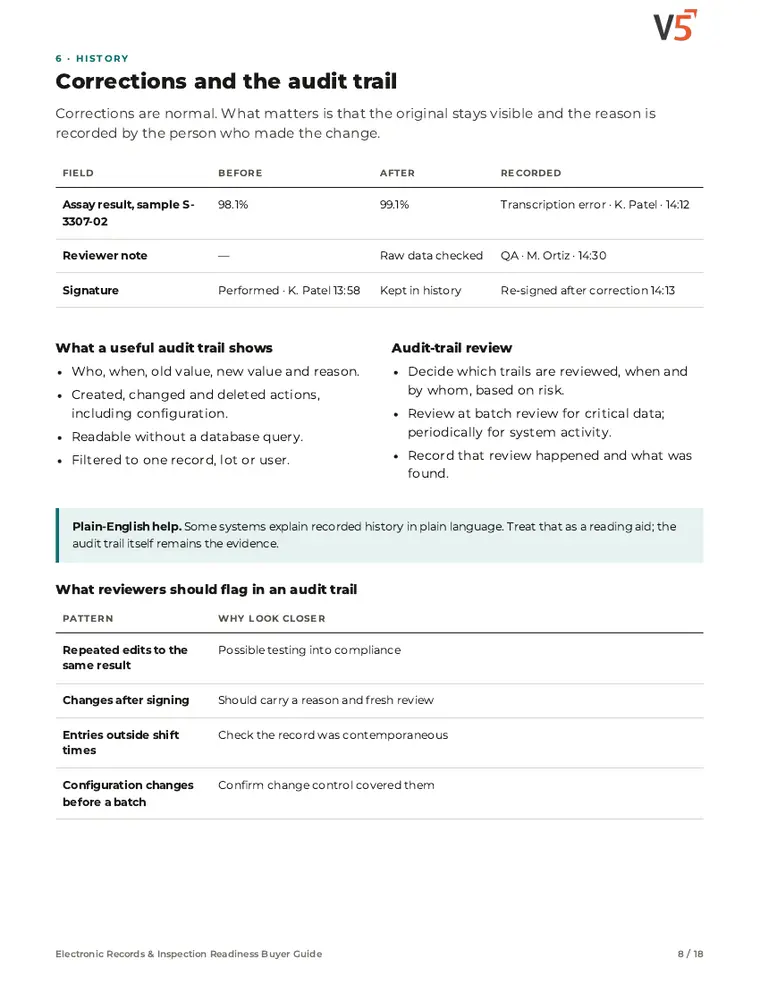
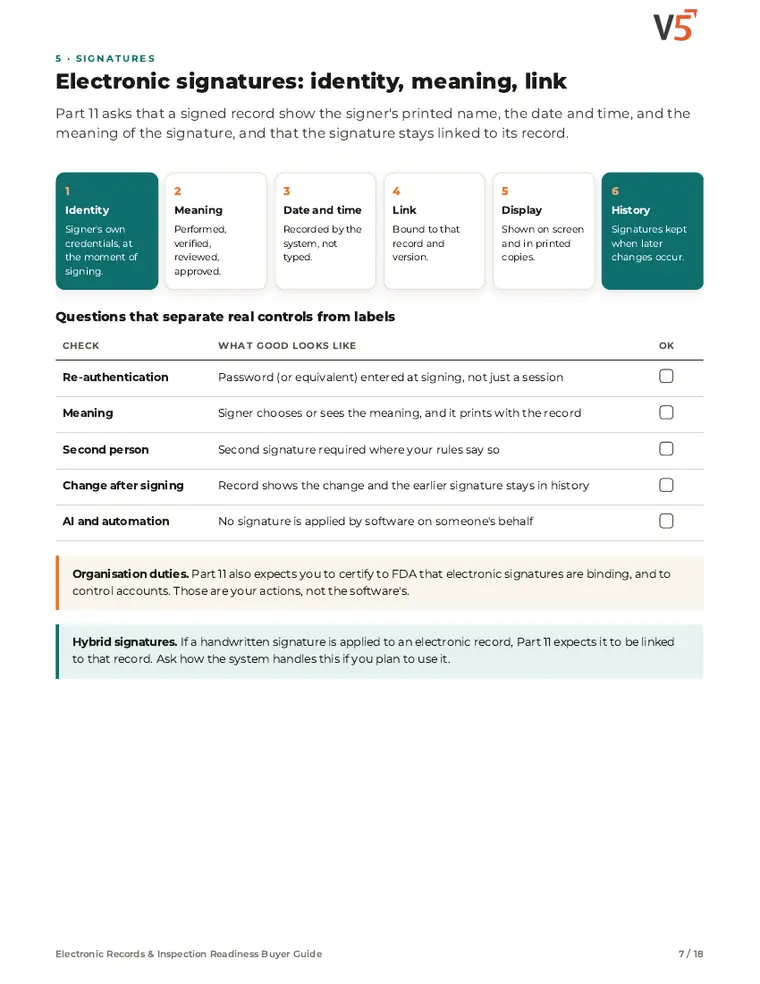
Electronic Records & Inspection Readiness Buyer Guide
For quality, regulatory, validation and IT teams evaluating electronic records, signatures and inspection readiness. Use it with or without V5.
18 pages
- See what a signature must show.
- Check corrections keep the original.
- Know where Part 11 applies.
Free. Just your name and email, and it downloads instantly.
We use your details to handle this request. Privacy policy. Practical orientation, not legal advice; your quality unit decides which rules apply.
Every finished medical device needs a production record. For decades FDA called it the Device History Record, defined in 21 CFR 820.184. Since QMSR took effect on 2 February 2026, that section is gone: Part 820 incorporates ISO 13485:2016, which requires records of production that establish conformity and traceability, and FDA still requires the UDI or control number to be documented. Neither version requires software. This guide covers what the record should contain, what changes when it becomes electronic, which Part 11 obligations follow, and what an inspector looks at.
What the former 21 CFR 820.184 listed (and why it still guides the record)
Before QMSR, 820.184 required the DHR to show that the device was made according to the Device Master Record, and to include or reference: dates of manufacture; quantity made; quantity released for distribution; acceptance records; the primary identification label and labelling for each production unit; and any UDI or control number. ISO 13485 clause 7.5.1 and 7.5.8 now carry the requirement, but that list is still a sensible checklist.
Worked example: what one device record shows
Serial INF-20417 (invented). The former 820.184 list, still a useful checklist under QMSR.
| Element | Example entry | Where it comes from |
|---|---|---|
| Dates of manufacture | Started 14 Sep, finished 15 Sep | Step timestamps |
| Quantity made / released | 1 made, 1 released | Build and release records |
| Acceptance records | Leak test pass, final inspection pass | Inspection steps with signatures |
| Label and labelling used | Label rev C, IFU rev F | Print event linked to the serial |
| UDI / control number | (01)…(21)INF-20417 | Generated from the build record |
- Dates of manufacture
- Example entry
- Started 14 Sep, finished 15 Sep
- Where it comes from
- Step timestamps
- Quantity made / released
- Example entry
- 1 made, 1 released
- Where it comes from
- Build and release records
- Acceptance records
- Example entry
- Leak test pass, final inspection pass
- Where it comes from
- Inspection steps with signatures
- Label and labelling used
- Example entry
- Label rev C, IFU rev F
- Where it comes from
- Print event linked to the serial
- UDI / control number
- Example entry
- (01)…(21)INF-20417
- Where it comes from
- Generated from the build record
More on what the former 21 CFR 820.184 listed (and why it still guides the record)
Travellers, operator initials, torque readings and environmental logs are kept because they show acceptance activities happened, not because the rule names them.
Where paper DHRs fail in practice
Paper DHRs rarely fail on content. They fail on contemporaneity, legibility and completeness.
More on where paper DHRs fail in practice
The classic findings are a traveller signed after the fact because the operator was busy, an inspection result recorded on a separate sheet that never made it into the folder, a superseded work-instruction revision still in circulation on the line, and a correction made without a dated initial or a reason. None of these mean a bad device was shipped. All of them mean the record cannot prove a good one was. Because the folder is assembled at release rather than as the build runs, the gap between what happened and what is written is invisible until someone goes looking — usually a reviewer with a deadline or an inspector with a sample.
What actually changes when the DHR goes electronic
An eDHR is not a scanned DHR. The meaningful difference is that the record is produced by the execution of the work rather than described after it.
Paper, scanned, electronic
| Paper DHR | Scanned PDF | Electronic record | |
|---|---|---|---|
| Written when | During or after the work | After the work | As each step is signed |
| Find all devices with lot X | Open folders | Search images, if indexed | Query linked records |
| Review | Every page | Every page | Exceptions first, rest on request |
| Part 11 applies | No | Depends how it is used | Yes, for required records |
- Written when
- Paper DHR
- During or after the work
- Scanned PDF
- After the work
- Electronic record
- As each step is signed
- Find all devices with lot X
- Paper DHR
- Open folders
- Scanned PDF
- Search images, if indexed
- Electronic record
- Query linked records
- Review
- Paper DHR
- Every page
- Scanned PDF
- Every page
- Electronic record
- Exceptions first, rest on request
- Part 11 applies
- Paper DHR
- No
- Scanned PDF
- Depends how it is used
- Electronic record
- Yes, for required records
More on what actually changes when the DHR goes electronic
When an operator completes an operation on screen, the operation, timestamp, operator identity, equipment used, component lot and serial, inspection result and signature are written as one transaction. Three consequences follow. First, contemporaneity stops being a discipline problem and becomes a property of the system. Second, the record becomes queryable — you can ask which devices used a given component lot, rather than opening folders. Third, release becomes review-by-exception, because the reviewer can be shown only the operations that deviated instead of paging through the ninety that did not.
The Part 11 obligations an eDHR brings with it
Going electronic adds 21 CFR Part 11 to the picture. The practical requirements are: an append-only audit trail capturing who changed what, when, from what value to what value, and why; electronic signatures bound to the record so they cannot be transferred or excised; a structured signature meaning such as performed, verified, or approved rather than a bare checkbox; authority checks so only qualified users can sign a given operation; operational checks that enforce sequencing; and validation evidence that the system does what it claims.
More on the Part 11 obligations an eDHR brings with it
A notified body assessing the same system under ISO 13485 will additionally look for control of the software as a process, which in practice means your validation package and change control, not just the feature list.
What an inspector will actually do with it
Inspections are sample-driven. An investigator picks a serial or lot, often linked to a complaint, and asks to see its record.
The inspector asks…
Each question should be answered from records linked to the device, not from memory.
- Signature on the step shows who and when.
- Training record shows the operator was qualified for that procedure on that date.
More on what an inspector will actually do with it
Then they probe: the operator's training for that step on that date, the calibration status of the instrument that produced a reading, the work-instruction revision in force, a correction and its reason. A good electronic record answers these from linked records quickly; a weak one sends you to four systems, and the finding comes from being unable to show the record was right.
Moving from DHR to eDHR without stopping production
Start with one product family on one line rather than a plant-wide cutover. Model the routing and acceptance activities as electronic steps; this is the real work and usually exposes undocumented practice.
More on moving from DHR to eDHR without stopping production
Run in parallel briefly so operators gain confidence and outputs can be compared. Cut over, then reuse the validation evidence for the next family. Leave historical paper records where they are; converting them is not required and invites data-integrity questions. Timing depends on your product, validation approach and team.
Questions
Is an eDHR required by FDA?
No. FDA requires a Device History Record; it does not require it to be electronic. What FDA does require is that whichever form you use is complete, contemporaneous, attributable and available. Electronic records are chosen because they make those properties structural rather than dependent on operator discipline.
Does an eDHR have to be one system?
No, but every system boundary is a place where the record can disagree with itself. If inspection results live in a LIMS and the build record lives in an MES, you must be able to show the link is reliable. Manufacturers running one platform spend far less time proving that link exists.
What is the difference between DHR, DMR and DHF?
The DMR is the recipe — the specifications and instructions for building the device. The DHR is the evidence that a specific device or batch was built to that recipe. The DHF is the design history file, showing the device was designed according to the design controls. One defines, one proves production, one proves design.
Does QMSR change the DHR requirement in 2026?
Yes in wording, not in substance. QMSR (effective 2 February 2026) adopts ISO 13485, which requires records of production establishing conformity and traceability rather than using the term Device History Record. You must still show a given device was made to specification, by qualified people, on controlled equipment, with traceable components, and FDA still requires the UDI or control number to be recorded.
Practical orientation, not legal advice. Rules differ by jurisdiction; your quality and compliance team decides what applies.
Keep reading
 ASEAN Supplement Rules: BPOM, Thai FDA, Vietnam and PH FDA
 eDHR Implementation Guide: Device Production Records Under the QMSR
- 21 CFR 106 Infant Formula CGMP Guide: Release, Testing and Traceability
 21 CFR 1271 HCT/P Guide: 361 Criteria, Donor Eligibility, CGTP and Reporting
 FDA Food-Contact Polymers (21 CFR 177): Clearance Routes, FCNs and Conditions of Use
 21 CFR 507 Animal Food Guide: CGMP, Food Safety Plan, PCQI and Supply-Chain