Every device ships with a complete, signed Device History Record.
Built for 21 CFR 820 / QSR, ISO 13485, and the EU MDR.
The codes you're accountable to — at the data layer.
Line clearance, calibration, kitting, build, test, UDI — one eDHR, written as the work happens.
Watch a single unit travel cell L3 from 06:58 to 08:25. The Device History Record required by 21 CFR 820.184, ISO 13485 §7.5 and EU MDR Annex II assembles itself out of the scans, torques, hashes, signatures and aggregation events. Nothing is keyed in afterwards.
Line clearance against the previous build
Cell L3 finished a different SKU last night. The kiosk presents the model-specific clearance checklist; the operator clears every fixture, removes residual labels, last-build kit bins and the previous DHR cover sheet. A witness e-signs separately under §11.200(b).
- checklist.cell L3 · 14/14 items · perf=K. Yu · ver=P. Singh
- removed: 2 fixtures, 1 label reel, 1 kanban bin
- permissive: build cannot start until clearance.ok=true
Performs build steps, captures torque/weld traces, witnesses clearance.
Independent §11.200(b) sign-off on clearance and material kit.
Runs leak, hi-pot and functional rigs; results stream into the eDHR by serial.
Reviews the self-built eDHR, signs release; no reconstruction.
Permissive conditions block forward motion. Lapsed cal, lapsed training, BOM mismatch, out-of-window torque, failed leak test — the station does not advance, the deviation opens itself, and the eDHR keeps the freeze in the record. There is no after-the-fact rewrite.
From login to release — no end-of-shift paperwork.
The terms your auditor uses
- DMR
- Device Master Record — the released specification for how a device is made (21 CFR 820.181).
- DHR / eDHR
- Device History Record — the per-unit record of how that specific device was made (820.184).
- UDI
- Unique Device Identifier — DI (model) + PI (serial/lot/expiry) printed on the device per 21 CFR 830.
- BoM
- Bill of Materials — the parts list and quantities for the assembly.
- CAPA
- Corrective And Preventive Action — the formal investigation + fix loop required by 820.100.
- Notified Body
- EU-recognised auditor that certifies your QMS for the MDR.
Sound familiar? We built this for you.
DHR reconstruction takes a paper-chase across binders, stickers, and shared drives.
Operator deviations are caught at final inspection — after rework cost is sunk.
Design changes don't propagate to the floor; obsolete revisions get built.
Notified Body audits surface gaps in training records and process validation.
The workflows you'd expect to see on day one.
Not a generic feature list — these are the specific medical devices workflows V5 ships configured for, ready to run on your batches.
eDHR per serial
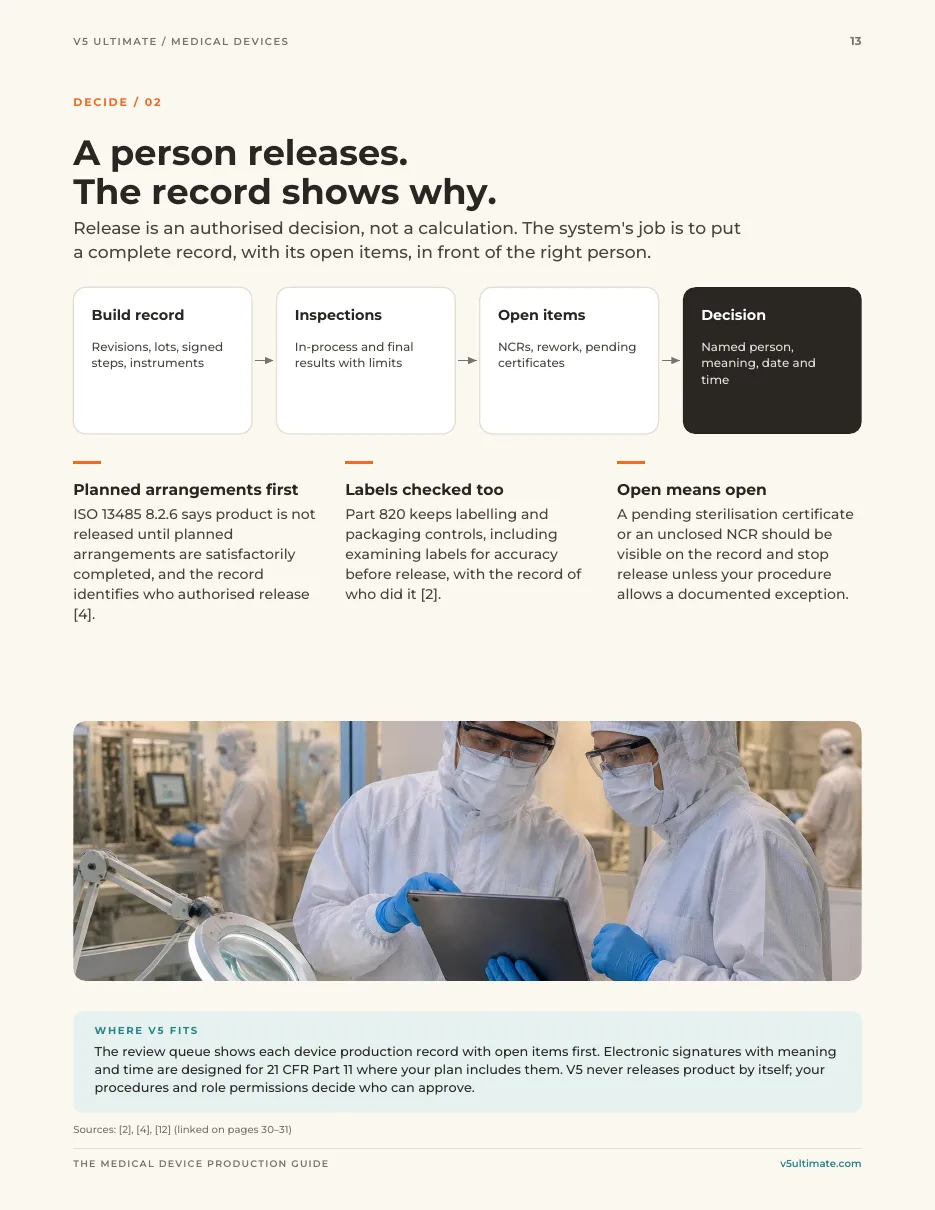
Every serialized unit builds its own Device History Record live — materials, operators, equipment, in-process checks, all signed at the step.
UDI generation & GUDID-ready output
DI + PI labels printed at the workstation; data file ready to push to FDA GUDID and EUDAMED.
Design control + DHF link-out
Every routing references the locked design rev; obsolete revs can't be built.
Training-gated steps
Operators are blocked from steps they aren't currently certified for; training records ride with the DHR.
Calibration & PM lockouts
Out-of-cal tools refuse to record a measurement; preventive maintenance overdue = line stop.
NCR / CAPA from the floor
Operators raise non-conformance in two taps; CAPA workflow tied straight to the affected lots and units.
The record assembles itself as the work happens.
No paperwork project at end of shift. No reconstruction at audit time. The evidence IS the workflow.
Self-building eDHR
Every serialized unit gets a signed, immutable record of materials, operators, equipment, and in-process checks — assembled in real time.
Hard-gated routings
Operators cannot advance to the next step until the prior step is signed, in-spec, and within design control limits.
UDI at point of build
DI + PI captured and printed at the workstation; reconciles to FDA GUDID.
Training enforcement
Operators are blocked from steps they aren't currently certified for. Training records ride with the DHR.
Paste your stack. See what V5 replaces vs keeps.
ERP, LIMS, MES, paper logs, spreadsheets — list what you run today and our AI returns an honest side-by-side: what V5 absorbs, what stays, and the realistic integration + retraining windows for Medical Devices.
Paste your current setup. See what V5 replaces — and what stays.
Honest side-by-side for medical devices operations. No form, no signup. Ask V5 names what V5 swaps out, what should stay, and what the switching risks actually are.
Be specific — naming the actual tools gets a sharper comparison.
What does V5 look like for your medical devices operation?
Tell us your scale and current stack. Get modules, rollout, compliance fit, and pricing band — pre-seeded for your industry.
Plain-English playbooks for Medical Devices regulations.
Structure, recurring inspection findings, and a practical 60-day path — written for QA, regulatory and operations leads.
Plain-English guide to FDA 21 CFR Part 11 — electronic records, electronic signatures, audit trails, and a practical path to a Part 11-compliant eQMS without theatre.
A practical, audit-ready walkthrough of EU GMP Annex 11 — what each clause means, what inspectors look for, and how to evidence compliance for any GxP system.
Plain-English guide to Regulation (EU) 2024/1689 — risk tiers, high-risk AI obligations, GMLP, Predetermined Change Control Plans (PCCPs), and how the AI Act stacks on Annex 11, 21 CFR Part 11, GAMP 5, CSA and ICH Q9.
Plain-English guide to Regulation (EU) 2017/746 — the In Vitro Diagnostic Regulation. Risk classes, performance evaluation, notified body involvement, and a path through the transition deadlines.
Plain-English guide to EU MDR technical documentation — Annex II device file, Annex III post-market surveillance, GSPR, clinical evaluation, and notified-body review.
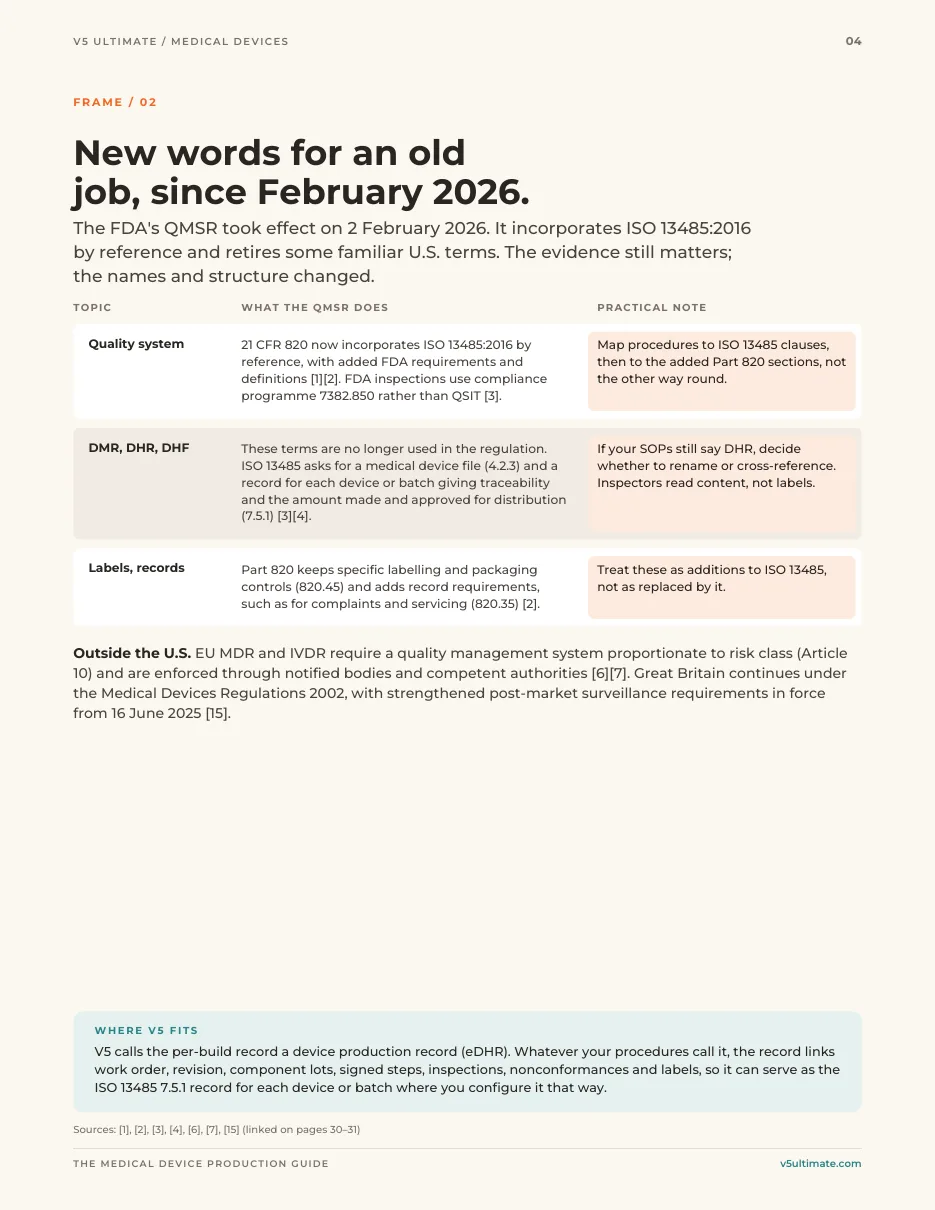
Plain-English guide to FDA's Quality Management System Regulation (QMSR) — what changes from 21 CFR 820, what 13485 brings in, and how to transition by 2 February 2026.
Plain-English guide to GAMP 5 second edition and FDA's Computer Software Assurance — software categories, risk-based testing, intended use, and a leaner validation pack.
Plain-English guide to the ISPE GAMP Records & Data Integrity (RDI) Good Practice Guide — ALCOA+, data lifecycle, hybrid records, audit trail review, and a defensible RDI programme aligned with MHRA, FDA, WHO and PIC/S expectations.
Plain-English guide to IEC 62304 — the lifecycle standard for medical device software. Safety classes, SOUP, problem resolution, and a software file that survives audit.
Spin up a workspace seeded for Medical Devices.
Default templates, validation rules, and report packs are pre-loaded for your industry. Run a real batch in under an hour.
Ask anything · No credit card · Onboard in days, not months