V5 Ultimate
Radiopharmaceuticals🇺🇸United States·

Decay-corrected batch records, conditional release, hot-cell ready.

Built for 21 CFR 212 (PET), 21 CFR 210/211, USP <823>, and NRC / state radioactive materials licensing.

← Different industry
Built around your regulators

The codes you're accountable to — at the data layer.

21 CFR 212
cGMP for PET drug products
21 CFR 210/211
cGMP for finished pharmaceuticals (therapy radiopharma)
21 CFR Part 11
Electronic records & signatures
USP <823>
Radiopharmaceuticals for PET — compounding, investigational, research
USP <797>
Pharmaceutical compounding — sterile preparations
10 CFR 35
NRC medical use of byproduct material
49 CFR 173
DOT shipping of Class 7 radioactive material (Type A)
How V5 maps to your floor

Five steps from receive to release — with the regulator on the hook at the end.

Tap to expand · download as PNG · paste into an audit prep deck.

A day in the life

From login to release — no end-of-shift paperwork.

What the auditor receives
The record assembles itself as the operator works — no end-of-shift paperwork project.
21 CFR 212 / NRCRADIOPHARMACEUTICAL DECAY-AWARE FLOW (Conditional Release + Decay)
KDE CAPTURED
  • isotope
  • A₀ (MBq)
  • calib time
  • manifest
1
ISOTOPE RECEIVE
KDE CAPTURED
  • A(t)=A₀·e⁻ᵏᵗ
  • λ / T½
  • target dose
  • calc by
2
DECAY CALC
KDE CAPTURED
  • hot-cell run
  • yield
  • QC sample
  • operator
3
SYNTHESIS
KDE CAPTURED
  • dose (MBq)
  • calib at
  • patient ref
  • operator
4
UNIT DOSE
KDE CAPTURED
  • radiochem purity
  • endotoxin
  • QP sig
  • conditional
5
QC RELEASE
KDE CAPTURED
  • A at calib
  • transport idx
  • carrier
  • ETA
6
SHIP + CALIB
PHYSICAL EVENT INFORMATION EVENT
KDE = the minimum data fields required to trace the lot through this step. Captured automatically as the operator works.
21 CFR 212 / NRCCOMPLIANT· CONDITIONAL RELEASE· DECAY-CORRECTED
TRACE IT. TRUST IT.
  1. T-zero·step 01
    Calibrate to T0

    Activity calibrated to the reference time — every later step decays from this anchor with A(t)=A0·e^(−λt).

  2. T+15·step 02
    Synthesis

    Cyclotron / synthesiser captures yield + activity. Operator has decay-corrected display, never raw counts.

  3. T+45·step 03
    QC + sterility

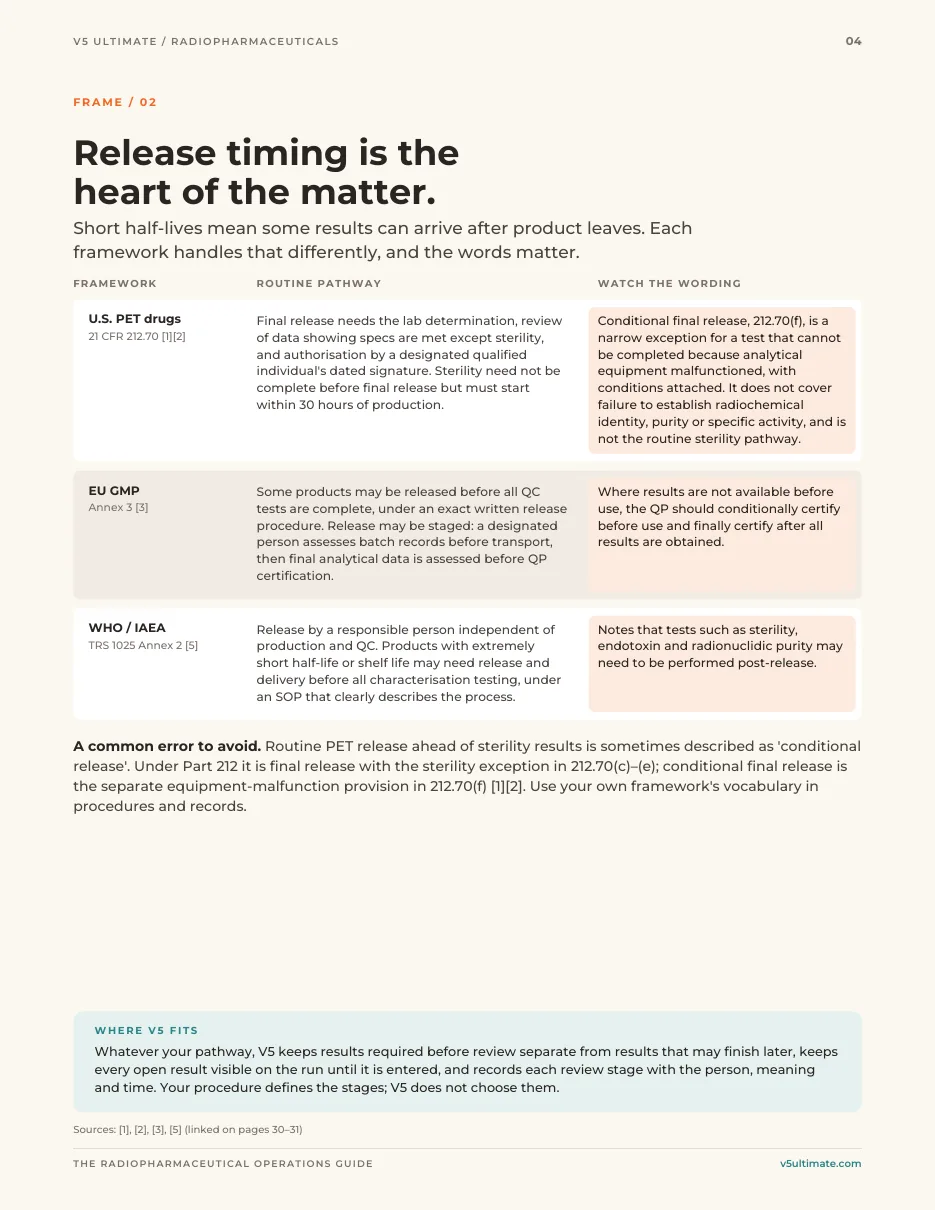
    Conditional release: shipment goes out before sterility result, then retroactive sign-off when sterility completes.

    21 CFR 212.70(d)
  4. T+60·step 04
    Unit-dose dispense

    Each patient dose dispensed at calibration time. Activity at administration is the dispense activity decayed forward.

  5. T+24h·step 05
    Retroactive sterility sig

    When the sterility test reads negative, the conditional release is finalised. Record locks. If positive → recall protocol fires.

Speaking your language

The terms your auditor uses

V5's UI uses these names for radiopharma workspaces — no cross-industry jargon to translate.
PET
Positron Emission Tomography — imaging using positron-emitting radiopharmaceuticals (e.g. 18F-FDG).
Half-life
Time for activity to decay to 50%. Drives the entire production + dispense schedule.
Conditional release
Shipping the lot before sterility completes (212.70(d)) — sterility result attaches retroactively.
T0 / calibration time
Reference time the activity is reported at — every dose is decayed from this anchor.
Becquerel / Curie
Units of activity. 1 Ci = 3.7×10¹⁰ Bq.
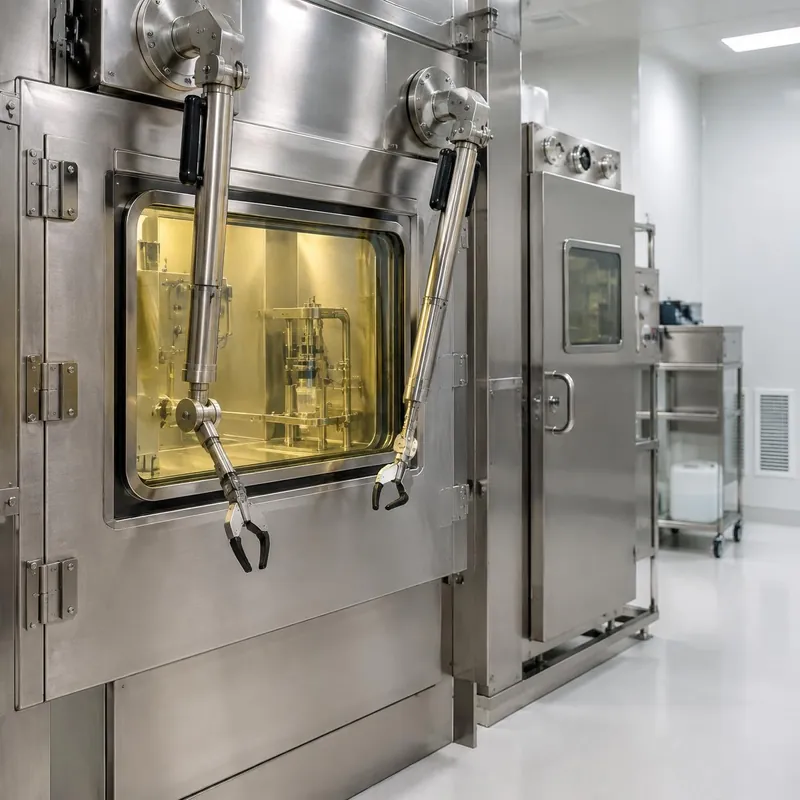
Hot cell
Shielded enclosure where radiopharmaceutical compounding happens.
What keeps you up at night

Sound familiar? We built this for you.

!

Decay correction lives in spreadsheets — every batch a manual re-calc, every transcription a deviation waiting to happen.

!

PET conditional release per 212.70(d) is paper-based; sterility close-out lags the dose by hours and never ties cleanly back to the batch.

!

Patient unit-dose dispense records (activity at injection time, syringe ID, calibration time) are reconstructed after the fact.

!

Survey, wipe-test, TLD, and decay-in-storage waste logs sit in three different binders and four different systems.

!

NRC / state license inspections turn into a week of re-assembly because no system carries the license number through to the records.

How Radiopharma teams use V5

The workflows you'd expect to see on day one.

Not a generic feature list — these are the specific radiopharma workflows V5 ships configured for, ready to run on your batches.

Isotope intake & A₀ capture

Isotope, activity at calibration, half-life, and manifest data captured at receive.

Real-time decay correction

A(t) = A₀·e^(−λt) computed live for every dose — at dispense, ship, and patient calib time.

Unit-dose dispensing

Per-patient dose, calibration time, and operator e-sig — short half-life products handled by the system, not the spreadsheet.

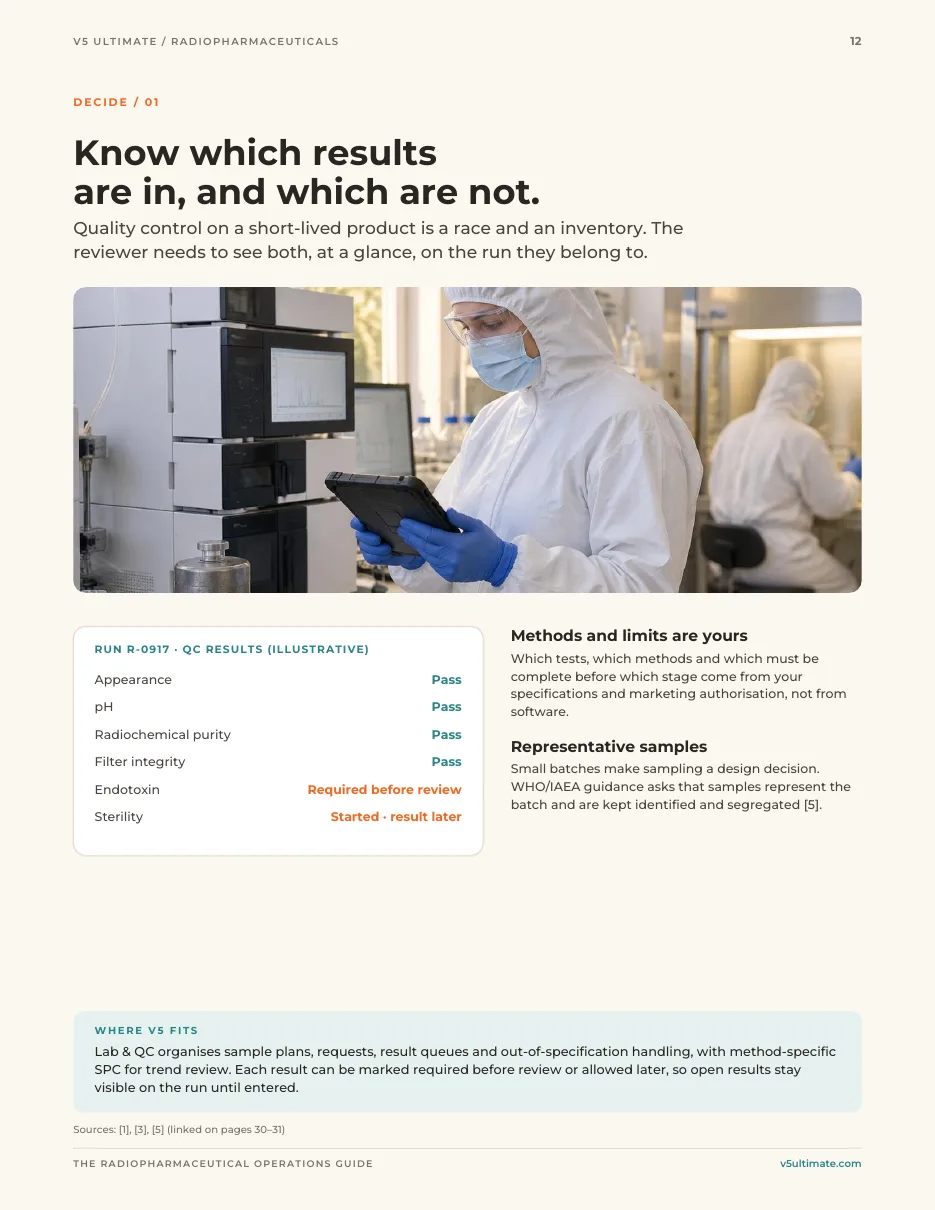
Conditional QC release

Radiochemical purity, endotoxin, and sterility tracked with conditional release per 21 CFR 212 / Annex 3.

QP / RP release sign-off

Qualified Person / Responsible Pharmacist e-sig with full chain of custody.

Transport index + carrier handoff

TI, package label, and carrier manifest computed from current activity at ship time.

Self-Building Compliance Records

The record assembles itself as the work happens.

No paperwork project at end of shift. No reconstruction at audit time. The evidence IS the workflow.

Built-in isotope master

Pb-212, Ac-225, Lu-177, F-18, Tc-99m, Ga-68, I-131 and more — half-lives, decay modes, default shelf-lives all wired in. Decay correction A(t)=A₀·e^(−λt) at every read, no spreadsheets.

Calibration-time batch record

Every work order carries a calibration datetime. The BMR records activity AT calibration; every later read auto-decays from there.

Conditional release with forced close-out

Per 212.70(d) — release the dose for patient use before sterility testing completes, with a system-enforced retroactive sterility sign-off that ties back to the original batch and operator.

Patient unit-dose dispense

One synthesis, many patient doses. Each dose has its own calibration time, syringe ID, and decay-corrected activity at injection — captured live, signed by the dispenser.

Two-signature batch release

Same 211.186 / 211.188 discipline as conventional pharma — preparer + independent reviewer e-sigs, immutable batch record, snapshot-from-MMR construction.

Readiness guides

Plain-English playbooks for Radiopharma regulations.

Structure, recurring inspection findings, and a practical 60-day path — written for QA, regulatory and operations leads.

21 CFR Part 11 Readiness Guide for Regulated Manufacturers

Plain-English guide to FDA 21 CFR Part 11 — electronic records, electronic signatures, audit trails, and a practical path to a Part 11-compliant eQMS without theatre.

Read the guide
DSCSA Readiness Guide: US Pharmaceutical Serialization & Traceability

Plain-English guide to the Drug Supply Chain Security Act (DSCSA) — serialization, aggregation, EPCIS exchange, verification, and the path through enhanced drug distribution security.

Read the guide
EU GDP Readiness Guide: Good Distribution Practice for Medicinal Products

Plain-English guide to EU Good Distribution Practice (2013/C 343/01) — Responsible Person duties, temperature control, qualifications, falsified medicines, and inspection.

Read the guide
EU GMP Annex 11 Readiness Guide for Computerised Systems

A practical, audit-ready walkthrough of EU GMP Annex 11 — what each clause means, what inspectors look for, and how to evidence compliance for any GxP system.

Read the guide
GAMP 5 & FDA CSA Readiness Guide for Computerized System Validation

Plain-English guide to GAMP 5 second edition and FDA's Computer Software Assurance — software categories, risk-based testing, intended use, and a leaner validation pack.

Read the guide
ISPE GAMP RDI Records & Data Integrity

Plain-English guide to the ISPE GAMP Records & Data Integrity (RDI) Good Practice Guide — ALCOA+, data lifecycle, hybrid records, audit trail review, and a defensible RDI programme aligned with MHRA, FDA, WHO and PIC/S expectations.

Read the guide
ICH Q10 Pharmaceutical Quality System

Plain-English guide to ICH Q10 — the global Pharmaceutical Quality System. Management responsibilities, lifecycle stages, enablers, and a practical implementation path.

Read the guide
ICH Q8, Q11 & Q12 Readiness Guide: QbD, Design Space and Lifecycle Management

Plain-English guide to ICH Q8(R2), Q11 and Q12 — QbD, design space, control strategy, Established Conditions and PACMPs. The QbD-to-lifecycle toolkit FDA, EMA and PMDA expect.

Read the guide
EU AI Act Readiness Guide for GxP and Regulated Manufacturing

Plain-English guide to Regulation (EU) 2024/1689 — risk tiers, high-risk AI obligations, GMLP, PCCPs, and how the AI Act stacks on Annex 11, 21 CFR Part 11, GAMP 5, CSA and ICH Q9.

Read the guide
Ready to see it on your batches?

Spin up a workspace seeded for Radiopharma.

Default templates, validation rules, and report packs are pre-loaded for your industry. Run a real batch in under an hour.

Ask anything · No credit card · Onboard in days, not months