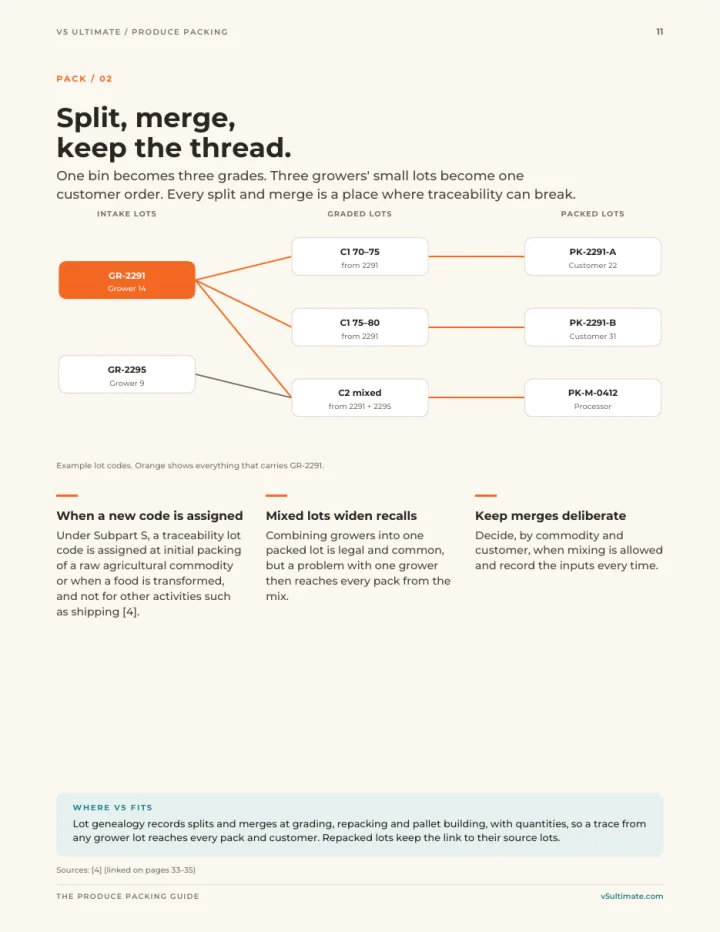
From the field to the case, every lot has a name and a story.
Built for the FSMA Produce Safety Rule and FSMA 204 Food Traceability.
The codes you're accountable to — at the data layer.
Five steps from receive to release — with the regulator on the hook at the end.
Tap to expand · download as PNG · paste into an audit prep deck.
From login to release — no end-of-shift paperwork.
- › field / lot
- › harvest date
- › grower
- › BoL
- › wash batch
- › sanitizer ppm
- › temp
- › operator
- › grade
- › rejects
- › lot
- › operator
- › pack type
- › lot
- › count
- › PTI label
- › cooler id
- › temp
- › duration
- › log
- › GTIN / PTI
- › lot
- › ship date
- › carrier
- 05:30·step 01Field receive
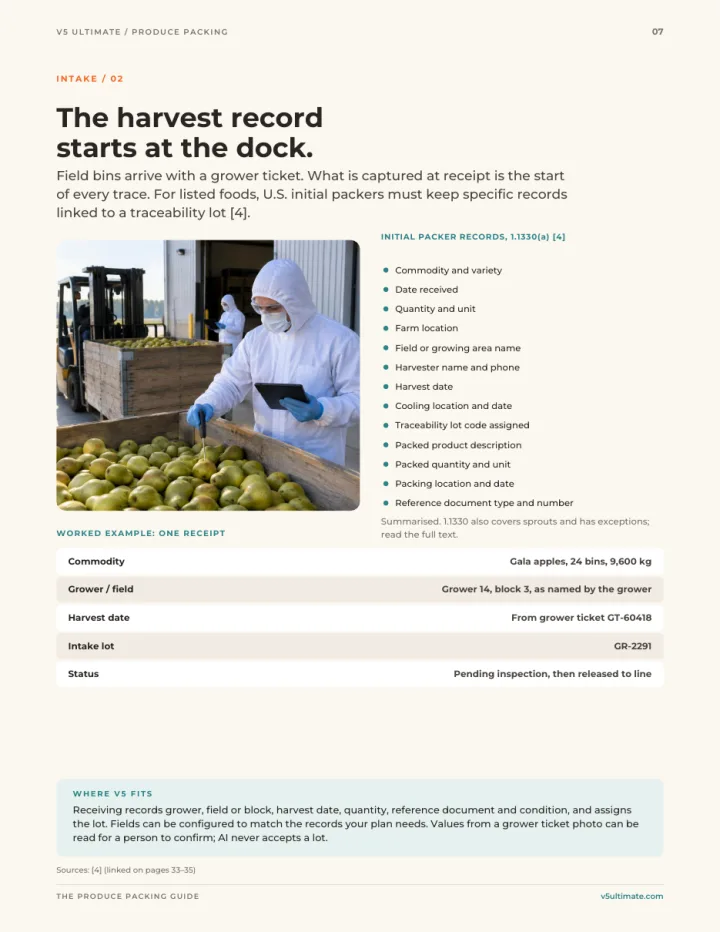
Truck arrives. Grower lot, harvest date, field block, cooler temp captured at the dock — every KDE for CTE-1.
FSMA 204 / Produce Rule - 06:00·step 02Wash + sanitation
Wash water sanitiser ppm logged automatically. Out-of-spec → line pauses and a hold goes on the lot in the wash.
- 08:00·step 03Pack house
Cases scanned as they're built. Each case inherits the input grower lot — no clipboard needed.
- 11:00·step 04Label + COO
Country-of-origin and PLU printed on every case. Master label proof matches the customer's brief.
- 13:00·step 05Ship
Loader scans cases onto the trailer with carrier + temp set point. Bill of lading stamped with the traceability lot code.
- End of day·step 06FSMA 204 export
One click → today's CTEs and KDEs exported in the FDA's preferred format. Audit = a download, not a project.
FSMA 204
The terms your auditor uses
- CTE / KDE
- Critical Tracking Event + Key Data Element — what FSMA 204 requires you to capture.
- TLC
- Traceability Lot Code — the unique code that follows the produce lot through the supply chain.
- PMA / PTI
- Produce Marketing Association + Produce Traceability Initiative — the case-label standard most retailers expect.
- Cooler chain
- Continuous cold-chain log from field to dock — required by Produce Rule.
- MRL
- Maximum Residue Limit — pesticide residue ceiling that varies by destination market.
- Field block
- Specific area of a farm a lot was harvested from — needed for trace-back.
Sound familiar? We built this for you.
Grower lot, harvest date, and field code are recorded three times — and they don't match.
Ag water and sanitation records live in a different binder from the pack record.
Buyer requests a recall; identifying which retailers got which grower-lots takes a day.
PACA and country-of-origin labeling get audited and the records don't tie to the pack.
The workflows you'd expect to see on day one.
Not a generic feature list — these are the specific produce packing workflows V5 ships configured for, ready to run on your batches.
Field & grower lot capture
Field ID, harvest date, grower, and BoL recorded at receive — the foundation for PTI labels downstream.
Wash water sanitizer & temp logs
Free chlorine / PAA ppm, water temp, and turnover captured per wash batch; out-of-range = hold.
Sort & grade yield tracking
Per-grade counts, rejects, and rework streamed live to the lot and to the daily yield dashboard.
Cool-chain time & temperature
Pre-cool, cold storage, and dispatch temps logged; excursions trigger a QA review before release.
PTI / GTIN case labels
PTI-compliant case labels with GTIN, lot, pack date — printed at the line, scanned at load-out.
FSMA 204 traceability + recall pull
Full CTE/KDE chain from field to consignee; recall scope returned in one query.
The record assembles itself as the work happens.
No paperwork project at end of shift. No reconstruction at audit time. The evidence IS the workflow.
Single grower-lot record
Grower, field, harvest crew, water test reference — all captured at receiving and carried through pack.
FSMA 204 sortable export
FTL CTEs export to the FDA's required spreadsheet format in seconds.
Buyer-direct genealogy
From a case scanned at retail, walk back to grower lot in one click.
Water + sanitation in the record
Pre-harvest and pack-house inspections ride with the lot, not in a separate binder.
Paste your stack. See what V5 replaces vs keeps.
ERP, LIMS, MES, paper logs, spreadsheets — list what you run today and our AI returns an honest side-by-side: what V5 absorbs, what stays, and the realistic integration + retraining windows for Produce Packing.
Paste your current setup. See what V5 replaces — and what stays.
Honest side-by-side for produce packing operations. No form, no signup. Ask V5 names what V5 swaps out, what should stay, and what the switching risks actually are.
Be specific — naming the actual tools gets a sharper comparison.
What does V5 look like for your produce packing operation?
Tell us your scale and current stack. Get modules, rollout, compliance fit, and pricing band — pre-seeded for your industry.
Plain-English playbooks for Produce Packing regulations.
Structure, recurring inspection findings, and a practical 60-day path — written for QA, regulatory and operations leads.
Plain-English guide to BRCGS Global Standard for Food Safety Issue 9 — fundamentals, HACCP, food safety culture, unannounced audits, and a path to AA grade.
Plain-English guide to FDA FSMA Section 204 — the Food Traceability List, Key Data Elements, Critical Tracking Events, and how to be 24-hour-ready before the January 2026 deadline.
Plain-English guide to FSMA Preventive Controls for Human Food (21 CFR 117) — the food safety plan, hazard analysis, PCQI duties, and a realistic readiness path.
Plain-English guide to FSSC 22000 v6 — ISO 22000, sector PRPs, and the additional FSSC requirements that auditors actually focus on during certification.
Plain-English guide to FDA's Foreign Supplier Verification Program — hazard analysis, supplier evaluation, verification activities, and the records FDA actually inspects.
Plain-English guide to HACCP per Codex Alimentarius CXC 1-1969 Rev.5 (2020) — the seven principles, the twelve logic steps, prerequisite programmes and a plan that survives any GFSI audit.
Plain-English guide to IFS Food Version 8 — the GFSI-recognised standard used across European retail. KO requirements, scoring, unannounced audits and a path to a Higher Level certificate.
Plain-English guide to ISO 22000:2018 — the international food safety management standard. PDCA, HACCP, PRPs, the operational PRP concept and a path to a clean certification audit.
Plain-English guide to the SQF Food Safety Code Edition 9 — system elements, food safety culture, environmental monitoring, unannounced audits and a path to a clean SQF certificate.
Spin up a workspace seeded for Produce Packing.
Default templates, validation rules, and report packs are pre-loaded for your industry. Run a real batch in under an hour.
Ask anything · No credit card · Onboard in days, not months