
Paperless manufacturing · eBR · eLogbook · Kiosk-native
Paperless manufacturing, one record at a time.
Replace the batch record binder, equipment logbook, cleaning log and training sheet with signed electronic records at kiosks on the floor, rolled out in stages you choose.
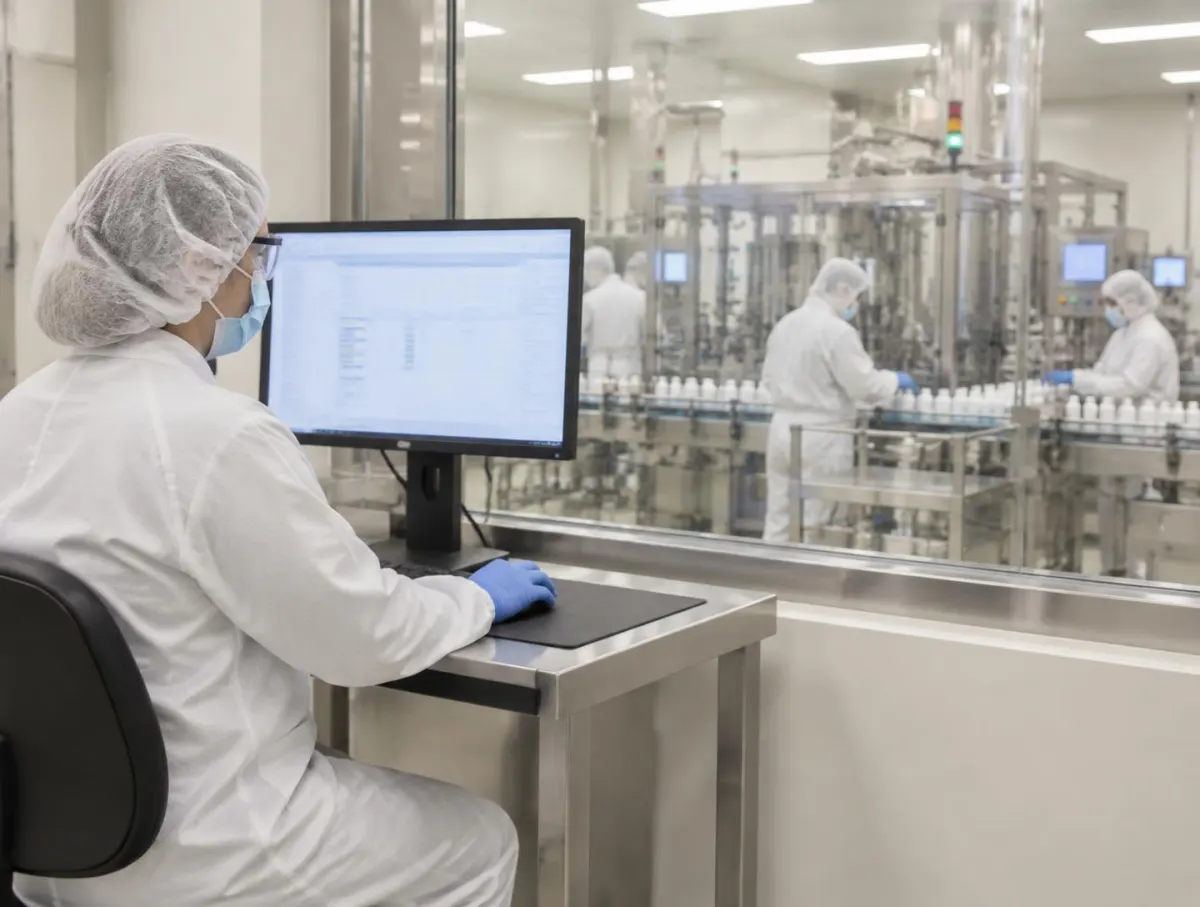
Start with one record
Replace one binder first, then add more when ready.
Signed at the Kiosk
Entries and signatures captured where the work happens.
Easy to Find Later
Search a lot and see its records in one place.
- Paper today
- Ring binder signed by hand
- In V5
- Electronic batch record with step signatures
Roll out in the order you choose; your team decides what goes first.
Full product detailCommon problems, what's included, why teams choose it, and where commercial meets regulated.
You searched paperless because the binder is still winning.
Batch records are printed, filled in by hand, scanned, then re-typed into a spreadsheet
Equipment logbooks and cleaning logs live in ring binders no inspector can navigate
Deviations are captured on a paper form, then re-entered into a QMS days later
SOP training is a signature sheet in a folder — you can't prove who was current when
The paper is where the transcription errors live — and where the inspector finds them
Everything that was on paper, run as one signed record.
Electronic batch record (eBR / eBMR / eDHR)
Structured, kiosk-native batch record with in-process checks, material scans, deviation branch, bound e-signatures and printed-copy criteria — replaces the printed MBR / batch packet on day one.
Electronic Logbooks
Equipment logbook, cleaning log, environmental round, calibration touch — all electronic, all searchable, all audit-trailed. The ring binder retires.
Deviation & CAPA at the Point of Capture
Operator raises a deviation on the same kiosk running the batch — QA is notified, root cause and CAPA linked to the batch record, closed inside V5.
Read-and-understood training
No wet-ink sign-off sheet in a folder.
Live QA Release Queue
Batch closes → QA sees a review-by-exception queue with every out-of-spec and every override highlighted → release signature is minutes, not days.
What changes the day this goes live.
- Transcription errors disappear because the shop-floor entry IS the record
- Inspector navigates one file, not five binders — audits shorten by half
Paperless the way an inspector expects to see it.
21 CFR Part 11
§11.10(e) audit trail, §11.10(f) operational checks, §11.10(g) authority checks, §11.50 / §11.70 signature manifestation and binding — all native, all reviewable.
EU GMP Annex 11
Risk management, validation, data integrity, e-signatures, printed-copy criteria, incident management, business continuity — software controls that support your Annex 11 approach; validation and procedures remain yours.
See the device-grade equivalent — eDHR, design controls and 21 CFR Part 820 / QMSR.
Paperless manufacturing, answered.
What does 'paperless manufacturing' actually cover?
In V5 it covers every place a regulated plant touches paper: the batch record (eBR / eBMR / eDHR), the equipment logbook, the cleaning log, the environmental monitoring round, the calibration touch, the deviation form, the CAPA workflow, the SOP training sheet and the QA release packet. They're one system, not eight.
Do we still need to validate?
Your validation team reviews and signs, they don't author from scratch.
What about signed hard copies for the regulator?
V5 emits printed-copy criteria per Annex 11 §8 and Part 11 §11.10(b) — every printed copy is watermarked, versioned and tied to the electronic source.
Does this work in a small plant, not just Big Pharma?
Yes. V5 paperless is designed for 20-500 person regulated plants — pharma, cosmetics, food, cannabis, medical device, veterinary. Kiosk-native means no per-user desktop, and the pricing follows plant scale rather than seat count.
Capabilities vary by plan and setup. Confirm specifics with our team before relying on them.
See V5 Ultimate Paperless Manufacturing Software with your own process.
Free trial. Real batch records.