Batch genealogy, SDS-aligned labels, and PSM-grade controls per lot.
Built for REACH / CLP, EPA TSCA, OSHA PSM (29 CFR 1910.119), GHS labeling, and DOT hazmat.
← Different industryThe codes you're accountable to — at the data layer.
Five steps from receive to release — with the regulator on the hook at the end.
Tap to expand · download as PNG · paste into an audit prep deck.
From login to release — no end-of-shift paperwork.
- › raw lot
- › supplier
- › SDS rev
- › CoA
- › recipe
- › temp profile
- › pressure
- › operator
- › assay
- › impurities
- › spec
- › QA sig
- › SDS rev
- › GHS pictograms
- › language
- › lot
- › container lot
- › net weight
- › tare
- › operator
- › UN #
- › hazard class
- › carrier
- › destination
- 06:30·step 01Receive raws
Drum + IBC scan at goods-in. Raw lot, supplier, SDS revision, CoA all captured. Expired SDS → quarantine, not release.
OSHA HCS / REACH - 08:00·step 02Reactor batch
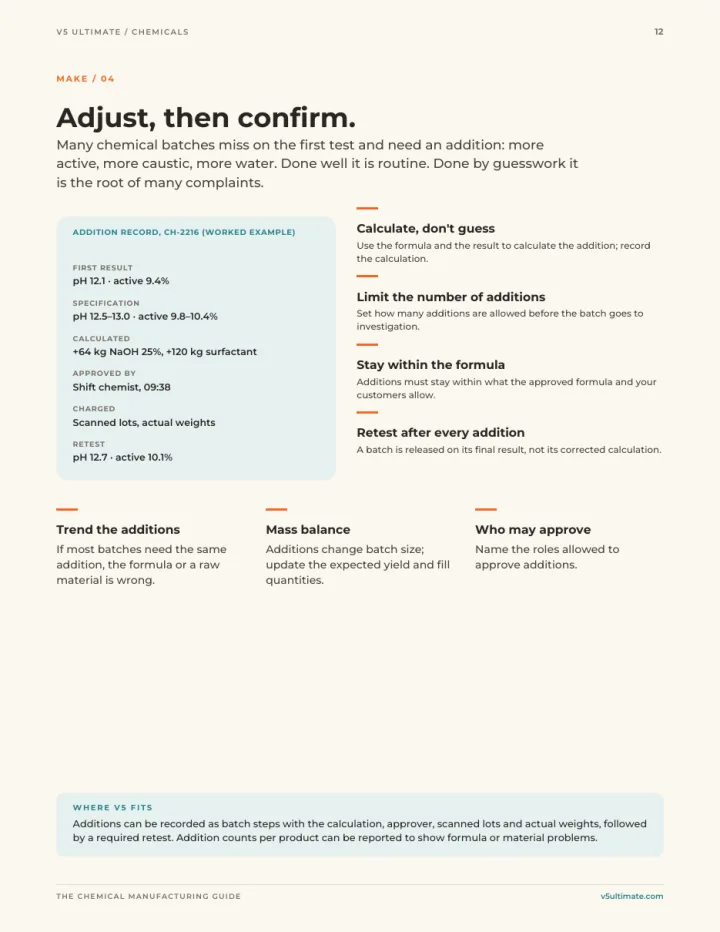
Recipe loads to the DCS. Temperature profile, pressure, addition order stream live to the batch record. Operator e-signs each phase.
- 11:30·step 03QC assay
Sample pulled. Assay, impurities, GHS classification verified against spec. OOS → CAPA opens and the lot holds.
OSHA PSM - 13:00·step 04SDS regeneration
SDS regenerated per lot if composition shifts. Pictograms, hazard codes, languages all auto-built from the formulation record.
GHS / CLP - 14:30·step 05Drum / IBC fill
Container lot, net weight, tare captured. Label prints with UN number, hazard class, GHS pictograms — never hand-stencilled.
- 16:00·step 06Ship + DOT/REACH
Carrier, destination, transport documents assembled. REACH dossier and TSCA inventory cross-checked before release.
The terms your auditor uses
- SDS
- Safety Data Sheet — the 16-section hazard document that travels with the product.
- GHS / CLP
- Globally Harmonised System / EU Classification, Labelling, Packaging — the pictogram + hazard-code framework.
- REACH
- EU regulation on Registration, Evaluation, Authorisation and restriction of CHemicals.
- TSCA
- Toxic Substances Control Act — US chemical inventory + new-substance review.
- OSHA PSM
- Process Safety Management — rules for highly hazardous chemical operations (29 CFR 1910.119).
- DOT UN #
- United Nations dangerous-goods number printed on every regulated container.
Sound familiar? We built this for you.
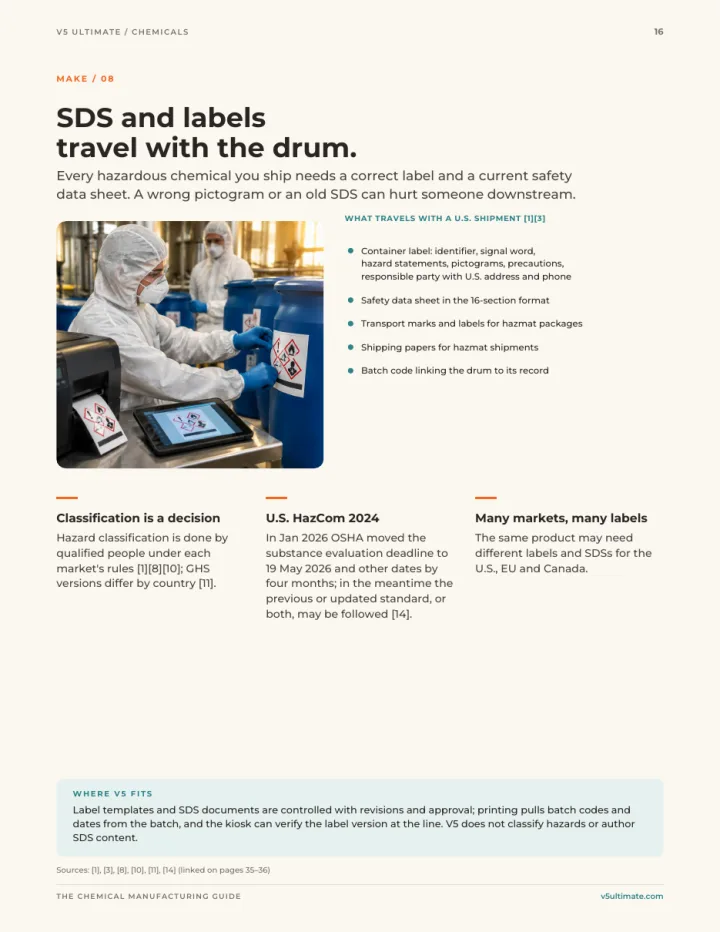
SDS revision and on-pack label revision drift; the drum that ships doesn't match the SDS in force.
REACH SVHC / TSCA status per finished lot is a manual lookup at customer-request time.
OSHA PSM mechanical-integrity and operating-procedure records sit outside production.
Batch genealogy stops at the reactor; intermediates aren't tied to finished drums.
The workflows you'd expect to see on day one.
Not a generic feature list — these are the specific chemicals workflows V5 ships configured for, ready to run on your batches.
Reactor batch control
Recipe, temp profile, pressure, and hold times enforced per SOP — deviations open a hold ticket.
Inline QC + spec gating
Assay, water, color, and impurity profile checked against spec before release.
SDS authoring & revision control
Per-formula SDS in GHS / CLP / GB CLP format — language variants for export destinations.
Drum / IBC / tanker filling
Net / gross / tare weights and seal numbers captured per container; loss-in-weight reconciled.
DOT / ADR / IMDG shipping
UN number, packing group, hazard class, and emergency contact on the manifest, generated from the lot.
REACH / TSCA inventory check
Substance inventory checked at formulation time; non-registered substances flagged before export.
The record assembles itself as the work happens.
No paperwork project at end of shift. No reconstruction at audit time. The evidence IS the workflow.
Label rev = SDS rev = lot
Released lot carries the exact GHS label revision and SDS revision in force on the fill date.
Substance status per lot
REACH SVHC, TSCA, RoHS status carried on every component and resolved per finished lot.
PSM-aware controls
Operating procedures, MOC, mechanical-integrity records bound to the covered process.
Reactor → drum genealogy
Intermediates and reactor batches tied forward to the finished drum that ships.
Paste your stack. See what V5 replaces vs keeps.
ERP, LIMS, MES, paper logs, spreadsheets — list what you run today and our AI returns an honest side-by-side: what V5 absorbs, what stays, and the realistic integration + retraining windows for Chemicals.
Paste your current setup. See what V5 replaces — and what stays.
Honest side-by-side for specialty & industrial chemicals operations. No form, no signup. Ask V5 names what V5 swaps out, what should stay, and what the switching risks actually are.
Be specific — naming the actual tools gets a sharper comparison.
What does V5 look like for your chemicals operation?
Tell us your scale and current stack. Get modules, rollout, compliance fit, and pricing band — pre-seeded for your industry.
Plain-English playbooks for Chemicals regulations.
Structure, recurring inspection findings, and a practical 60-day path — written for QA, regulatory and operations leads.
Plain-English guide to ISO 9001:2015 — the international QMS standard. Risk-based thinking, process approach, leadership and the path to a clean certification audit.
Plain-English readiness guide to ISO/IEC 17025:2017 for chemical testing laboratories — competence, impartiality, method validation, measurement uncertainty and ILAC-aligned accreditation.
Plain-English guide to ISO 17034:2016 — competence of reference material producers. CRM characterization, homogeneity, stability, metrological traceability, commutability and uncertainty budgets.
Plain-English readiness guide to the American Chemistry Council Responsible Care management system standard RC14001 — EHS&S integration with ISO 14001, Process Safety, Product Safety and Security Codes.
Spin up a workspace seeded for Chemicals.
Default templates, validation rules, and report packs are pre-loaded for your industry. Run a real batch in under an hour.
Ask anything · No credit card · Onboard in days, not months