V5 Ultimate
Blood & Tissue🇺🇸United States·

Every unit ships with a signed donor-to-distribution record an FDA investigator could sign off on.

Built for 21 CFR 1271 (HCT/Ps), 21 CFR 606 / 630 / 640 (blood cGMP), AABB and AATB standards, and ISBT 128 labeling.

← Different industry
Built around your regulators

The codes you're accountable to — at the data layer.

21 CFR 1271
Human Cells, Tissues, and Cellular & Tissue-based Products (HCT/Ps)
21 CFR 606
cGMP for Blood and Blood Components
21 CFR 630
Requirements for blood and blood components — donor eligibility
21 CFR 640
Additional standards for human blood and blood products
21 CFR Part 11
Electronic records & signatures
AABB Standards
Standards for Blood Banks and Transfusion Services (current edition)
AATB Standards
Standards for Tissue Banking (current edition)
ISBT 128
Global standard for the terminology, identification, coding and labeling of MPHO
FACT-JACIE
Cellular therapy accreditation (where HPC / CAR-T is in scope)
EU 2004/23/EC + 2002/98/EC
EU Tissues and Cells / Blood Directives (for export-relevant work)
How V5 maps to your floor

Five steps from receive to release — with the regulator on the hook at the end.

Tap to expand · download as PNG · paste into an audit prep deck.

A day in the life

From login to release — no end-of-shift paperwork.

What the auditor receives
The record assembles itself as the operator works — no end-of-shift paperwork project.
21 CFR 1271 / 606 / FDA BIMOBLOOD & TISSUE DONOR-TO-DISTRIBUTION FLOW (HCT/P + ISBT 128)
KDE CAPTURED
  • donor id
  • eligibility
  • deferral chk
  • consent
1
DONOR INTAKE
KDE CAPTURED
  • DIN
  • volume
  • phlebotomist
  • time
2
COLLECT
(WHOLE / APHERESIS / TISSUE)
KDE CAPTURED
  • NAT / serology
  • ABO / Rh
  • QC sig
  • result
3
IDM TEST
KDE CAPTURED
  • component id
  • method
  • yield
  • operator
4
PROCESS
(COMPONENTS / GRAFTS)
KDE CAPTURED
  • quarantine st.
  • med-dir sig
  • two e-sigs
  • release
5
QUARANTINE & RELEASE
KDE CAPTURED
  • ISBT 128
  • product code
  • expiry
  • consignee
6
ISBT 128 LABEL & SHIP
PHYSICAL EVENT INFORMATION EVENT
KDE = the minimum data fields required to trace the lot through this step. Captured automatically as the operator works.
21 CFR 1271 / 606 / FDA BIMOCOMPLIANT· DONOR-TO-RECIPIENT LOOKBACK· ISBT 128 VERIFIED
TRACE IT. TRUST IT.
  1. 07:00·step 01
    Donor intake

    Donor arrives. Eligibility questionnaire, vitals, deferral history pulled live. Reactive history → auto-defer; the phlebotomist never sees a 'maybe'.

    21 CFR 630 / 1271 Subpart C
  2. 08:00·step 02
    Collection

    DIN scanned at the chair. Whole blood, apheresis, or tissue recovery — volume, duration, phlebotomist e-sig all captured to the unit record.

    21 CFR 606.160 / AABB Std 5
  3. 10:30·step 03
    IDM testing

    Sample tubes route to the lab. NAT + serology + ABO/Rh stream back to the unit. Until they're complete and in-spec, the unit cannot leave quarantine.

    21 CFR 610 / 630
  4. 12:00·step 04
    Processing

    Whole blood → components (RBC, plasma, platelets) or tissue recovery → graft processing. Method, yield, operator e-sig on each step.

  5. 14:00·step 05
    Medical-director release

    Med-dir reviews the assembled record — donor eligibility, IDM, processing, visual inspection. Two e-sigs close the unit for release.

    21 CFR 606.100
  6. 15:30·step 06
    ISBT 128 label + ship

    Label prints with the ISBT 128 DIN, product code, expiry, ABO/Rh. Barcode verified before the unit leaves the building. Consignee scan captures chain of custody.

    ISBT 128 / AABB Std 5.1
  7. Any time·step 07
    Lookback

    A reactive post-donation result triggers automatic lookback: every component from that donor, every consignee, every recipient — resolved in seconds, not days.

    21 CFR 610.46 / 610.47
Speaking your language

The terms your auditor uses

V5's UI uses these names for blood & tissue workspaces — no cross-industry jargon to translate.
HCT/P
Human Cells, Tissues, and Cellular & Tissue-Based Products — the FDA category covering tissue allografts (21 CFR 1271).
DIN
Donation Identification Number — the unique code assigned at collection and carried through every component.
IDM
Infectious Disease Marker testing — the serology + NAT panel every donation is screened against.
ISBT 128
Global standard for labeling Medical Products of Human Origin — required by FDA, AABB, AATB, and most national regulators.
Lookback
The required forward trace from a reactive donor to every component, consignee, and recipient (21 CFR 610.46 / 610.47).
AABB / AATB
Accreditation bodies for blood banks (AABB) and tissue banks (AATB) — both audit on top of the FDA baseline.
Quarantine release
The control that prevents an in-process unit from being distributed until all IDM testing is complete and in-spec.
What keeps you up at night

Sound familiar? We built this for you.

!

Donor eligibility, IDM testing, and product release live in different systems — release happens before serology is back, or the unit sits in quarantine because nobody reconciled it.

!

Lookback for a reactive donor is a multi-day binder hunt across donations, components, and consignees.

!

ISBT 128 labels are reprinted by hand when a barcode smudges — there's no audit trail tying the reprint to the original.

!

Cold-chain excursions on platelets, plasma, or tissue grafts get caught at month-end, not at the moment of excursion.

!

AABB / AATB and FDA Form 483s flag the same gap every cycle: SOP-of-record vs SOP-actually-followed.

How Blood & Tissue teams use V5

The workflows you'd expect to see on day one.

Not a generic feature list — these are the specific blood & tissue workflows V5 ships configured for, ready to run on your batches.

Donor intake & eligibility

Donor ID, deferral check, eligibility questionnaire, and consent captured before collection.

Collection + DIN assignment

Donation Identification Number, volume, phlebotomist, and times captured at collection.

IDM / NAT / serology results

Infectious disease marker results gate quarantine release; reactive units segregated automatically.

Component processing & yield

Per-component method, yield, and lot lineage tracked from whole blood / apheresis through to graft.

Two-sig quarantine release

Medical director + QA e-sigs required to move from quarantine to distributable inventory.

ISBT 128 labeling & lookback

ISBT 128 product code, expiry, and consignee on every unit; donor-to-recipient lookback in seconds.

Self-Building Compliance Records

The record assembles itself as the work happens.

No paperwork project at end of shift. No reconstruction at audit time. The evidence IS the workflow.

Donor-record + processing-record, together

Donor eligibility determination, vitals, deferral history, IDM panel, processing steps, and release decision live on one immutable record per unit.

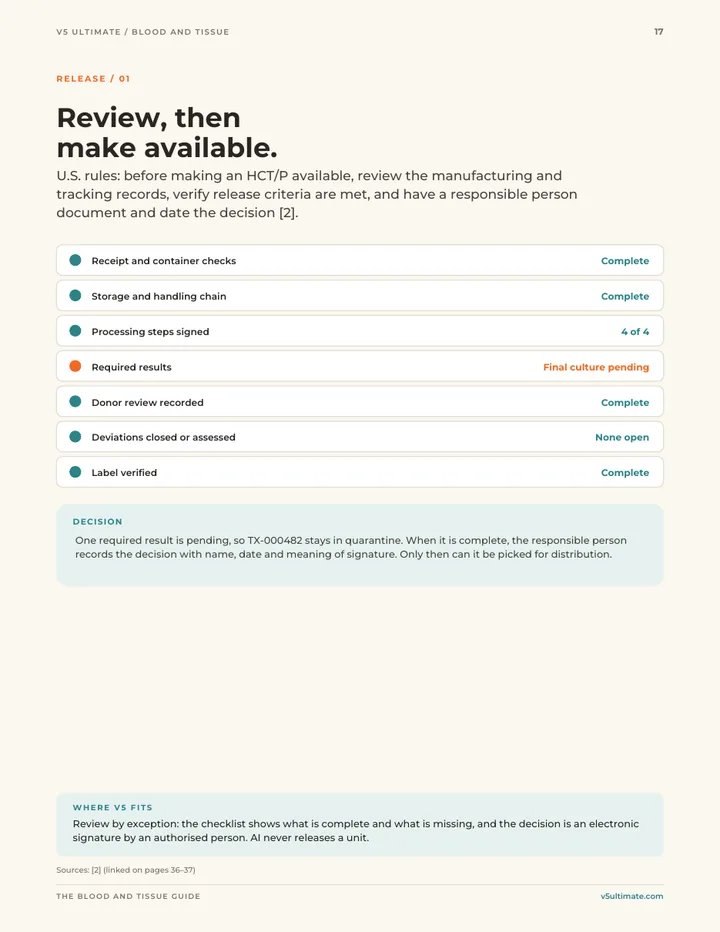
Hard-gated release

A unit cannot move from quarantine to distribution until IDM testing is complete, in-spec, and medical-director e-signed. No exceptions, no overrides without a recorded reason.

Donor-to-recipient lookback in seconds

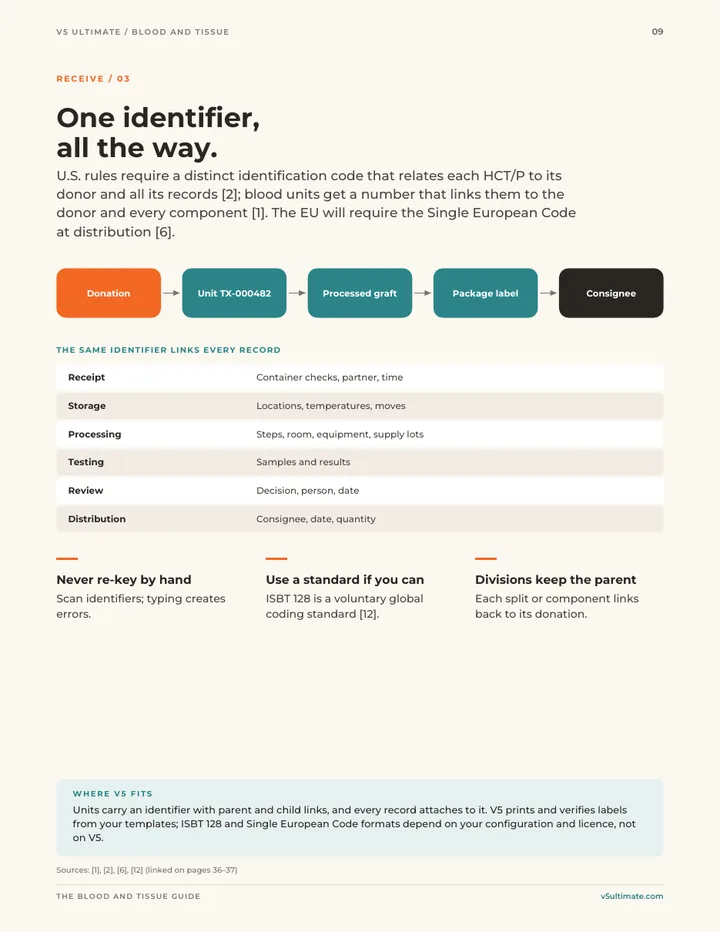
Forward genealogy from donor → collection → components → finished labels → consignee. A reactive donor produces a complete recall scope in one query.

ISBT 128 compliant labeling

Data Identifiers, product codes, and donation identification number generated and verified at every handoff. Reprint events are signed and traceable to the original.

Cold-chain CCPs with auto-quarantine

Storage and shipping temperatures monitored against product-specific limits. Excursions auto-hold affected units and open a deviation — they don't wait for month-end review.

Self-building audit packet

AABB, AATB, FACT-JACIE and FDA BIMO inspections all read the same record — typed, hashed, signed, ALCOA+. No end-of-cycle paperwork project.

Readiness guides

Plain-English playbooks for Blood & Tissue regulations.

Structure, recurring inspection findings, and a practical 60-day path — written for QA, regulatory and operations leads.

AABB Blood Bank Standards

Readiness guide for blood banks and transfusion services against the AABB Standards for Blood Banks and Transfusion Services (33rd ed.) and 21 CFR 600/606/610.

Read the guide
EU Tissues & Cells Directive 2004/23/EC

Readiness guide for EU tissue and cell establishments — Directive 2004/23/EC, implementing Directives 2006/17 and 2006/86, the SoHO Regulation transition and competent authority inspection.

Read the guide
FDA 21 CFR 1271 HCT/P

Readiness guide for human cells, tissues, and cellular and tissue-based products under 21 CFR Part 1271 — registration, donor eligibility, CGTP, adverse reaction reporting and 361 vs 351 boundary.

Read the guide
NIS2 & DORA Readiness Guide for Life Sciences IT

Plain-English guide to NIS2 (Directive (EU) 2022/2555) and DORA — Article 21 measures, 24/72-hour incident reporting, ICT third-party risk and how NIS2 stacks on Annex 11 and ISO 27001 for tissue establishments and blood banks.

Read the guide
ISPE GAMP RDI Records & Data Integrity

Plain-English guide to the ISPE GAMP Records & Data Integrity (RDI) Good Practice Guide — ALCOA+, data lifecycle, hybrid records, audit trail review, and a defensible RDI programme aligned with MHRA, FDA, WHO and PIC/S expectations.

Read the guide
ICH E6(R3) Good Clinical Practice

Plain-English guide to ICH E6(R3) — Quality by Design, Critical-to-Quality factors, sponsor and investigator duties, Annex 2 computerised systems and a defensible GCP programme for cell, tissue and advanced therapy clinical investigations.

Read the guide
Ready to see it on your batches?

Spin up a workspace seeded for Blood & Tissue.

Default templates, validation rules, and report packs are pre-loaded for your industry. Run a real batch in under an hour.

Ask anything · No credit card · Onboard in days, not months