
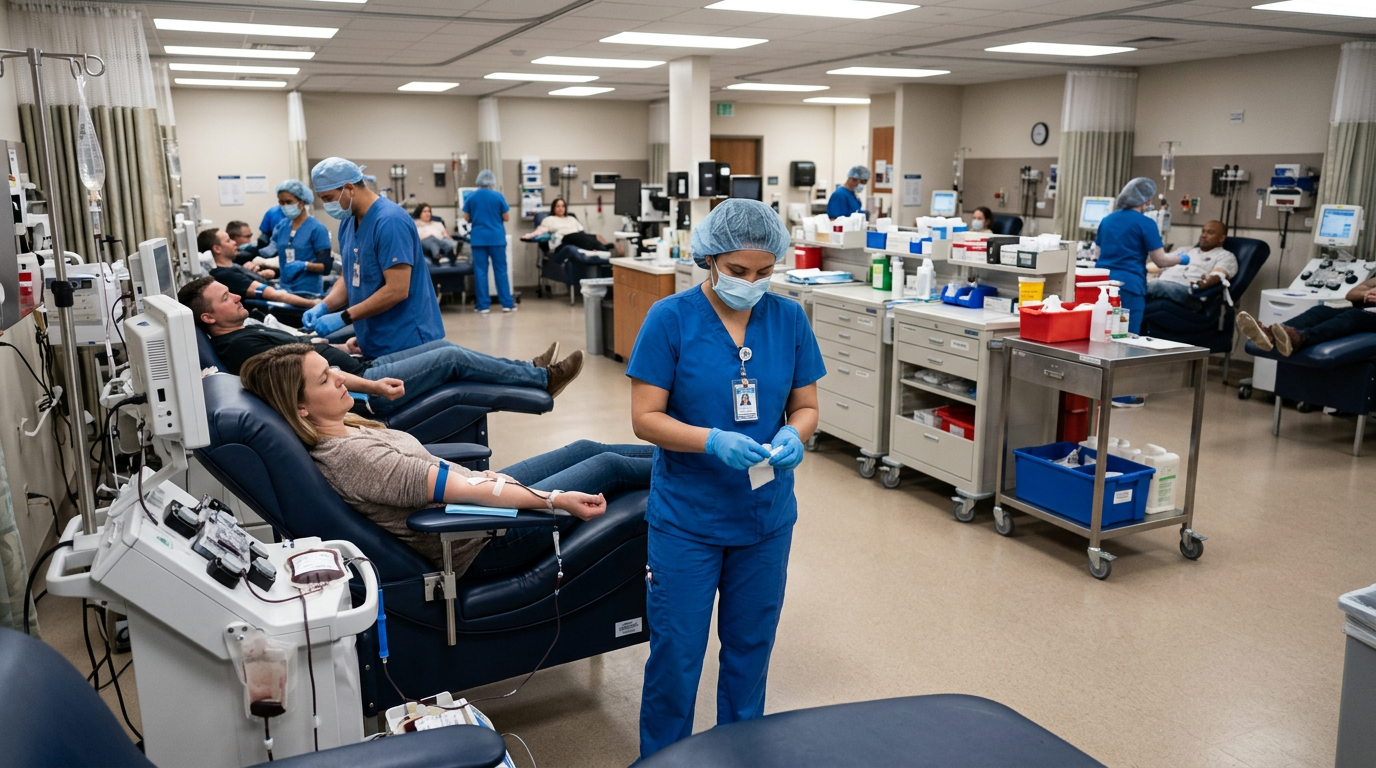
From arm to hospital fridge — one signed donor-to-distribution record per unit.
V5 Ultimate runs every step where 21 CFR 1271, 21 CFR 606 / 630 / 640, AABB and AATB Standards apply — donor registration and eligibility, phlebotomy or aseptic recovery, component split / wash / cryopreserve, IDM-gated quarantine, ISBT 128 labeling, hard-gated release by the Medical Director and continuous cold-chain from freezer to hospital fridge. The unit record builds itself as staff work. When the FDA BIMO or AABB assessor arrives, the record is already complete.
Built for 21 CFR 1271 (HCT/Ps), 21 CFR 606 / 630 / 640 (blood cGMP), AABB and AATB standards, and ISBT 128 labeling.
The same unit record — seen the way you run the centre.
For a blood centre or tissue bank, the small wins compound every donation. Finance sees discard drop and cost-per-issued-unit fall. Operations sees quarantine turn faster. The Medical Director sees a release record the FDA and AABB assessor will actually recognise.
Lower component discard, faster quarantine turn, and true cost per issued unit finally on the page — instead of surfacing at month-end.
- Per-donation actual cost: kit, satellite bags, IDM reagents, staff time and rework — visible in $, today.
- Lower discard from cold-chain excursions caught at the moment, not at end-of-month reconciliation.
- Fewer reprints and re-labels from errors caught at the workstation, not at the hospital receiving dock.
- Most blood centres see V5 pay back inside year one and keep compounding.
From donor arm to hospital fridge — one immutable per-unit thread.
Follow one donation. Every step below is a single screen in V5 — and the eligibility, IDM, ISBT 128 and cold-chain layer runs underneath them all.
Donor screened against current 21 CFR 630 criteria, DIN generated, arm to bag on one record — before a needle enters the vein.
- Donor eligibility questionnaire enforced at the current FDA-guidance revision — a lapsed rev physically blocks the chair.
- Photo ID + DIN barcode reconciliation at chair-side — mismatch is refused before venepuncture.
- Vitals (BP, pulse, temp, Hb / hct) captured on the chair-side device and posted straight to the eligibility record.
- Deferral history — permanent, temporary, TTI, iron, malaria, MSM etc. — enforced automatically; ineligible donors never reach the chair.
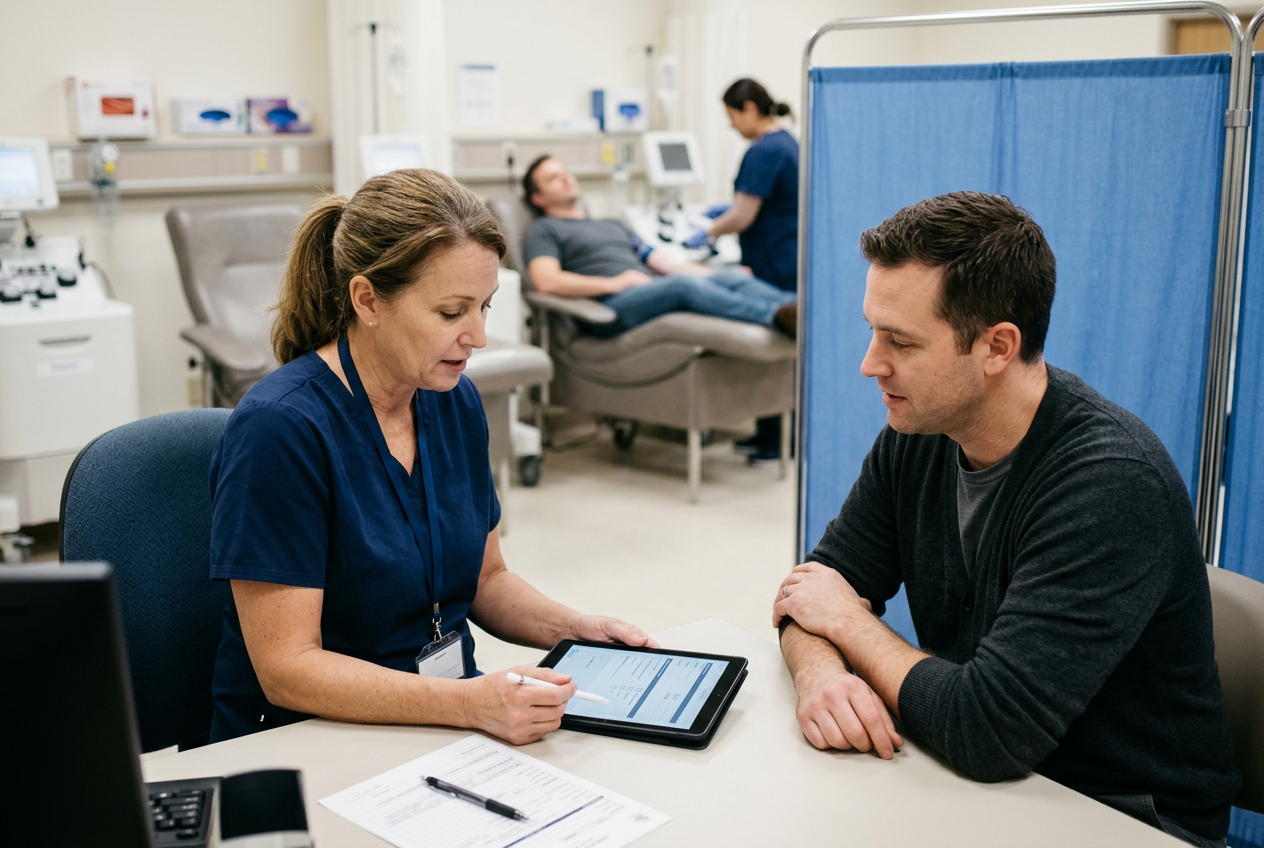
One donation, three components, one immutable process record — each split, wash and freeze recorded to the DIN.
- Processing SOP lockdown — the kiosk only shows the current approved rev and refuses ad-hoc substitution.
- Every component (RBC / plasma / platelets / cryo / tissue graft) inherits the parent DIN and adds its ISBT 128 product code.
- Instrument integration — centrifuges, plasma extractors, sterile connect devices, cell washers and controlled-rate freezers — streamed to the record.
- Operator hard-blocked from a step they are not currently qualified for — competency, aseptic technique and cGTP training enforced at the bench.
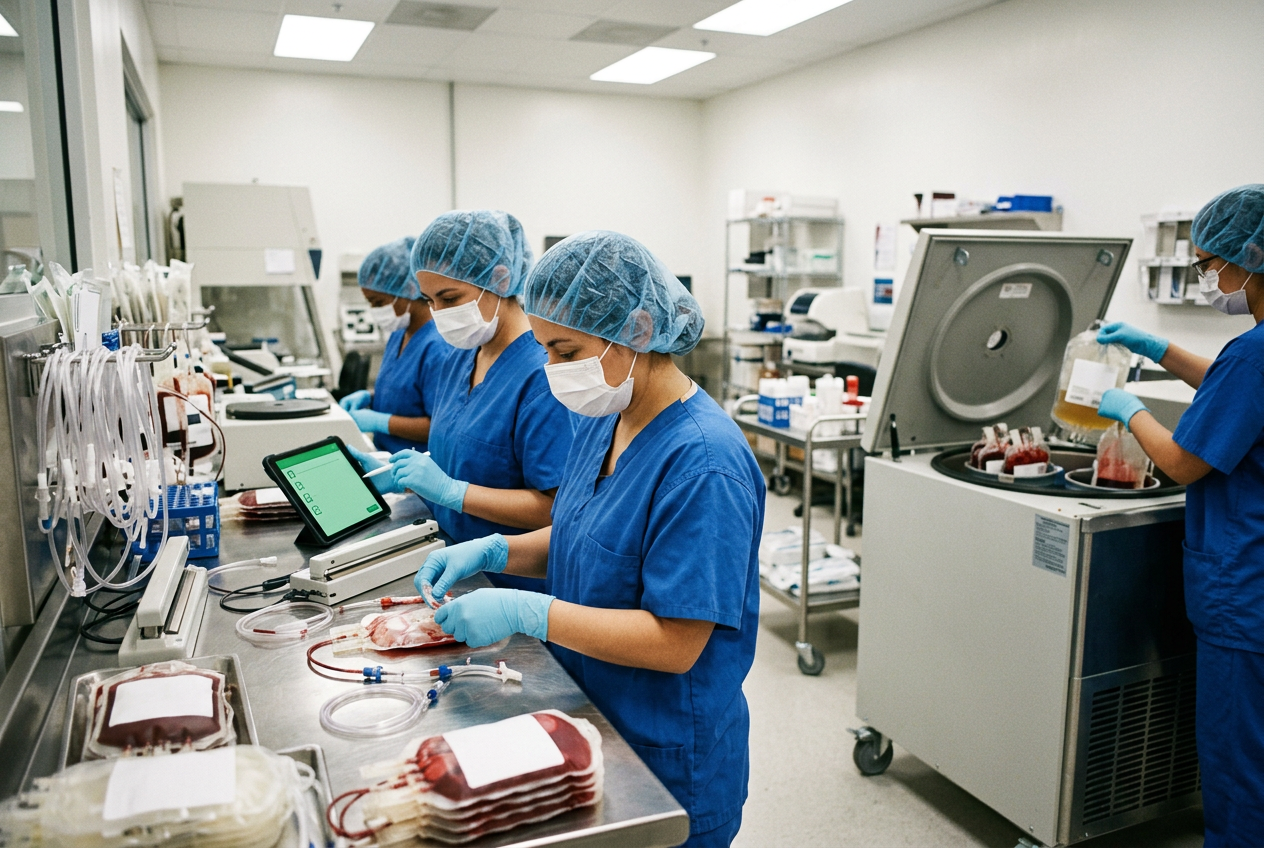
No unit leaves quarantine until every marker is negative — and the Medical Director has signed.
- IDM panel configured as gates — a missing or reactive marker physically prevents release.
- LIMS integration with Roche, Abbott, Grifols Procleix and Ortho — results wired straight to the unit; no re-key.
- Reactive donor triggers deferral (permanent / temporary as applicable), notification and lookback across every prior donation automatically.
- Two-signature release — Medical Director + designee — before quarantine flip. Every override is a signed, reasoned event.

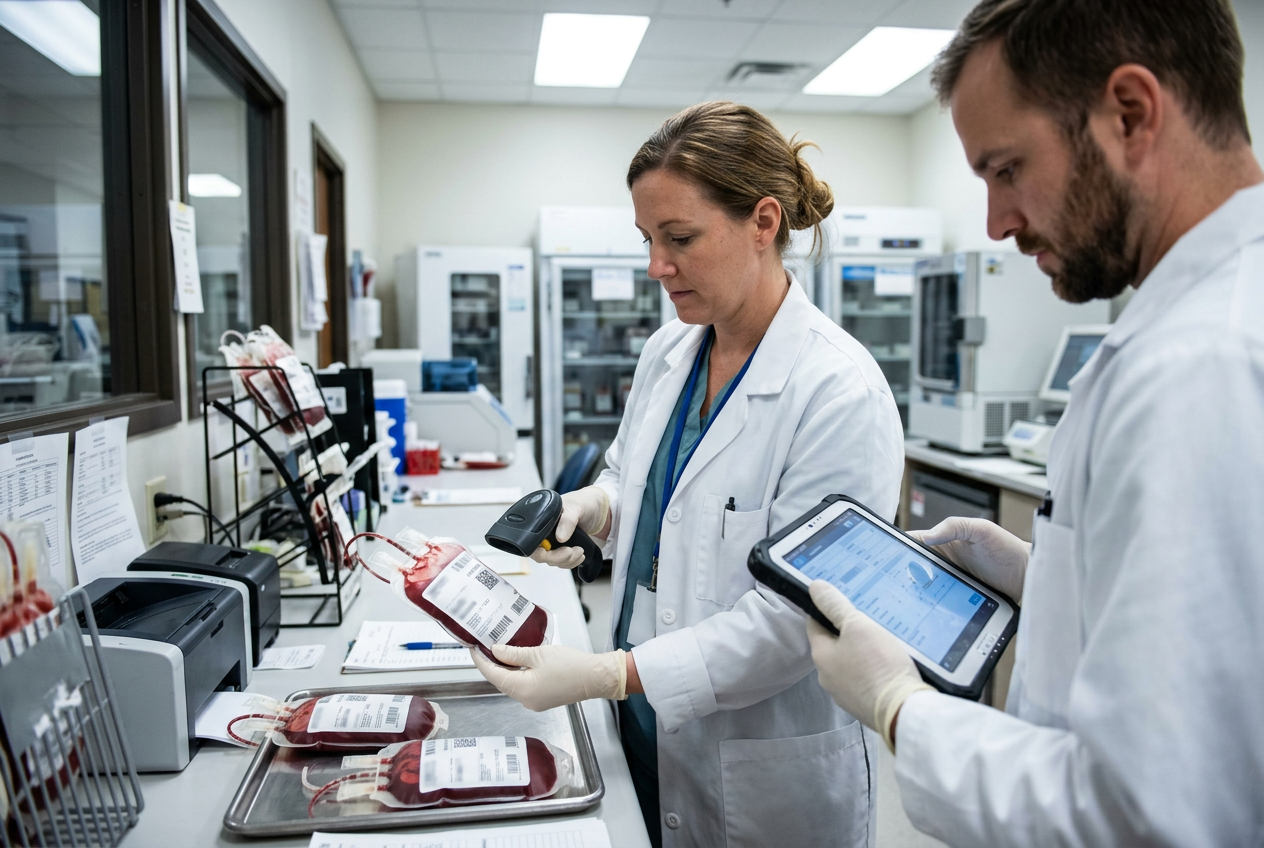
One released unit, current-rev ISBT 128 label, every reprint signed — Data Identifiers verified at every handoff.
- ISBT 128 Data Identifiers, product codes and DIN generated and verified at each label — bad barcodes never leave the station.
- Confirmatory ABO / Rh typing on a second sample gated before final label print.
- Reprints — smudged, damaged, split — captured as signed events tied to the original DIN and the reason.
- Special-attribute codes (CMV neg, irradiated, leukoreduced, HLA-matched) auto-derived from the processing record.
"Donor D-88214 just came back HIV-1 NAT reactive — which components and hospitals are exposed?"
Every shipment ships with a validated cold-chain shipper, a temperature logger and a consignee manifest tied to the released DIN. When a reactive donor, adverse-transfusion event, cold-chain excursion or FDA BPDR is raised, V5's DIN + component tree paints the affected units, consignee hospitals and prior donations — forward from the donation and backward to donor, IDM panel and every kit lot that built it.
A repeat donor's next-visit NAT panel returns HIV-1 reactive. V5 walks the tree — every prior donation, the components split from it, and every hospital consignee that received them. Pull the lever to see the lookback scope.
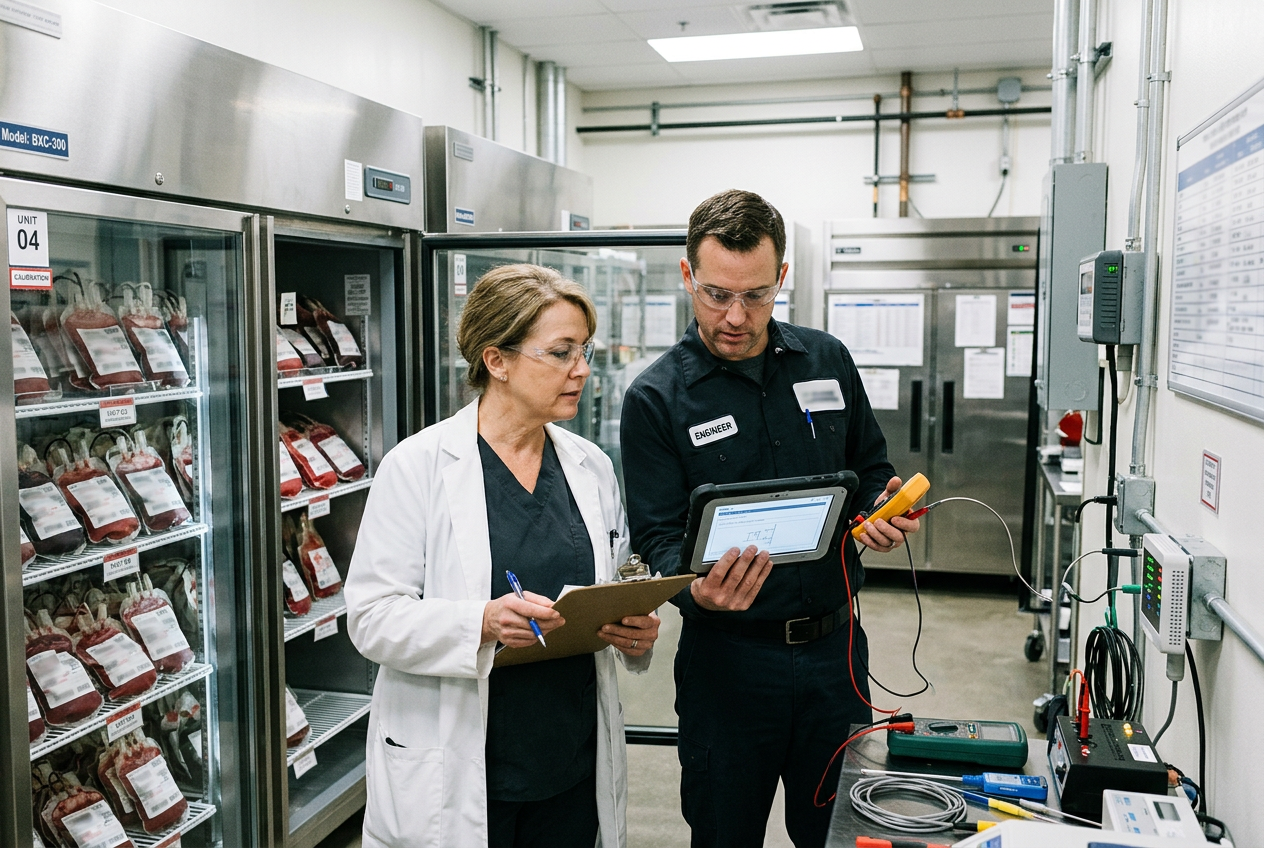
Refrigerator PM, freezer mapping and centrifuge calibration — on the same tablet as the donor floor.
- PM and mapping schedules per refrigerator, freezer, incubator, centrifuge and LN₂ dewar — expired mapping blocks release.
- Calibration cycles per ISO/IEC 17025-traceable standards — balances, sealer welds, cell washers, temperature probes and pipettes.
- Continuous temperature monitoring on every storage unit and shipper — excursions auto-hold affected units and open a deviation in real time.
- Change-over cleaning and aseptic-connect kit verification enforced before the next processing run loads.
Quality, BPDR and adverse-event reporting run through every donation — not stapled to the record at the end.
- Incoming inspection per collection kit, satellite bag set, reagent and shipping container — CoA match, sample, identity, expiry.
- In-process gates — vitals, Hb / hct, aseptic connect verify, seal integrity, IDM, ABO / Rh confirm.
- Two-signature release — technologist + Medical Director / designee — can't be skipped before a unit leaves quarantine.
- BPDR intake, transfusion-reaction reports and look-back — one workflow, FDA-ready export.
- AABB / AATB standards mapping — every applicable control tagged to the record producing the evidence.
- Document control and training matrix — superseded SOPs and lapsed competencies hard-block the bench.

Every quality feature in V5 — mapped to a 21 CFR 1271 / 606 / AABB / AATB centre.
The same platform that runs pharmaceuticals and medical devices — set up for the way a blood centre or tissue bank actually registers donors, collects, processes, tests, labels and releases a unit under 21 CFR 1271, 606, AABB and AATB.
Donor eligibility & deferral registry
Configurable to current FDA guidance and AABB Standards. Permanent, temporary and TTI deferrals enforced at the chair; ineligible donors never reach venepuncture. Deferral history follows the donor across visits.
IDM panel gating
Full antibody + NAT panel wired to Roche cobas, Abbott Alinity, Grifols Procleix and Ortho VITROS. Reactive or invalid results auto-hold every affected component and open deferral / lookback.
Two-signature Medical Director release
Technologist + Medical Director review-and-release before any unit ships. Every gate signed with a 21 CFR Part 11 e-signature — identity + meaning captured. Overrides are signed, reasoned events.
BPDR, deviation & transfusion reaction
One workflow from issue raised through root cause, action, verification and close. Linked to the affected DIN, donor, component, workstation and operator — BPDR export built into the record.
ISBT 128 & reprint control
Data Identifiers, product codes and DIN generated and verified at every label. Reprints — smudged, damaged, split — captured as signed events tied to the original DIN. Superseded label versions physically invisible.
Supplier scorecards & re-qualification
On-time delivery, kit CoA quality, deviation rate, sterility failure history and audit findings rolled into a live supplier score. Expired qualifications block goods-in automatically.
Calibration & instrument qualification
Balances, sealer welds, centrifuges, cell washers, temperature probes and pipettes on an ISO/IEC 17025-traceable calibration calendar — certificates attached, next-due enforced.
Continuous cold-chain monitoring
Every refrigerator, freezer, incubator, LN₂ dewar and validated shipper streamed against product-specific limits. Excursions auto-hold and open a deviation — no waiting for month-end review.
Look-back campaign export
Reactive donor triggers look-back across every prior donation, component and consignee — with a signed export ready for FDA and receiving hospital notification.
Live on your apheresis machines, IDM analysers, freezers and ISBT 128 label printers — no rip-and-replace.
We connect at the level your biomeds and laboratory expect — HL7, ASTM E1394, OPC UA, MQTT, REST, EDI, file drops, SQL. Most blood centres are live on day one with the apheresis, IDM, freezer and label-printer stack already in the building.
IDM analysers & LIMS
Roche cobas, Abbott Alinity, Grifols Procleix, Ortho VITROS. Antibody and NAT results streamed to the unit record — no re-key, no transcription.
Apheresis & processing kit
Terumo BCT, Fresenius Kabi Amicus, Haemonetics MCS+ and NexSys. Sterile connection devices, plasma extractors, cell washers and controlled-rate freezers logged to the DIN.
ISBT 128 label printers
Zebra, Datamax-O'Neil, Sato and Toshiba thermal-transfer. Data Identifiers, product codes and expiries pinned per unit; superseded label rev physically refused.
Cold storage & continuous monitoring
Helmer, Thermo Scientific, Follett, So-Low and PHCbi refrigerators / freezers / incubators; Cooltrace, Berlinger, Sensitech and Elpro loggers wired to the release gate.
Hospital HIS & EHR
HL7 v2 and FHIR interfaces to Epic Beaker, Cerner PathNet, Meditech and Sunquest. Consignee issue, transfusion reaction and BPDR events reconcile at the DIN.
BI & data warehouse
Power BI, Tableau, Looker, Snowflake, Databricks. Direct SQL access to your tenant — your data, your queries, your validated reports.
21 CFR 1271, 606 / 630 / 640, AABB, AATB, FACT-JACIE & ISBT 128 — at the data layer.
The records build themselves as each unit is collected, processed and released. When the FDA BIMO investigator or AABB assessor walks in, the evidence pack is one click — not a week of re-assembly.
Fixed-price, named team, one collection stream live before you pay for the next.
- Week 1–4·step 01Discovery & floor scan
We walk one collection stream with your team — donor questionnaire, SOPs, apheresis and processing methods, IDM assay panel, ISBT 128 label library, cold-chain shippers and existing HIS fields. Out: a fixed scope and price.
- Week 5–9·step 02Configure & integrate
Donor master, SOPs, IDM panel, ISBT 128 label library, cold-chain templates, apheresis / IDM / freezer / label-printer integrations and HIS feeds loaded. IQ / OQ on the bench.
- Week 10–13·step 03PQ, pilot & train
One collection stream live in pilot. Three-shift staff training on the floor with the actual UI — not slides. PQ and UAT signed by the Medical Director, QA and operations.
- Week 14–16·step 04Go live & hyper-care
Cut over. Two weeks of hyper-care with your named delivery team on-site. KPIs published on the wall before we leave.
The first six questions on every blood centre / tissue bank RFP.
How does V5 keep the centre aligned with 21 CFR 1271, 606 / 630 / 640 and current FDA guidance?
How does V5 handle Biological Product Deviation Reports (BPDR) and look-back on a reactive donor?
How does V5 support ISBT 128 labelling, reprints and second-typing controls?
Will V5 talk to our apheresis machines, IDM analysers, freezers and label printers?
How does V5 handle continuous cold-chain and shipper qualification?
What about IT — 21 CFR Part 11 controls, SOC 2, validated change control, FACT-JACIE where cellular therapy is in scope?
Book a 30-minute walkthrough with a blood & tissue specialist.
We'll show a live self-building donor record, chair-side eligibility enforcement, component split into ISBT 128 labelled units, IDM-gated quarantine, Medical Director e-signed release, cold-chain distribution and a mock reactive-donor lookback — on a workspace seeded for a working centre.
Fixed-price go-live · No platform lock-in · Onboard in 10–16 weeks