Recipe control and regrind traceability — for compounders and molders who supply regulated end-markets.
Built for ISO 9001, IATF 16949, FDA 21 CFR 177 (food contact), and USP Class VI.
The codes you're accountable to — at the data layer.
Five steps from receive to release — with the regulator on the hook at the end.
Tap to expand · download as PNG · paste into an audit prep deck.
From login to release — no end-of-shift paperwork.
- › resin lot
- › supplier
- › grade
- › MoA
- › recipe
- › additives
- › % w/w
- › operator
- › line id
- › melt temp
- › rate
- › operator
- › MFI
- › color ΔE
- › spec
- › QA sig
- › lot
- › yield
- › moisture
- › operator
- › pack
- › lot
- › CoA
- › ship to
- 07:00·step 01Recipe lock
Compound recipe carries the regrind % limit. Operator can't push above the spec without an e-sig + reason code.
- 08:00·step 02Compound / mold
Process parameters (melt temp, screw RPM, cycle time) stream straight onto the batch record.
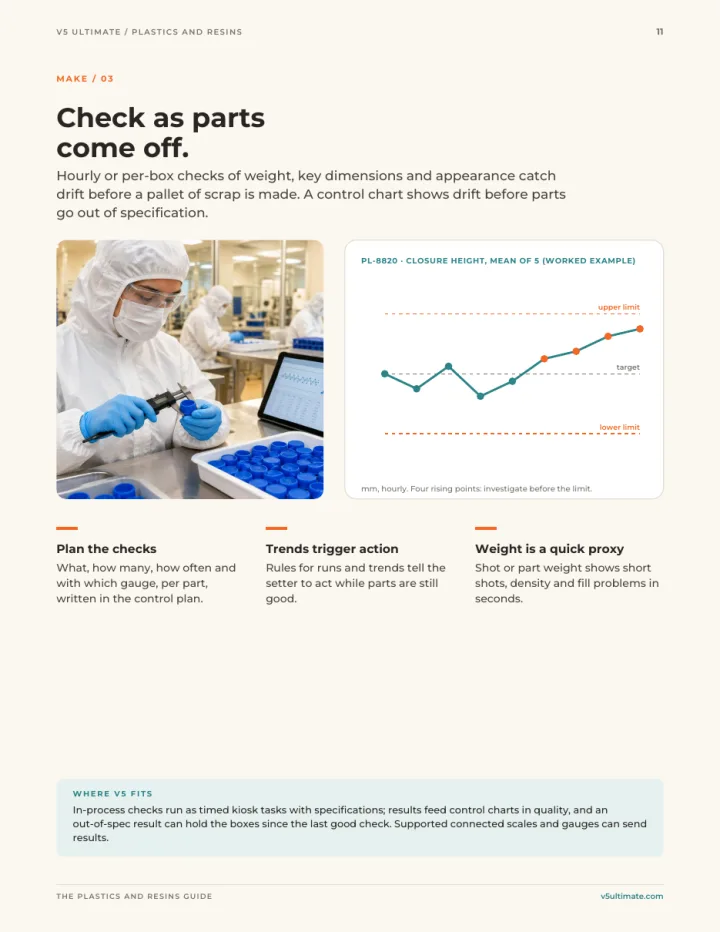
- 11:00·step 03Dimensional QC
CMM / gauge readings post directly. SPC charts update live; trend nudge fires before the spec is breached.
- 13:00·step 04Customer spec gate
Lot release checked against the customer drawing tolerance. Out-of-band → contained, not shipped.
ISO 9001 / IATF 16949 - 15:00·step 05PPAP / FAI ready
First-Article and PPAP packs assemble from the same data — dimensional, material certs, control plan, all in one folder.
- EOD·step 06Signed lot record
Lot record + CoA render together. Customer-specific PPAP element checklist stays green or surfaces the gap.
The terms your auditor uses
- PPAP
- Production Part Approval Process — automotive-style approval pack (AIAG).
- FAI / FAIR
- First Article Inspection (Report) — AS9102 for aerospace, otherwise a similar dimensional pack.
- IATF 16949
- Automotive QMS standard built on ISO 9001.
- Regrind %
- Recycled material allowed in a compound — capped by customer spec.
- Control plan
- Document listing every characteristic monitored at every step (input → output).
- MRB
- Material Review Board — the team that decides what to do with non-conforming material.
Sound familiar? We built this for you.
Master batch recipes drift between the office and the floor.
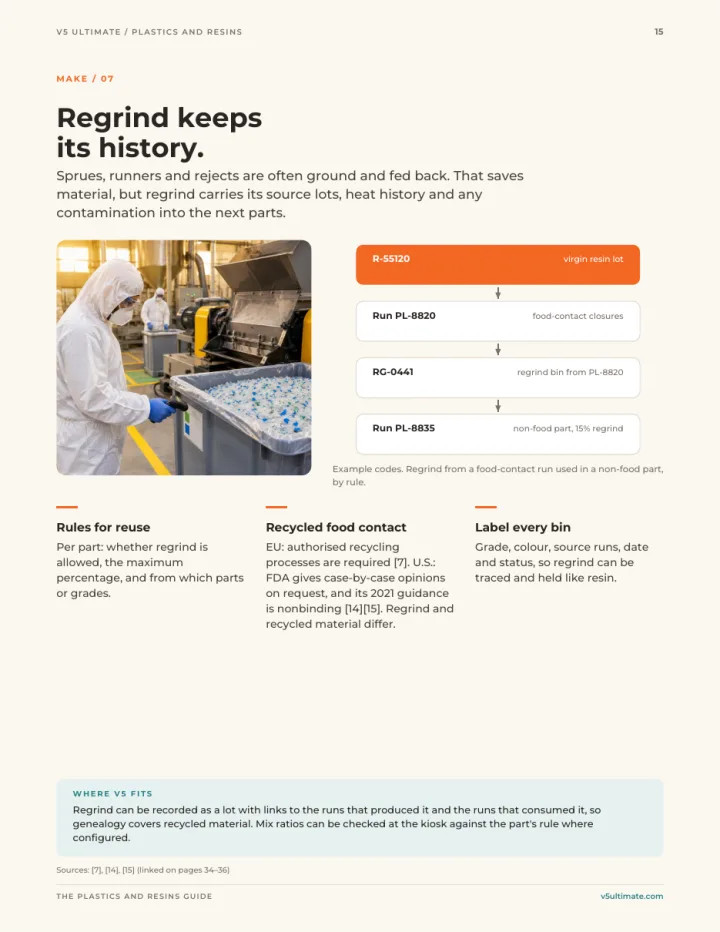
Regrind ratios aren't tracked by shot; spec compliance is a guess.
Customer Certificates of Compliance are produced manually and lag shipment.
Substance compliance (REACH SVHC, RoHS) is a manual lookup per customer request.
The workflows you'd expect to see on day one.
Not a generic feature list — these are the specific plastics & resins workflows V5 ships configured for, ready to run on your batches.
Resin lot + grade tracking
Inbound resin lot, grade, MoA, and food-contact status recorded at receive.
Compounding recipe enforcement
Additive % w/w and addition order locked; deviations open a hold ticket automatically.
MFI / color / moisture QC
Melt Flow Index, color ΔE, and moisture results captured at the line and tied to the pellet lot.
Pelletizing yield & throughput
Per-line yield, fines %, and changeover times streamed live.
Food-contact compliance pack
21 CFR 177 / EU 10/2011 declarations of compliance generated per grade and per lot.
Reclaim / regrind traceability
Regrind ratio and source-lot lineage tracked into every blended lot.
The record assembles itself as the work happens.
No paperwork project at end of shift. No reconstruction at audit time. The evidence IS the workflow.
One controlled recipe
Approved master batch recipe is the only recipe the line can run.
Regrind by shot
Virgin / regrind ratios captured per shot, with thresholds enforced against customer spec.
CoC with the shipment
Certificate of Compliance generated from the released lot data — ships with the truck.
Substance status per lot
REACH SVHC and RoHS status carried on every component and resolved per finished lot.
Paste your stack. See what V5 replaces vs keeps.
ERP, LIMS, MES, paper logs, spreadsheets — list what you run today and our AI returns an honest side-by-side: what V5 absorbs, what stays, and the realistic integration + retraining windows for Plastics & Resins.
Paste your current setup. See what V5 replaces — and what stays.
Honest side-by-side for plastics & resins operations. No form, no signup. Ask V5 names what V5 swaps out, what should stay, and what the switching risks actually are.
Be specific — naming the actual tools gets a sharper comparison.
What does V5 look like for your plastics & resins operation?
Tell us your scale and current stack. Get modules, rollout, compliance fit, and pricing band — pre-seeded for your industry.
Plain-English playbooks for Plastics & Resins regulations.
Structure, recurring inspection findings, and a practical 60-day path — written for QA, regulatory and operations leads.
Readiness guide for plastic food-contact materials under Commission Regulation (EU) 10/2011 — Union List, SML, OML, NIAS, declaration of compliance and supporting documentation.
Readiness guide for plastics and resin manufacturers supplying food-contact polymers under 21 CFR 177 — clearance routes, FCN, threshold of regulation, extractables and migration testing.
Plain-English guide to ISO 9001:2015 — the international QMS standard. Risk-based thinking, process approach, leadership and the path to a clean certification audit.
Spin up a workspace seeded for Plastics & Resins.
Default templates, validation rules, and report packs are pre-loaded for your industry. Run a real batch in under an hour.
Ask anything · No credit card · Onboard in days, not months