FSMA-grade batch records with AAFCO nutrient guarantee per lot.
Built for FDA 21 CFR 117, FSMA 204 traceability, AAFCO labeling, and SQF / BRCGS schemes.
← Different industryThe codes you're accountable to — at the data layer.
Five steps from receive to release — with the regulator on the hook at the end.
Tap to expand · download as PNG · paste into an audit prep deck.
From login to release — no end-of-shift paperwork.
- › ingredient lot
- › supplier
- › CoA
- › FSVP
- › recipe
- › % w/w
- › AAFCO profile
- › operator
- › CCP id
- › probe temp
- › dwell
- › operator
- › guaranteed analysis
- › moisture
- › QA sig
- › release
- › AAFCO statement
- › lot
- › BB date
- › weight
- › pallet lot
- › ship date
- › carrier
- › recall scope
- 06:30·step 01Receive ingredients
Driver scans the BoL. Ingredient lot, supplier, FSVP verification, AAFCO category — all captured at goods-in.
21 CFR 507 / FSVP - 08:00·step 02Formulate
Recipe pulls input lots and writes the batch. Guaranteed analysis (protein, fat, fibre, moisture) calculated against the AAFCO profile.
- 10:00·step 03Cook + kill step
CCP probe streams core temp + dwell time. Step won't sign until lethality target is met. Failure → auto-hold + NCR.
21 CFR 507 / HACCP - 13:00·step 04QC release
QA verifies guaranteed analysis, moisture, micro. Release gate is spec-or-no-ship — preventative controls enforced, not aspirational.
- 14:30·step 05Pack + label
Label prints with the AAFCO statement, lot, best-before, weight — pulled from the registered recipe.
AAFCO Model Reg - 16:00·step 06Ship + lot trace
Pallet lot, ship date, carrier, recall scope captured. Mock recall resolves in seconds — every bag tied back to every input lot.
The terms your auditor uses
- AAFCO
- Association of American Feed Control Officials — sets US pet food labelling + nutrient standards.
- Guaranteed analysis
- Min/max nutrient declarations on the label (protein, fat, fibre, moisture).
- Kill step / CCP
- Critical Control Point in the cook step — temperature × time that destroys pathogens.
- FSVP
- Foreign Supplier Verification Programs — required for imported ingredients under FSMA.
- FEDIAF
- European pet food federation — equivalent of AAFCO for EU markets.
- Recall scope
- The exact list of finished lots that contain a suspect input lot — what V5 returns in seconds.
Sound familiar? We built this for you.
Guaranteed analysis on the bag drifts from the batch actually made.
FSMA-204 KDEs (lot, location, date, qty) are reconstructed at audit time.
Recall on a bad ingredient lot takes days because forward / backward traces aren't linked.
Pre-requisite programmes (sanitation, allergen, glass policy) sit in three different binders.
The workflows you'd expect to see on day one.
Not a generic feature list — these are the specific pet food workflows V5 ships configured for, ready to run on your batches.
FSVP + ingredient lot intake
Supplier approval, FSVP record, allergen profile, and CoA captured at receive.
Recipe + AAFCO profile control
Nutrient guarantees and AAFCO profile compliance computed from the formula and CoAs.
Kill-step / cook CCP capture
Probe temp, dwell, and validated lethality recorded per cook cycle.
Guaranteed-analysis label panel
Crude protein, fat, fiber, moisture — printed values match the BPR by construction.
FSMA 117 / 507 traceability
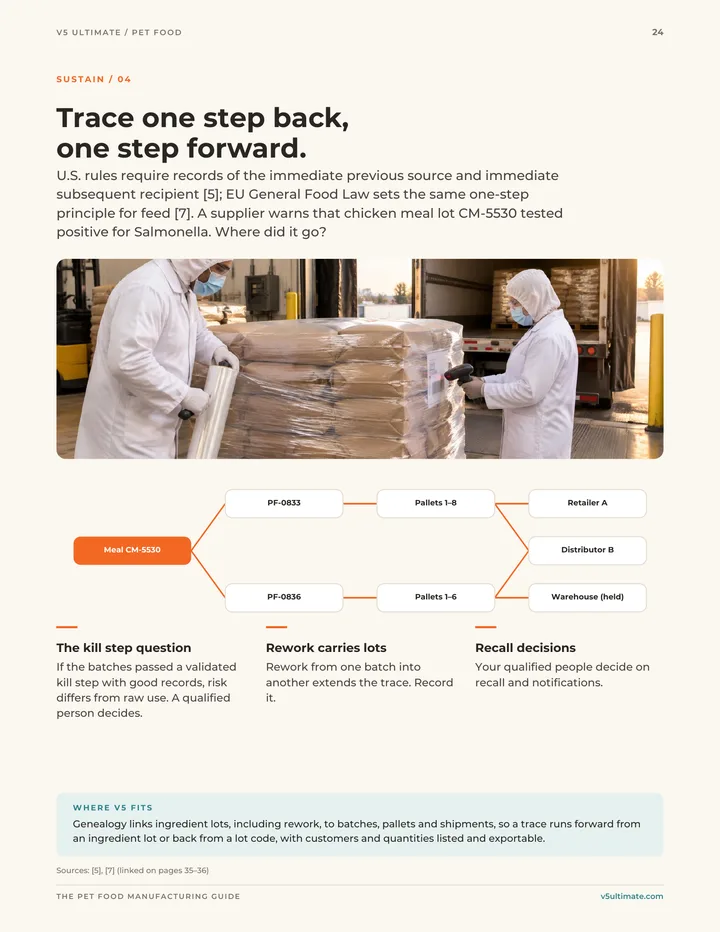
Forward / backward genealogy from ingredient lot to pallet to retailer for fast recall.
Complaint & adverse-event log
Consumer / vet complaints tied to lot, line, shift, and supplier — trended for CAPA.
The record assembles itself as the work happens.
No paperwork project at end of shift. No reconstruction at audit time. The evidence IS the workflow.
Nutrient guarantee per lot
Per-batch nutrient roll-up checked against the AAFCO guaranteed analysis before release.
FSMA-204 ready
Receipt → transformation → ship CTEs auto-captured with all required KDEs; export on demand.
1-up / 1-down trace
Forward + backward trace from a finished bag to every supplier lot in seconds.
GFSI evidence
Sanitation, allergen, glass / hard plastic, training records all attached to the batch.
Paste your stack. See what V5 replaces vs keeps.
ERP, LIMS, MES, paper logs, spreadsheets — list what you run today and our AI returns an honest side-by-side: what V5 absorbs, what stays, and the realistic integration + retraining windows for Pet Food.
Paste your current setup. See what V5 replaces — and what stays.
Honest side-by-side for pet food & pet supplements operations. No form, no signup. Ask V5 names what V5 swaps out, what should stay, and what the switching risks actually are.
Be specific — naming the actual tools gets a sharper comparison.
What does V5 look like for your pet food operation?
Tell us your scale and current stack. Get modules, rollout, compliance fit, and pricing band — pre-seeded for your industry.
Plain-English playbooks for Pet Food regulations.
Structure, recurring inspection findings, and a practical 60-day path — written for QA, regulatory and operations leads.
Plain-English guide to BRCGS Global Standard for Food Safety Issue 9 — fundamentals, HACCP, food safety culture, unannounced audits, and a path to AA grade.
Plain-English guide to FDA FSMA Section 204 — the Food Traceability List, Key Data Elements, Critical Tracking Events, and how to be 24-hour-ready before the January 2026 deadline.
Plain-English guide to FSMA Preventive Controls for Human Food (21 CFR 117) — the food safety plan, hazard analysis, PCQI duties, and a realistic readiness path.
Plain-English guide to FSSC 22000 v6 — ISO 22000, sector PRPs, and the additional FSSC requirements that auditors actually focus on during certification.
Plain-English guide to FDA's Foreign Supplier Verification Program — hazard analysis, supplier evaluation, verification activities, and the records FDA actually inspects.
Plain-English guide to HACCP per Codex Alimentarius CXC 1-1969 Rev.5 (2020) — the seven principles, the twelve logic steps, prerequisite programmes and a plan that survives any GFSI audit.
Plain-English guide to IFS Food Version 8 — the GFSI-recognised standard used across European retail. KO requirements, scoring, unannounced audits and a path to a Higher Level certificate.
Plain-English guide to ISO 22000:2018 — the international food safety management standard. PDCA, HACCP, PRPs, the operational PRP concept and a path to a clean certification audit.
Plain-English guide to the SQF Food Safety Code Edition 9 — system elements, food safety culture, environmental monitoring, unannounced audits and a path to a clean SQF certificate.
Spin up a workspace seeded for Pet Food.
Default templates, validation rules, and report packs are pre-loaded for your industry. Run a real batch in under an hour.
Ask anything · No credit card · Onboard in days, not months