Pass a 111 audit on any random batch, any random day.
Built for 21 CFR 111, FSMA, and NSF/USP certification audits.
The codes you're accountable to — at the data layer.
Five steps from receive to release — with the regulator on the hook at the end.
Tap to expand · download as PNG · paste into an audit prep deck.
From login to release — no end-of-shift paperwork.
- › lot
- › supplier
- › CoA
- › quarantine
- › NIR / FTIR id
- › specs met
- › QC sig
- › release
- › BPR step
- › weights
- › order
- › operator
- › fill weight
- › AQL
- › operator
- › time
- › count
- › torque
- › label rev
- › lot
- › MMR signed
- › BPR closed
- › CoA out
- › ship lot
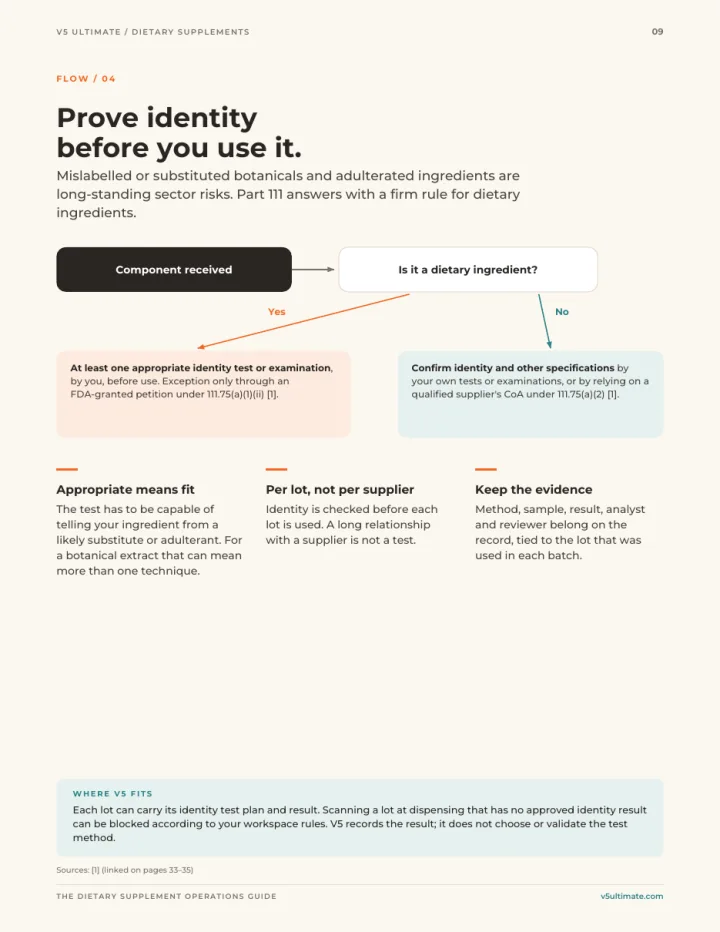
- 07:00·step 01Identity test
Incoming raw material gets FTIR / HPLC identity test before release. Result attached to the lot — no test, no use.
21 CFR 111.75 - 07:30·step 02MMR snapshot
WO release snapshots the approved MMR into the batch — exact weights, in-process specs, and the master label all locked.
- 09:00·step 03Dispense + blend
Scale streams every weighment. Blender RPM + time captured automatically. Yield calculated live, variance flagged.
- 12:00·step 04Encapsulation / tableting
Press writes capsule weight checks every 15 min. Out-of-band readings hold the line and open a deviation.
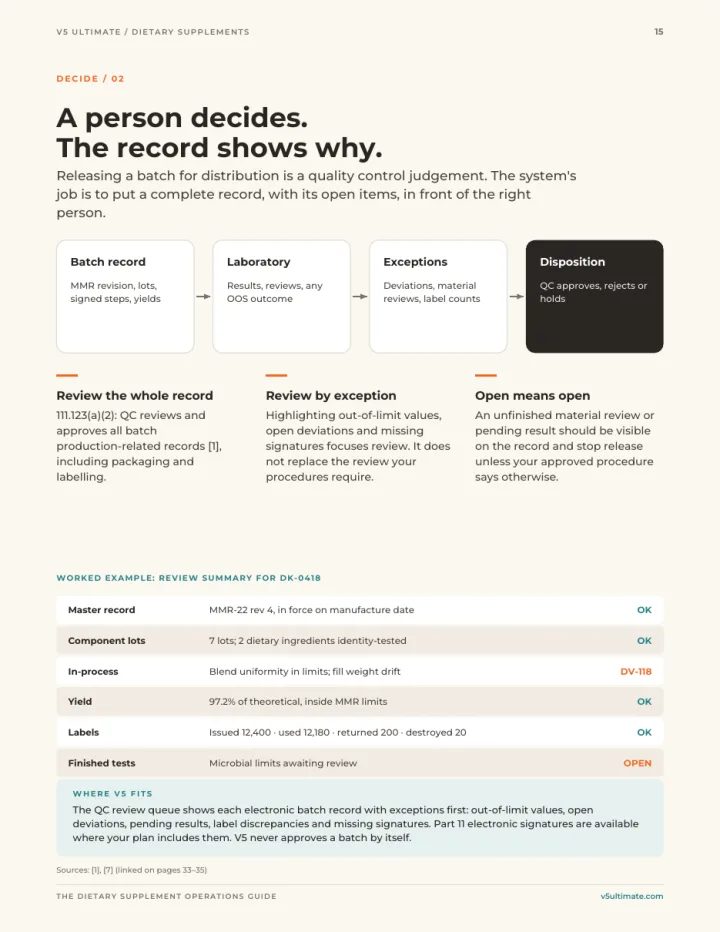
- 14:30·step 05QC release
Finished lot tested against the MMR spec. Label content checked against the formula, ingredient by ingredient.
21 CFR 111.70 - 16:00·step 06BPR sign-off
Two e-sigs close the Batch Production Record — preparer + independent reviewer. CoA renders from the same snapshot.
21 CFR 111.205
The terms your auditor uses
- MMR
- Master Manufacturing Record — the approved, immutable recipe per 21 CFR 111.205.
- BPR
- Batch Production Record — the signed reproduction of the MMR for a specific batch (111.255).
- Identity test
- Required test on every incoming dietary ingredient before use (111.75).
- DSHEA
- Dietary Supplement Health and Education Act — defines what counts as a supplement.
- Structure/function claim
- Permitted claim about how an ingredient affects body structure — not a disease claim.
- NSF / cGMP audit
- Third-party audit against 21 CFR 111 — most retailers require one before they'll list you.
Sound familiar? We built this for you.
MMR approval, identity testing, and quality release all live in different binders.
Inbound ingredient identity testing isn't tied to release — material gets used before QA signs off.
Label claims drift from the formula; the marketing label and the BPR don't match.
Co-mans get the blame at audit because the trail of who-did-what isn't clean.
The workflows you'd expect to see on day one.
Not a generic feature list — these are the specific dietary supplements workflows V5 ships configured for, ready to run on your batches.
MMR + BPR pairing
Master Manufacturing Record drives every Batch Production Record — 21 CFR 111 by construction.
Inbound identity testing gate
Material can't be issued to production until NIR/FTIR identity passes and QA releases the lot.
Label-claim ↔ formula reconciliation
Per-serving values on the Supplement Facts panel are computed from the BPR — marketing label and formula stay in lockstep.
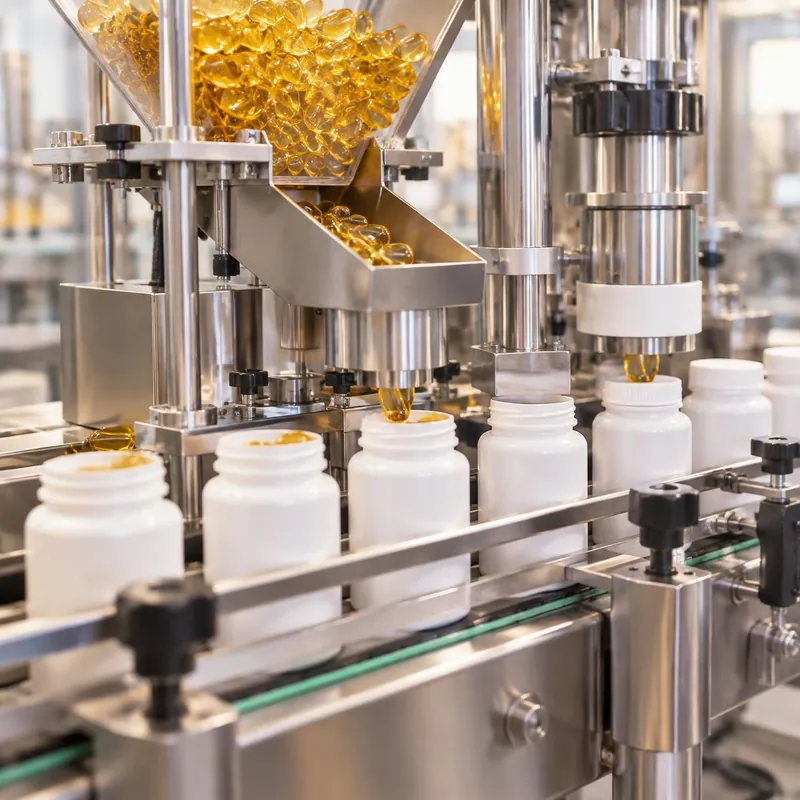
Encapsulation / tablet weight checks
Fill weight, AQL sampling, and reject rates captured per cycle and signed off.
Quality release packet
CoA, identity, BPR sign-off, and finished-product test results bundled and signed before shipment.
Adverse-event capture
Inbound AE reports tied to the exact lot, supplier, and shift — DSHEA-ready files.
The record assembles itself as the work happens.
No paperwork project at end of shift. No reconstruction at audit time. The evidence IS the workflow.
MMR + BPR by construction
Approved MMR snapshots into the work order. The executed work order IS the BPR.
Identity testing gates release
Ingredient identity (visual, FTIR, HPLC) is a signed gate — material can't be dispensed without it.
Label-to-formula reconciliation
Per-serving claims auto-calculate from the released formula; label printed from the same source.
Quality holds are physical
Quarantine status enforces at scan time. Operators can't pick what QA hasn't released.
Paste your stack. See what V5 replaces vs keeps.
ERP, LIMS, MES, paper logs, spreadsheets — list what you run today and our AI returns an honest side-by-side: what V5 absorbs, what stays, and the realistic integration + retraining windows for Dietary Supplements.
Paste your current setup. See what V5 replaces — and what stays.
Honest side-by-side for dietary supplements operations. No form, no signup. Ask V5 names what V5 swaps out, what should stay, and what the switching risks actually are.
Be specific — naming the actual tools gets a sharper comparison.
What does V5 look like for your dietary supplements operation?
Tell us your scale and current stack. Get modules, rollout, compliance fit, and pricing band — pre-seeded for your industry.
Plain-English playbooks for Dietary Supplements regulations.
Structure, recurring inspection findings, and a practical 60-day path — written for QA, regulatory and operations leads.
Plain-English guide to FDA 21 CFR Part 11 — electronic records, electronic signatures, audit trails, and a practical path to a Part 11-compliant eQMS without theatre.
Plain-English guide to GAMP 5 second edition and FDA's Computer Software Assurance — software categories, risk-based testing, intended use, and a leaner validation pack.
Plain-English guide to the Modernization of Cosmetics Regulation Act — facility registration, product listing, safety substantiation, adverse-event reporting, and GMPs for cosmetics sold in the US.
Spin up a workspace seeded for Dietary Supplements.
Default templates, validation rules, and report packs are pre-loaded for your industry. Run a real batch in under an hour.
Ask anything · No credit card · Onboard in days, not months