USDA-grade traceability without the binder room.
Built for USDA FSIS HACCP, FSIS Directive 7111.1, and lethality validation.
The codes you're accountable to — at the data layer.
Five steps from receive to release — with the regulator on the hook at the end.
Tap to expand · download as PNG · paste into an audit prep deck.
From login to release — no end-of-shift paperwork.
- › carcass id
- › supplier
- › temp
- › vet sign
- › lot in / out
- › plate size
- › operator
- › time
- › recipe
- › casing lot
- › weight
- › operator
- › CCP cycle
- › core temp
- › duration
- › lethality
- › CCP target
- › actual temp
- › time
- › operator
- › lot
- › label code
- › HACCP sign
- › ship date
- Pre-shift·step 01Pre-op sanitation
USDA-style pre-op inspection on the kiosk. Failed swab opens an NCR and the line stays down.
9 CFR 416 - 06:00·step 02Formulate
HACCP plan locked into the WO. Lethality + stabilisation steps required by Appendix A/B chosen at WO release.
- 08:00·step 03Cook step (CCP)
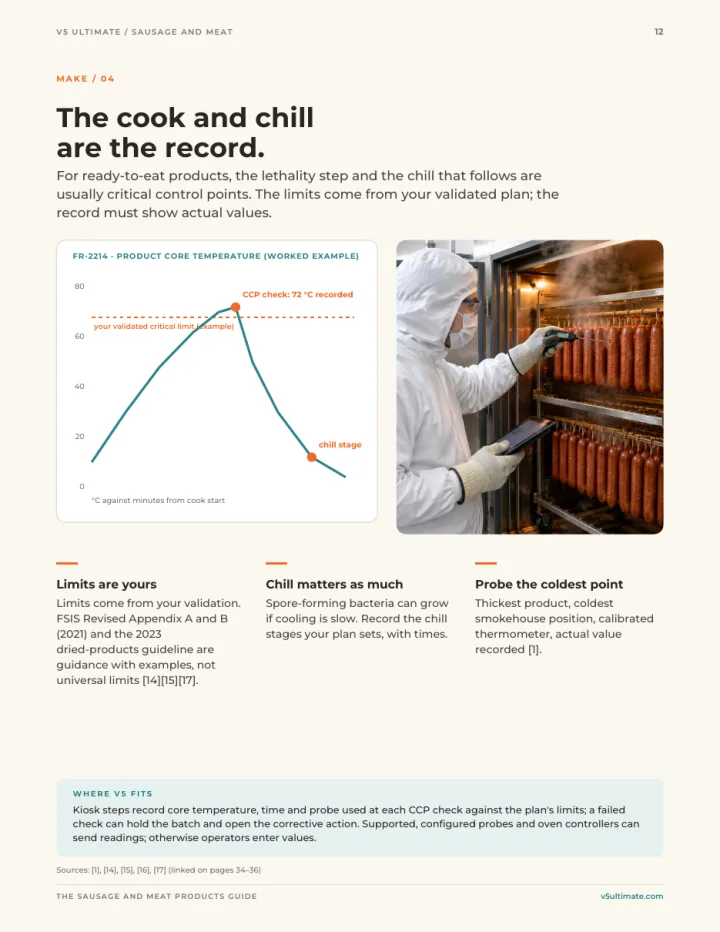
Probe temperature + dwell time stream live. If the lethality target isn't met → product held automatically.
9 CFR 417 (HACCP CCP) - 11:00·step 04Chill + hold
Chiller stream feeds the record — Appendix B stabilisation criteria checked without an operator clipboard.
- 13:00·step 05Pack + label
FSIS-approved label prints from the formula. Net weight, safe-handling, est. number — all on the same artwork.
- 15:00·step 06Pre-shipment review
QA reviewer signs the daily PSR. Any deviation gets investigated before the load leaves.
9 CFR 417.5
The terms your auditor uses
- FSIS
- Food Safety and Inspection Service — USDA agency that regulates meat, poultry, egg products.
- Appendix A / B
- FSIS lethality (A) and stabilisation (B) compliance guidelines for ready-to-eat products.
- CCP
- Critical Control Point — the step in the HACCP plan you must monitor or you have a recall.
- PSR
- Pre-Shipment Review — required HACCP record review before product leaves the establishment (9 CFR 417.5).
- Establishment number
- FSIS-assigned EST # printed on every label.
- NR
- Non-conformance Report — what you generate from a failed pre-op or in-process check.
Sound familiar? We built this for you.
Cook step temperatures and chill rates live on probe printouts taped into binders.
Pre-shipment review is a manager flipping through paper — easy to miss a deviation.
Label approval files don't tie to the lots that actually ran with that label.
An FSIS withholding action is a fire drill; finding the affected lots takes a shift.
The workflows you'd expect to see on day one.
Not a generic feature list — these are the specific meat & sausage workflows V5 ships configured for, ready to run on your batches.
Carcass & primal lot intake
Vet sign-off, carcass ID, supplier, and arrival temp captured at receive — USDA / FSIS ready.
Recipe & seasoning weigh-out
Cure, nitrite, seasoning, and protein ratios captured with two-person sign-off for regulated ingredients.
CCP probe temps + lethality
Cook core temp, dwell, and computed lethality (Fo) streamed into the HACCP log per cycle.
Chill-down monitoring
Stabilization rule (e.g. 120°F → 80°F → 40°F windows) computed automatically; deviations halt release.
HACCP plan execution & sign-off
Every CCP, monitoring step, and corrective action signed live by the assigned operator and verifier.
Species, net-weight & nutrition labels
Species declaration, net-weight verification, and nutrition facts panel generated from the recipe.
The record assembles itself as the work happens.
No paperwork project at end of shift. No reconstruction at audit time. The evidence IS the workflow.
Cook & chill in the lot record
Probe temps, dwell time, chill rate captured live; deviations halt the shift and trigger a CAPA.
Pre-shipment review gate
Lots can't ship until a designated reviewer has signed off — system enforces, not memory.
Label-version on every lot
The exact FSIS-approved label version that ran is recorded with the lot.
Withholding-ready
Affected lots and downstream customers identified in seconds, not shifts.
Paste your stack. See what V5 replaces vs keeps.
ERP, LIMS, MES, paper logs, spreadsheets — list what you run today and our AI returns an honest side-by-side: what V5 absorbs, what stays, and the realistic integration + retraining windows for Meat & Sausage.
Paste your current setup. See what V5 replaces — and what stays.
Honest side-by-side for sausage & meat products operations. No form, no signup. Ask V5 names what V5 swaps out, what should stay, and what the switching risks actually are.
Be specific — naming the actual tools gets a sharper comparison.
What does V5 look like for your meat & sausage operation?
Tell us your scale and current stack. Get modules, rollout, compliance fit, and pricing band — pre-seeded for your industry.
Plain-English playbooks for Meat & Sausage regulations.
Structure, recurring inspection findings, and a practical 60-day path — written for QA, regulatory and operations leads.
Plain-English guide to BRCGS Global Standard for Food Safety Issue 9 — fundamentals, HACCP, food safety culture, unannounced audits, and a path to AA grade.
Plain-English guide to FDA FSMA Section 204 — the Food Traceability List, Key Data Elements, Critical Tracking Events, and how to be 24-hour-ready before the January 2026 deadline.
Plain-English guide to FSMA Preventive Controls for Human Food (21 CFR 117) — the food safety plan, hazard analysis, PCQI duties, and a realistic readiness path.
Plain-English guide to FSSC 22000 v6 — ISO 22000, sector PRPs, and the additional FSSC requirements that auditors actually focus on during certification.
Plain-English guide to HACCP per Codex Alimentarius CXC 1-1969 Rev.5 (2020) — the seven principles, the twelve logic steps, prerequisite programmes and a plan that survives any GFSI audit.
Plain-English guide to IFS Food Version 8 — the GFSI-recognised standard used across European retail. KO requirements, scoring, unannounced audits and a path to a Higher Level certificate.
Plain-English guide to ISO 22000:2018 — the international food safety management standard. PDCA, HACCP, PRPs, the operational PRP concept and a path to a clean certification audit.
Plain-English guide to the SQF Food Safety Code Edition 9 — system elements, food safety culture, environmental monitoring, unannounced audits and a path to a clean SQF certificate.
Spin up a workspace seeded for Meat & Sausage.
Default templates, validation rules, and report packs are pre-loaded for your industry. Run a real batch in under an hour.
Ask anything · No credit card · Onboard in days, not months