Retailer-grade traceability and CPSC compliance, without the chargebacks.
Built for CPSC reporting, Prop 65, and major retailer compliance programs.
The codes you're accountable to — at the data layer.
Five steps from receive to release — with the regulator on the hook at the end.
Tap to expand · download as PNG · paste into an audit prep deck.
From login to release — no end-of-shift paperwork.
- › part
- › lot / serial
- › supplier
- › CoC
- › serial
- › BOM rev
- › operator
- › time
- › test id
- › result
- › tester
- › deviation
- › serial
- › carton id
- › label rev
- › qty
- › case GTIN
- › qty
- › lot
- › operator
- › pallet id
- › ship date
- › carrier
- › destination
- 07:00·step 01BOM + supplier check
Approved BOM loaded. Each component lot's supplier scorecard checked — no use of a vendor on hold.
CPSA - 08:00·step 02Build to spec
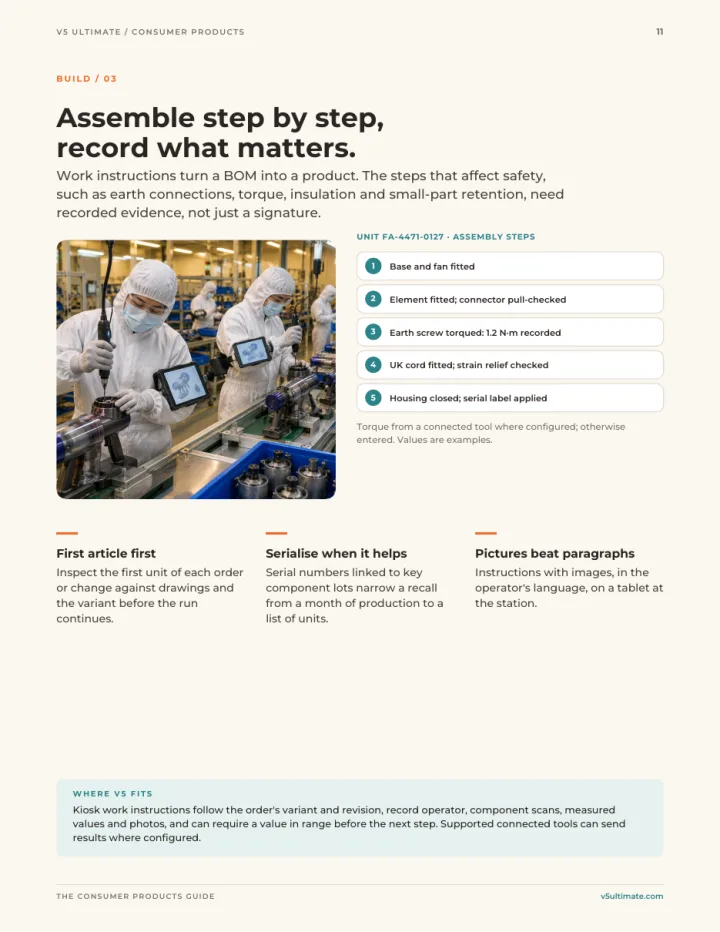
Operators follow released routing on the kiosk. Required inspection points enforced before the next station unlocks.
- 10:30·step 03In-process inspection
Photo evidence captured at the steps that matter. AQL sampling plan auto-applied to the lot.
- 13:00·step 04Prop 65 label
California-bound SKU? Prop 65 warning prints on the right artwork — never the wrong one.
Prop 65 - 15:00·step 05Retailer-ready export
GTIN, lot, manufacture date, country-of-origin — exported in the format the retailer asked for. No spreadsheet wrangling.
- When it matters·step 06Section 15 ready
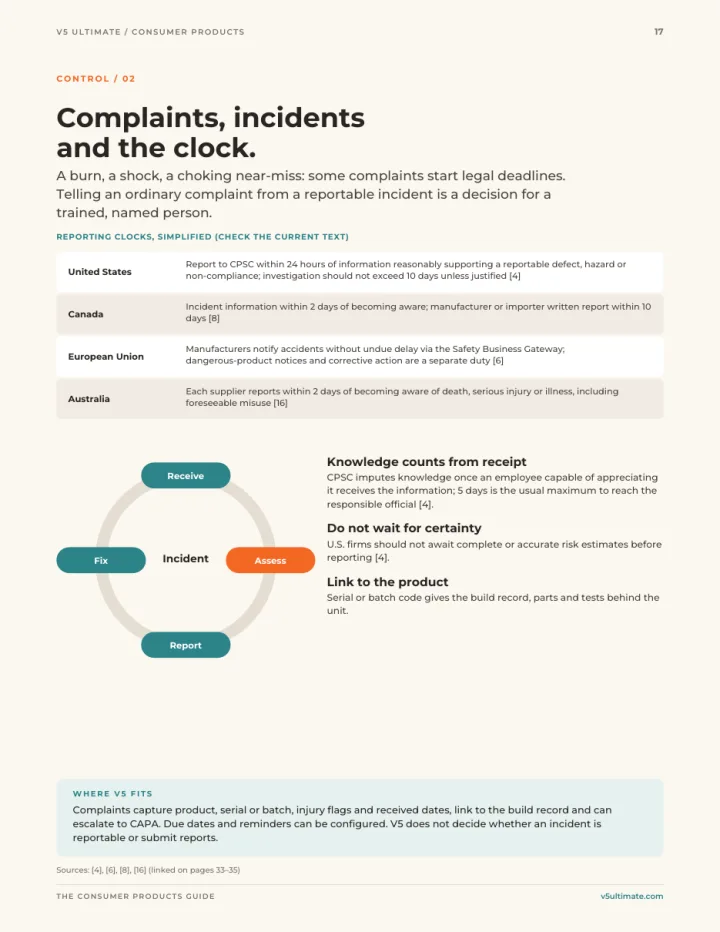
Substantial product hazard? V5 already has every unit, lot, and ship-to. Early-warning report in minutes, not weeks.
CPSA §15
The terms your auditor uses
- CPSC
- Consumer Product Safety Commission — US regulator for consumer goods.
- CPSIA / Section 102
- Children's products require third-party testing + tracking labels.
- CPC
- Children's Product Certificate — issued from your test results, required at import / sale.
- GCC
- General Certificate of Conformity — for non-children's regulated products.
- Prop 65
- California's chemical-warning label law — list updated yearly.
- AQL
- Acceptable Quality Level — sampling plan most retailers reference (ANSI/ASQ Z1.4).
Sound familiar? We built this for you.
Retailer chargebacks for label, lot, or pack issues — and no record to dispute them.
CPSC Section 15 reportable incidents surface weeks after the fact.
Prop 65 warning labels are inconsistent across SKUs and runs.
Component supplier changes don't propagate to the BOM in time.
The workflows you'd expect to see on day one.
Not a generic feature list — these are the specific consumer products workflows V5 ships configured for, ready to run on your batches.
Serialized assembly + BOM enforcement
Each unit gets a serial; BOM rev is locked to the work order — wrong-part swaps are physically blocked.
Functional & safety test capture
Pass/fail, deviations, and rework loops logged per serial — feeds product-safety reports.
Carton / case / pallet aggregation
Parent-child SSCC / GTIN hierarchy built at pack-out; recall scope by case or pallet.
Recall & CPSC reporting
Field issues linked to serials, lots, suppliers, and shifts — CPSC § 15(b) packet generated on demand.
Component supplier CoC tracking
Certificates of Conformance attached to inbound lots; expired or missing = receive block.
Line yield & rework dashboards
Real-time scrap, rework, and first-pass yield by station and shift.
The record assembles itself as the work happens.
No paperwork project at end of shift. No reconstruction at audit time. The evidence IS the workflow.
Retailer-ready export
Production records, lot codes, and inspection results exportable in retailer formats.
Section 15 early warning
Customer complaints and field returns aggregate against lots and surface trends quickly.
Prop 65 by SKU
Warning requirements and label versions tied to each SKU and channel.
Approved-supplier enforcement
Receiving rejects components from unapproved suppliers; BOM changes route through approval.
Paste your stack. See what V5 replaces vs keeps.
ERP, LIMS, MES, paper logs, spreadsheets — list what you run today and our AI returns an honest side-by-side: what V5 absorbs, what stays, and the realistic integration + retraining windows for Consumer Products.
Paste your current setup. See what V5 replaces — and what stays.
Honest side-by-side for consumer products operations. No form, no signup. Ask V5 names what V5 swaps out, what should stay, and what the switching risks actually are.
Be specific — naming the actual tools gets a sharper comparison.
What does V5 look like for your consumer products operation?
Tell us your scale and current stack. Get modules, rollout, compliance fit, and pricing band — pre-seeded for your industry.
Plain-English playbooks for Consumer Products regulations.
Structure, recurring inspection findings, and a practical 60-day path — written for QA, regulatory and operations leads.
Plain-English guide to ISO 22716 — Good Manufacturing Practices for cosmetics. EU Regulation 1223/2009 link, premises, production, laboratory, internal audits and the path to a clean inspection.
Plain-English guide to ISO 9001:2015 — the international QMS standard. Risk-based thinking, process approach, leadership and the path to a clean certification audit.
Plain-English guide to the Modernization of Cosmetics Regulation Act — facility registration, product listing, safety substantiation, adverse-event reporting, and GMPs for cosmetics sold in the US.
Spin up a workspace seeded for Consumer Products.
Default templates, validation rules, and report packs are pre-loaded for your industry. Run a real batch in under an hour.
Ask anything · No credit card · Onboard in days, not months