
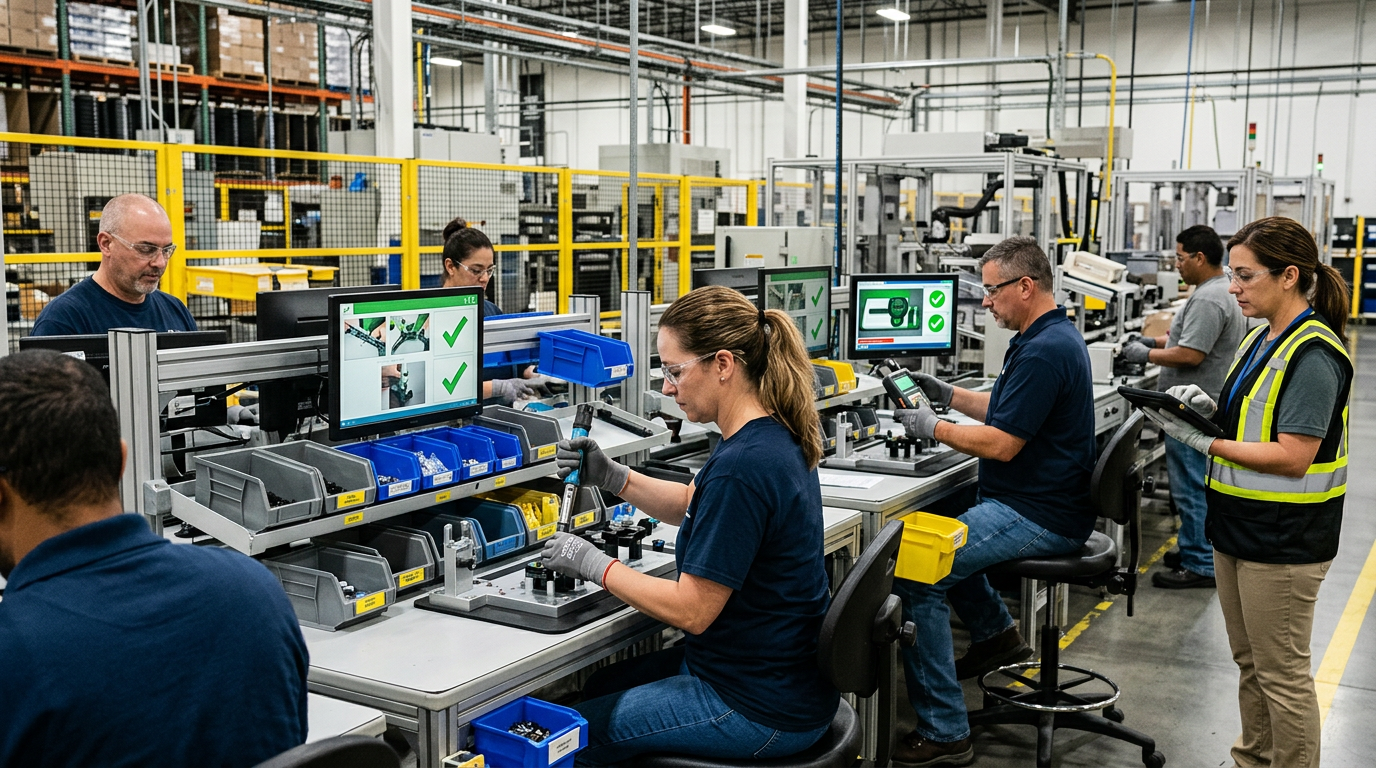
From component lot to retailer DC — one serialized Device History Record.
V5 Ultimate runs every step CPSC, EU GPSR 2023/988, UK GPSR, RoHS and Prop 65 care about — supplier + RoHS / REACH qualification at goods-in, eBOM under formal ECO control, kiosk-led assembly with smart-tool torque streams, serialized build, HiPot + drop + functional test in the LIMS, retail cartons with the current-rev GPSR / Prop 65 / GS1 Digital Link label, and serial-level trace to every retailer DC. The Device History Record builds itself as the operator works — and a retailer chargeback becomes a two-tap rebuttal, not a week of paperwork.
Built for CPSC reporting, Prop 65, and major retailer compliance programs.
The same DHR — seen the way you run the brand.
For a consumer brand or contract assembler, the small wins compound every build. Finance sees fewer retailer chargebacks. Operations sees the next campaign hit its promise date. QA sees a build record that CPSC, the EU GPSR Safety Business Gateway and the big-box retailer audit already recognise.
Retailer chargebacks defended in hours — not lost. Rework crushed by smart-tool torque envelopes. True cost per unit finally on the page.
- Per-build actual cost: components, sub-assemblies, labour, test time and rework — visible in $, today.
- Fewer paid chargebacks — the serial's DHR, retailer PO and shipment record rebut deductions in one PDF.
- Fewer rework loops from assembler errors caught at the workstation, not at final functional test.
- Most consumer brands and contract assemblers see V5 pay back inside year one on chargeback recovery alone.
From the supplier CoC to the retail carton — one serial-locked thread.
Follow one build. Every step below is a single screen in V5 — and the eBOM lockdown, ECO control, retailer program rules, GS1 Digital Link and calibration layer runs underneath them all.
Qualified supplier, current CoC + RoHS / REACH declaration reconciled to the approved part — before a component crosses the dock.
- CoC + RoHS 3 + REACH SVHC verified at receipt — no declaration, no goods-in.
- Part number, manufacturer, revision, IEC 62368-1 / UL / CE safety cert and country of origin checked against the approved AVL.
- Every reel, tray, tube and carton barcoded into ESD-safe stores with vendor lot and date-code.
- Contract assembly: brand-owner / co-man split explicit on every receipt so "who owns the serial" is never ambiguous.

The only build the line can run is the eBOM revision the ECO board has approved — silent BOM drift is physically impossible.
- eBOM lockdown — the kiosk only shows the current rev approved by ECO and refuses uncontrolled substitutions.
- Smart-tool torque, screw-count, press-fit force and cable-continuity results streamed straight to the serial's DHR.
- Kiosk-led work instructions with images, videos and poka-yoke — no paper build sheet at the station.
- Assembler hard-blocked from a workstation they are not qualified for — ISO 9001 training enforced at the tool.
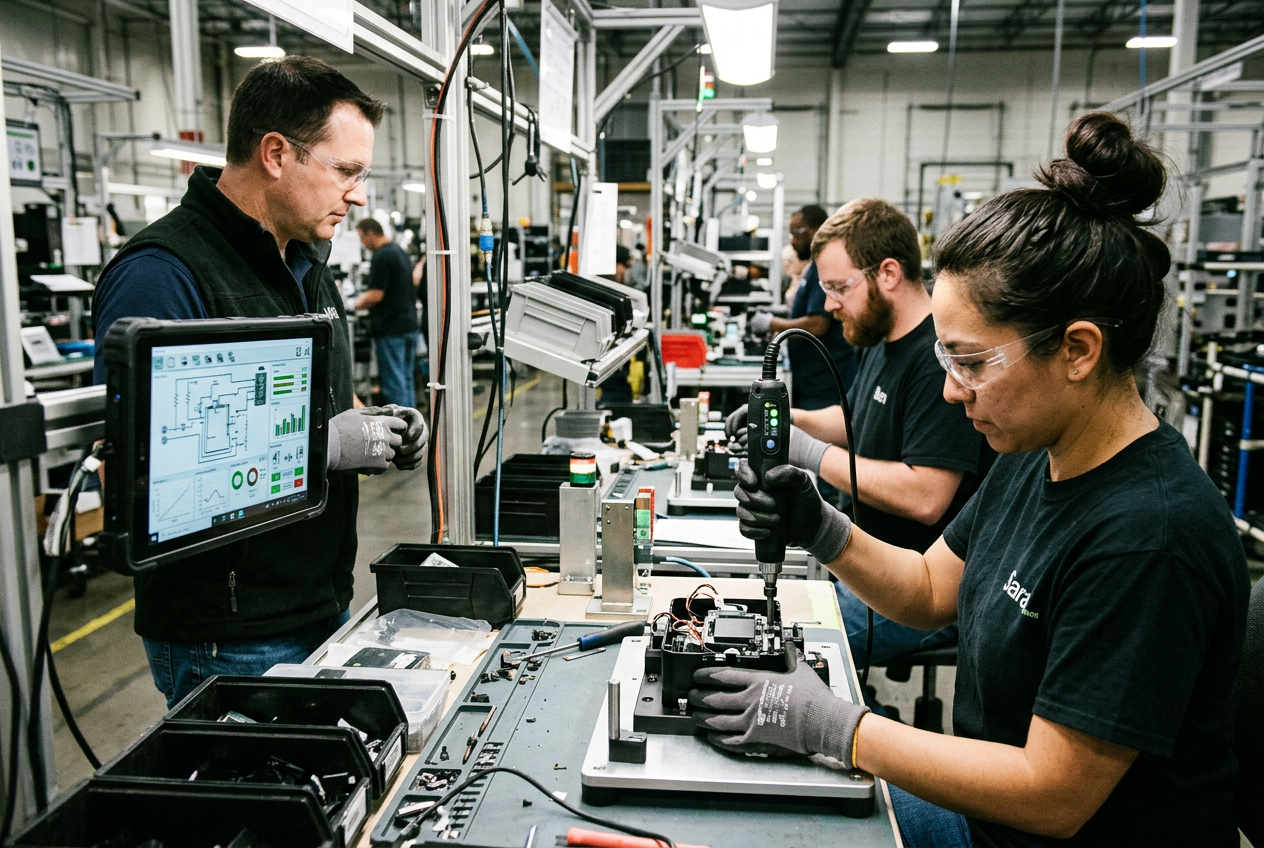
The serial can't ship until HiPot, functional and every method is green — and the reviewer sees every deviation in one place.
- IEC 62368-1 electrical safety and functional gates wired in — no green, no serial release.
- Instrument integration for HiPot testers, ground-bond, EMC pre-scan, drop rigs and ISTA packaging test — results straight to the DHR.
- Deviation / OOS linked to the affected serial, workstation and operator — no orphan events.
- Two-independent-signature release — one production, one QA — before the build leaves quarantine.

One built serial, one current-rev GPSR / Prop 65 / GS1 Digital Link carton — label rev = eBOM rev = ECO, at the printer.
- Serialized carton build with GS1 SGTIN / SSCC and GS1 Digital Link QR — one scan lands on the correct product passport.
- Current-rev GPSR / Prop 65 / retailer label pinned per SKU — the printer refuses a superseded revision.
- Vision inspection for GPSR pictograms, Responsible Economic Operator block, importer, Prop 65 warning and GS1 Digital Link decode.
- Cartoning, pallet build and retailer EDI (Walmart, Target, Costco, Amazon Vendor) reconciled to the released serial range before dispatch.

"If a motor lot was just flagged — which retailer DCs are exposed?"
Every pallet ships with retailer EDI, the current GPSR / Prop 65 label rev and a serial-range manifest tied to the released build. When a Section 15 incident, GPSR safety notification, supplier NCR or field return triggers a stop-sale, V5's serial + component tree paints the affected serial ranges and retailer DCs — forward from the build order and backward to every component, PCBA, motor and label rev that built it.
A CPSC Section 15 incident report lands on a countertop grinder — and the motor supplier simultaneously flags a winding defect in motor lot MOT-2255. V5 walks the tree — the exact serial range built from that lot, every retailer DC in the US, EU and UK, and every GPSR / RoHS / REACH declaration attached. Pull the lever.
Smart-tool calibration, press-fit PM and HiPot verification — on the same tablet as production.
- PM per smart driver, press-fit station, HiPot tester, cartoner and labeller.
- Calibration cycles per ISO/IEC 17025-traceable standards — torque analyzers, HiPot testers, force gauges, thermocouples.
- ESD floor, wrist-strap and heel-strap daily verification tied to the release calendar.
- Change-over sign-off and first-off inspection enforced before the next SKU loads.

Quality, CPSC and GPSR incident intake run through every build — not stapled to the record at the end.
- Incoming inspection per component, PCBA, motor, cable, plastic and pack — CoC + RoHS + REACH + safety cert match, AQL sample, identity.
- In-process gates — torque envelope, screw-count, HiPot, ground-bond, functional-test signature.
- Two-signature release — one production, one QA — can't be skipped before a serial range leaves quarantine.
- CPSC Section 15 early-warning: complaints + field returns aggregate against serial + component lots and surface a reportable trend inside the 24-hour clock.
- EU GPSR Safety Business Gateway + UK Product Safety Database drafts assembled from the same event — pre-populated, ready for the RE to submit.
- Retailer chargeback defence — Walmart, Target, Costco, Amazon Vendor deductions rebutted from the serial's DHR in one export.

Every quality feature in V5 — mapped to a CPSC / GPSR / RoHS brand.
The same platform that runs pharmaceuticals and medical devices — set up for the way a consumer brand or contract assembler actually kits, builds, tests, cartons, labels and releases a serialized product under CPSC 16 CFR, EU GPSR 2023/988, UK GPSR, RoHS, REACH, Prop 65, ISO 9001 and IEC 62368-1.
Incoming inspection & supplier qualification
Configurable per component, PCBA, motor, cable, plastic and pack. CoC + RoHS + REACH + safety-cert check, AQL sample plan computed from lot size; a failed identity or dimensional raises a hold automatically.
In-process gates & smart-tool streams
Scheduled QC checks — torque envelope, screw-count, press-fit force, cable-continuity, HiPot, ground-bond, functional-test signature. Limits enforced; OOS opens an investigation.
Two-signature release
Production + QA review-and-release before any serial range ships. Every gate signed with an identity-verified e-signature — identity + meaning captured.
Deviation, OOS & CPSC Section 15
One workflow from issue raised through root cause, action, verification and close. Linked to the affected serial, DHR, workstation, assembler and supplier — CPSC Section 15 24-hour clock and EU GPSR Safety Business Gateway routing built in.
eBOM, ECO & label lockdown
Electronic BOMs are immutable, rev-locked and tied to the current ECO. Current-rev GPSR / Prop 65 / retailer label pinned per SKU — the printer refuses a superseded revision, and the label rev equals the eBOM rev.
Supplier scorecards & re-qualification
On-time delivery, CoC quality, deviation rate, RoHS drift and audit findings rolled into a live supplier score. Expired qualifications block goods-in automatically.
Calibration & tool qualification
Smart torque drivers, HiPot testers, ground-bond, force gauges, thermocouples and torque analyzers on an ISO/IEC 17025-traceable calibration calendar — certificates attached, next-due enforced.
GS1 Digital Link & product passport
SGTIN + SSCC serialisation, GS1 Digital Link QR on every carton with the product passport / recall lookup URL, tied to each SKU and eBOM rev. Ready for the EU Digital Product Passport where in scope.
Retailer chargeback defence
Walmart Retail Link, Target POL, Costco IIS and Amazon Vendor Central deductions rebutted from the serial's DHR — the same PDF answers the retailer, the CPSC and the internal RCA.
Live on your smart tools, test rigs, cartoners and label printers — no rip-and-replace.
We connect at the level your engineers and QA expect — OPC UA, Modbus, MQTT, REST, EDI, file drops, SQL. Most consumer assemblers are live on day one with the drivers, testers, cartoners and labellers already in the plant.
Smart torque drivers & press-fit
OPC UA and Ethernet/IP links to Atlas Copco, Bosch Rexroth, Desoutter, Ingersoll Rand, Kolver, Mountz and Cleco. Torque, angle, screw-count and press-fit force logged straight to the serial.
HiPot, functional & EMC
Chroma, Hipotronics, Vitrek, Slaughter, Associated Research, Rohde & Schwarz. HiPot, ground-bond, insulation resistance and EMC pre-scan results wired to in-process gates.
Vision, marking & serialization
Cognex, Keyence, Omron vision; Videojet, Domino, Markem-Imaje, Zebra thermal-transfer and print-and-apply labellers. GS1 SGTIN + SSCC + Digital Link QR pinned per serial at the line.
Cartoners, case packers & palletizers
Bosch Packaging, Marchesini, IMA, Krones, Fuji cartoners and case packers; Fanuc, ABB and KUKA palletising cells. Pack reconciled to the released serial range before dispatch.
ERP, PLM, MES & retailer EDI
SAP, NetSuite, Microsoft Dynamics 365, Oracle, Infor; PTC Windchill, Siemens Teamcenter, Arena PLM. Walmart Retail Link, Target POL, Costco IIS, Amazon Vendor Central EDI wired to released serials.
BI & data warehouse
Power BI, Tableau, Looker, Snowflake, Databricks. Direct SQL access to your tenant — your data, your queries, your validated reports.
CPSC 16 CFR, EU GPSR 2023/988, RoHS, REACH, Prop 65, ISO 9001 & IEC 62368-1 — at the data layer.
The records build themselves as the build is executed. When the CPSC investigator, EU Market Surveillance Authority or big-box retailer auditor walks in, the evidence pack is one click — not a week of re-assembly.
Fixed-price, named team, one product family live before you pay for the next.
- Week 1–4·step 01Discovery & floor scan
We walk one product family with your team — eBOMs, work instructions, assembly cells, HiPot / functional methods, GPSR / Prop 65 / retailer label library, ECO board, existing ERP + PLM fields. Out: a fixed scope and price.
- Week 5–9·step 02Configure & integrate
Item master, eBOMs, in-process gates, LIMS methods (IEC 62368-1 / IEC 60068 / ISTA), GPSR / Prop 65 label library, retailer EDI, smart-tool / test-rig / labeller integrations and ERP + PLM feeds loaded. IQ / OQ on the bench.
- Week 10–13·step 03PQ, pilot & train
One product family live in pilot. Three-shift assembler training on the floor with the actual UI — not slides. PQ and UAT signed by QA, RE and operations.
- Week 14–16·step 04Go live & hyper-care
Cut over. Two weeks of hyper-care with your named delivery team on-site. KPIs published on the wall before we leave.
The first six questions on every consumer products RFP.
How does V5 keep the plant aligned with the approved eBOM and ECO?
How does V5 handle CPSC Section 15 early-warning and reportable incidents?
How does V5 defend retailer chargebacks from Walmart, Target, Costco and Amazon?
Will V5 talk to our smart tools, HiPot testers, cartoners and labellers?
We're a contract assembler with multiple brand-owners on one site — how does V5 keep them separate?
What about IT — ISO 9001, IEC 62368-1, SOC 2, validated change control?
Book a 30-minute walkthrough with a consumer products specialist.
We'll show a live self-building eDHR, eBOM lockdown under ECO control, smart-tool torque streaming, HiPot + functional test in the LIMS, current-rev GPSR / Prop 65 / GS1 Digital Link carton print at the packaging line, two-signature release, a retailer chargeback rebuttal export and a mock CPSC Section 15 traceback — on a workspace seeded for a working consumer products site.
Fixed-price go-live · No platform lock-in · Onboard in 10–16 weeks