
Record what went wrong while the facts are fresh.
Capture the problem at the step, against the work order and lot, with evidence attached. A person records cause and impact.
7-day free trial, no card required. Deviation records are in Professional and Enterprise. Every plan records checks at the step and has a QA review queue.

Facts captured on the spot.
The operator records what happened at the step, linked to the work order, lot and photos.
Product protected while you look.
The affected lot can be put on hold, so it waits for a person's decision.
From cause to corrective action.
The responsible person records cause and impact and can raise a CAPA that keeps the link.
Follow one deviation
Raise it where it happened
Try it: the operator scans an older label roll. Raise the deviation, then record containment.
- Lot L-5120
- On hold
- Labelled so far
- 0 units · stopped at set-up
- Rev B rolls
- Removed · quarantined
- Quality notified
- 06:44
Nothing is held until someone records it.
Worked example. The AI class suggestion (Professional and Enterprise) is a draft a person confirms.
How deviations work: capture, hold, investigation and CAPA
Tap a step below to see what happens.Choose a step below to see what happens.
Step 1 of 4
- What happenedLabel rev B loaded; rev C required
- Recorded byOperator J. Okafor · 06:42
- LinkedWO-5120 · Step 2 · lot L-5120
- ReferenceDEV-1104
Work order, step, lot, person and time are filled in from where it was raised.
Recorded at the step, by who saw it
- Raise it from the step on the shop-floor screen. The work order, step, lot, person and time are filled in for you.
- Write what happened in plain words and attach a photo or note while you are still at the line.
Checks at the step are in every plan. Linked deviation records need Professional or Enterprise.
More on record: full record and set-up
Also on this record
- Photo
- Label roll attached
Deviations can also start from receiving, a complaint or an audit finding, not only from the line.
- Fields
- Which fields a deviation has follows your procedures and workspace set-up. This example is fictional.
- Opened automatically?
- Not claimed here. Whether an event prompts a deviation depends on your configuration; confirm it with us.
- AI first draft
- Where enabled, AI can suggest a description from the recorded step data for the operator to edit. Professional and Enterprise.
Quality Management Buyer Guide
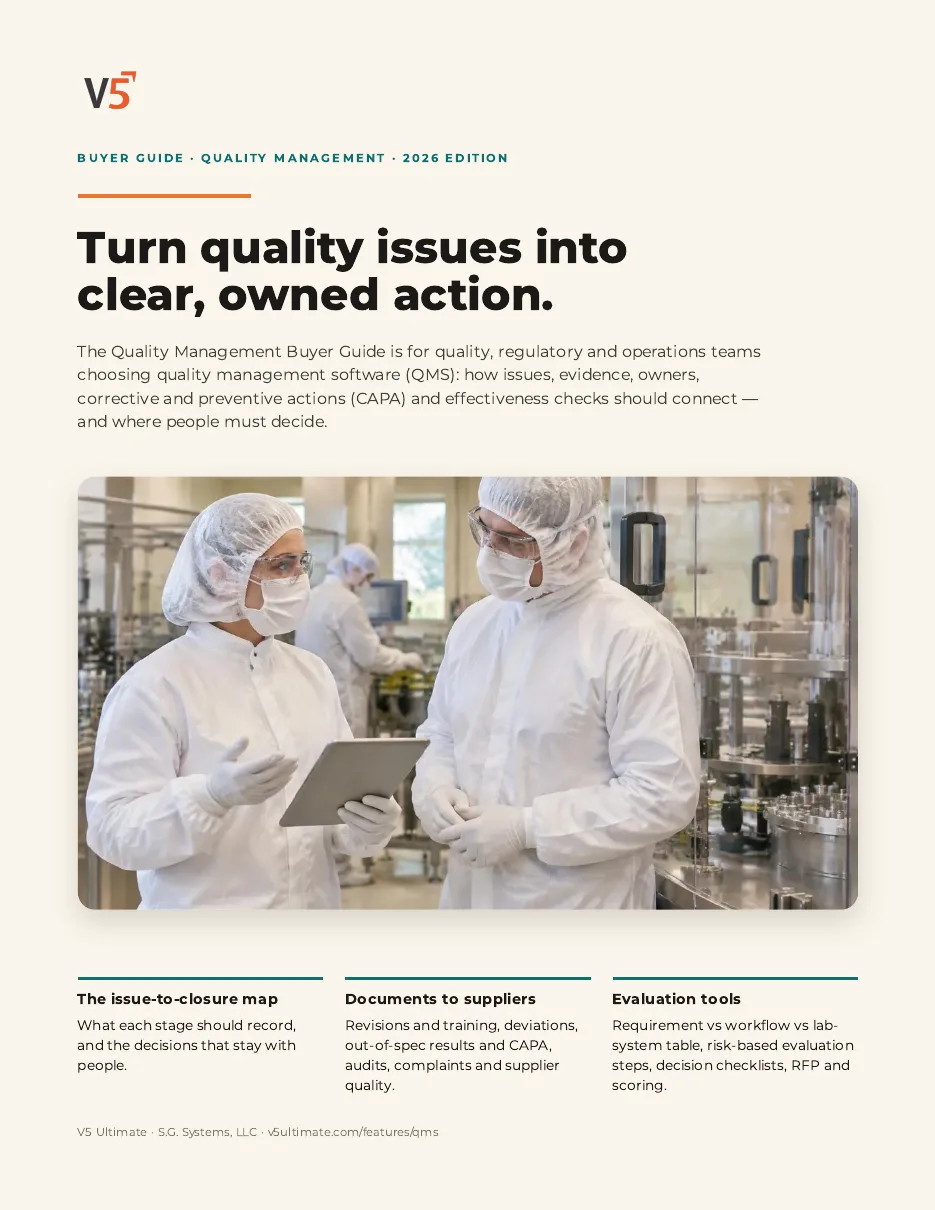
For quality, regulatory and operations teams choosing quality management software. Use it with or without V5.
- 1Know what a usable deviation record holds.
- 2Follow an issue to a person's closure.
- 3Test deviation handling with one of your events.
See what's inside
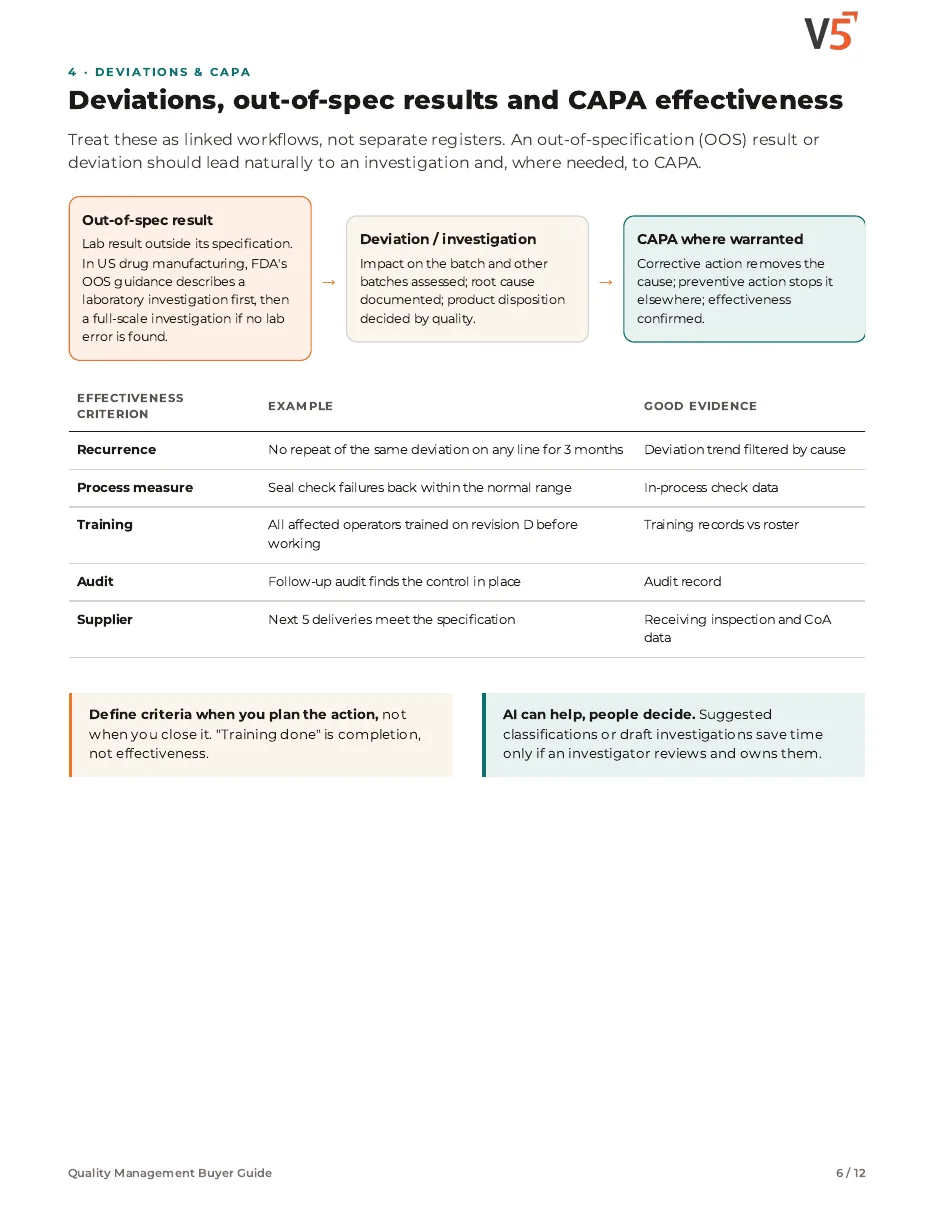
- What a usable deviation record holds, and how out-of-spec results and CAPA effectiveness checks connect to it.
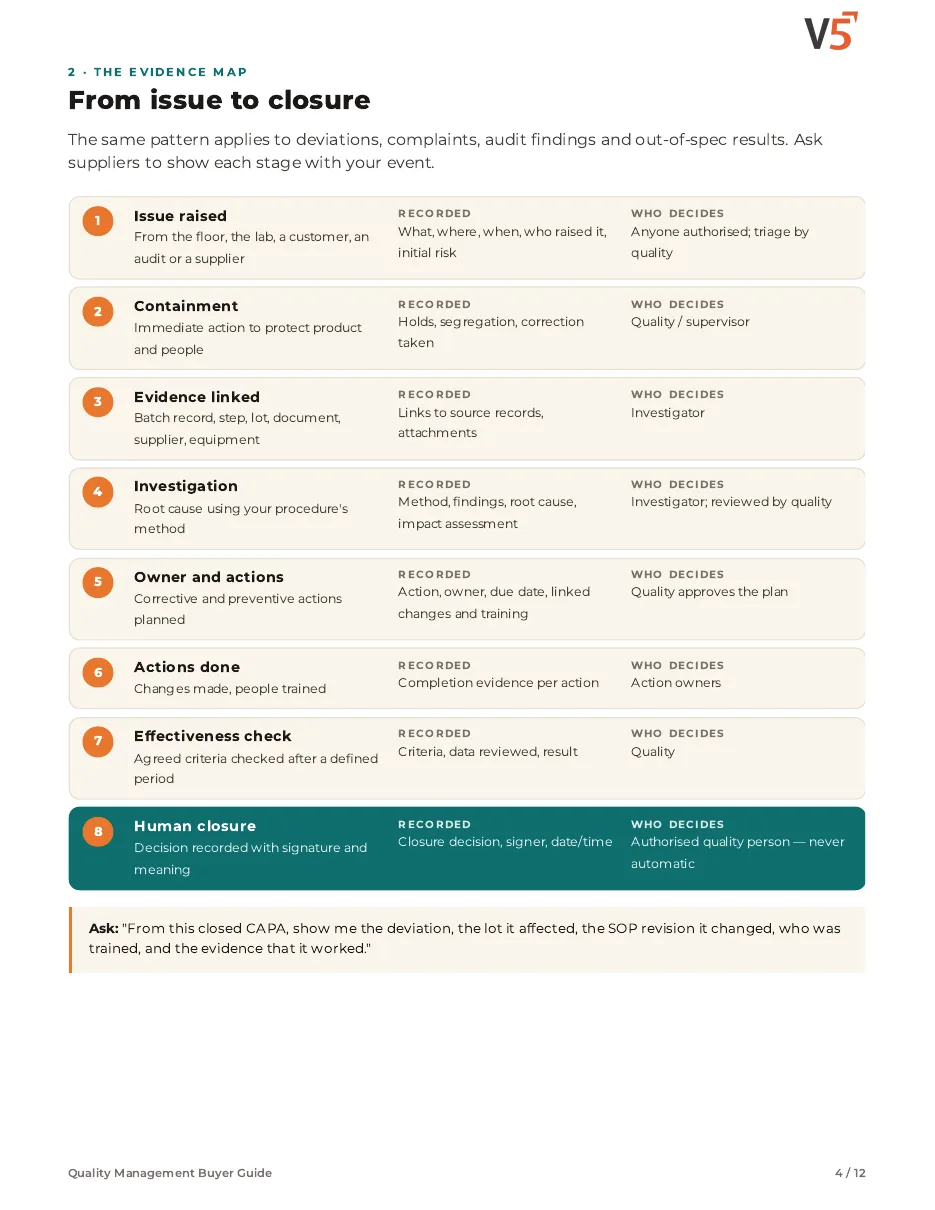
- An eight-stage map from issue raised to human closure, with the evidence and owner at each stage.
- Decision checklists, RFP questions and a scored sheet to test deviation handling with one of your own events.
Chapters: why quality systems stall · from issue to closure · documents, revisions and training · deviations, out-of-spec results and CAPA effectiveness · audits, complaints, supplier quality and traceability · requirement, workflow or lab system · risk-based evaluation and validation · decision checklists and RFP questions · scored evaluation · where V5 fits and sources.
We ask for your name and email so we can handle this request. The PDF downloads in your browser. Privacy policy
One record from the line to the fix
Deviations link to the work order, lot, CAPA and release review, so nobody re-keys the facts and the reviewer sees the whole story.
What's included
Everything below is about deviations and what connects to them. Each item says which plan it needs. Compare plans
Recording and containing
Capture the facts at the source and stop the problem spreading.
Checks at the step · QA review queue · Deviation management
Explore recording
Recording and containing
Capture the facts at the source and stop the problem spreading.
Checks at the step · QA review queue · Deviation management
- Checks at the stepResults recorded against limits and flagged when outside.
- QA review queueCompleted work waits for a person to review it.
- Deviation managementProfessional and EnterpriseLinked to work order, step and lot, with holds and approvals.
- SMS notificationsText alerts for deviations and releases.
- Routed notificationsProfessional and EnterpriseEmail and SMS triggers with escalation and a delivery record.
Investigating and closing
People decide the cause; V5 keeps the evidence and the history.
AI deviation triage · Audit-trail explainer · CAPA
Explore investigation
Investigating and closing
People decide the cause; V5 keeps the evidence and the history.
AI deviation triage · Audit-trail explainer · CAPA
- AI deviation triageProfessional and EnterpriseSuggests a classification, a CAPA and a draft investigation for a person to confirm.
- Audit-trail explainerProfessional and EnterpriseAsk why something happened; answered from recorded history.
- CAPAProfessional and EnterpriseRoot cause, actions with owners and due dates, effectiveness checks.
- Electronic signaturesProfessional and EnterpriseSignatures with meaning, designed for 21 CFR Part 11.
- Tamper-evident audit trailProfessional and EnterpriseDesigned for ALCOA+ data integrity.
- Risk managementEnterpriseFMEA and ICH Q9-aligned assessments.
Causes, classifications and closure are recorded by people under your procedures. V5 supports your quality system; it does not by itself make you compliant or validated.
Try it with one of your own deviations.
Start your free trialOr (you can edit the question before sending) or .