
See the yield gap when the job completes, not at month end.
The finished quantity is recorded at completion, so the gap between what went in and what came out shows on the work order.
7-day free trial, no card required. Work orders and completion are in every plan. Cost/COGS and variance are in Professional and Enterprise. AI yield forecasting is coming soon.

Follow one completed job
Work order WO-5502 should make 500 units. Four stages from completion to follow-up.
Yield against the band your team set
Try it: change the finished quantity and see where the difference sits.
- Recorded scrap6 kg
- Samples2 kg
- Unexplained10 kg
Bands are set by your people. V5 shows the difference; people investigate the cause.
Explore the details: every stage, with limits and set-up notes
Tap a step below to see what happens.Choose a step below to see what happens.
Step 1 of 4
- Theoretical500 units
- Made492 units
- Packed good470 units
- Rejects22 · recorded
Entered when the job completes.
Finished quantity at completion
- The finished quantity is recorded at completion.
- Consumption is worked out from the recipe.
Figures are only as good as what's recorded on the floor.
More on complete: full record and set-up
Also on this record
- Consumption
- From recipe
Rejects are recorded with the job.
- Example
- Figures match the worked example in the yield worksheet.
Yield between production and cost
Production records the output, yield shows the gap, and cost puts a value on it.
What's included
What yield variance uses, and which plan each item needs. Compare plans
Yield
Completion, yield, difference.
Work orders, blending, packaging · Inventory, receiving and dispense · Cost/COGS & variance
Explore yield variance
Yield
Completion, yield, difference.
Work orders, blending, packaging · Inventory, receiving and dispense · Cost/COGS & variance
- Work orders, blending, packagingCompletion and consumption.
- Inventory, receiving and dispenseDispensed per lot.
- Cost/COGS & varianceProfessional and EnterpriseStandard vs actual.
- Deviation managementProfessional and EnterpriseFollow-up when needed.
AI demand and yield forecasting: coming soon, not available today. People set yield bands and investigate differences.
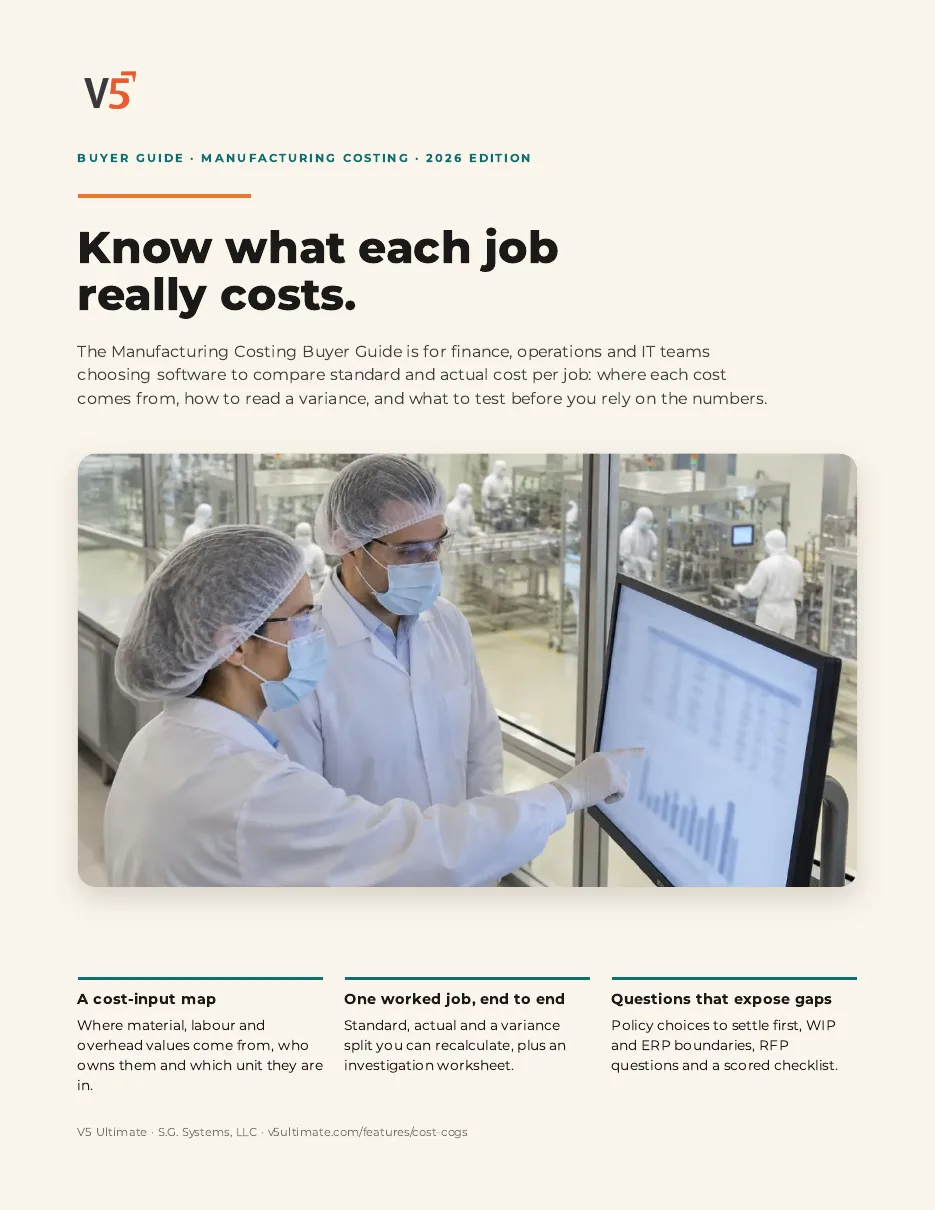
Manufacturing Costing Buyer Guide
For finance, operations and plant teams comparing planned and actual job cost, including yield and usage variance. Use it with or without V5.
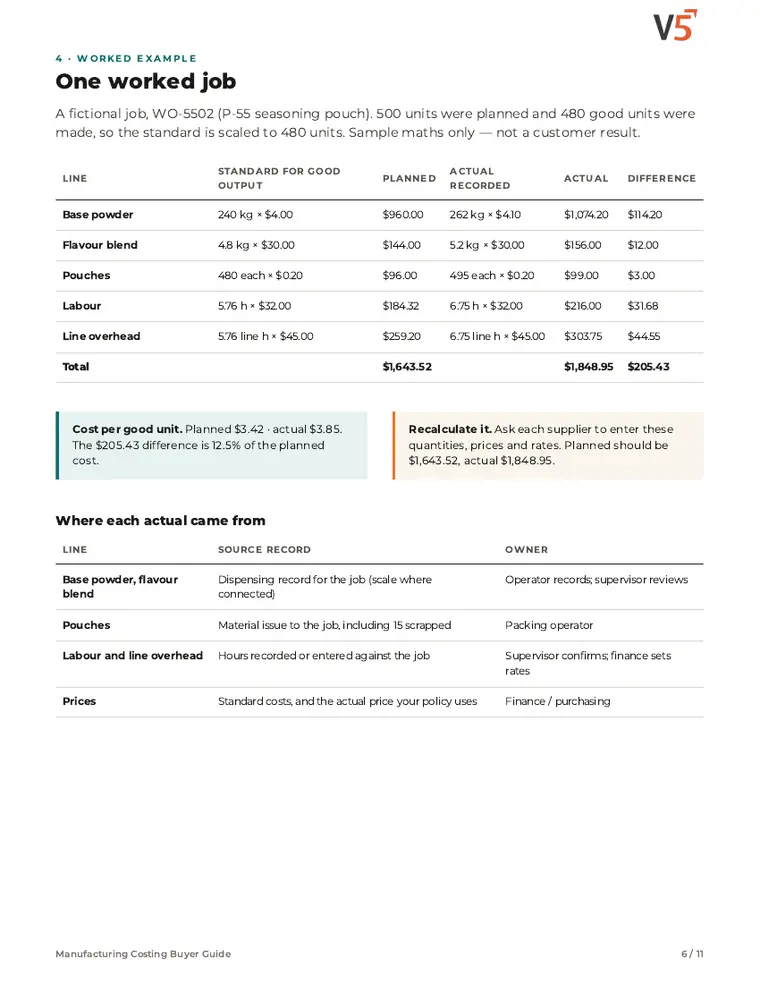
- 1Work through one job, 480 of 500.
- 2Split usage from price.
- 3A person decides the cause.
See what's inside
- The cost-input map
- Units, conversions and standard versus actual
- One worked job: 500 planned, 480 good
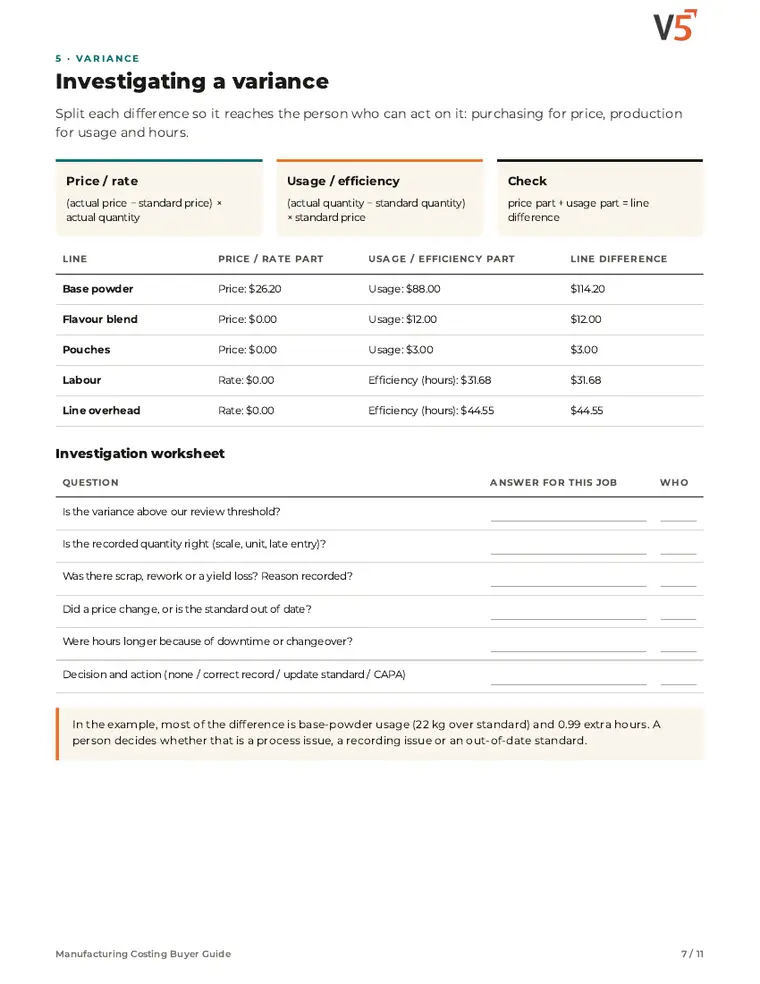
- Investigating a variance
- Labour and overhead policy choices
- WIP, period close and your ERP
- RFP questions and scored checklist
Chapters: why job costs go wrong · cost-input map · units and standard versus actual · one worked job · investigating a variance · labour and overhead · WIP, period close and ERP · RFP and scored checklist · where V5 fits and sources.
We ask for your name and email so we can handle this request. The PDF downloads in your browser. Privacy policy
Try it with one of your own completed jobs.
Start your free trialOr (you can edit the question before sending) or .