V5 Ultimate
Specialty & Industrial Chemicals · How V5 Runs

How V5 Ultimate runs a specialty chemical plant, end to end.

Eleven REACH / TSCA / OSHA-regulated touchpoints — substance qualification to customer recall — sharing one immutable ledger. Mapped to EU REACH, EU CLP, US TSCA, OSHA PSM / HazCom, DOT 49 CFR, ATEX, RCRA, ISO 9001 / 14001 / 45001 and 21 CFR Part 11.

Start free trial
REACHCLPTSCAOSHA PSMGHS Rev. 10DOT 49 CFRRCRAATEXISO 9001/14001/4500121 CFR Part 11
ONE IMMUTABLE LEDGERREACH · CLP · TSCA · OSHA PSM / HazCom · DOT · ATEX · RCRA · ISO 9001 / 14001 / 45001 · Part 1101SupplierREACH / TSCA file02ReceiveSDS + DOT verify03Recipe lockSDS-bound label04React / fillkiosk + PSM05QC releasevs limits06Label / packCLP / GHS = SDS07Shiprestriction gatesThe evidence chainEvery action signs the ledger — nothing is re-keyed at the end.
Executive summary

One ledger, every touchpoint — substance qualification to customer recall in seconds.

V5 Ultimate runs a specialty chemical plant as one connected system. SDS-bound recipes, kiosk-led charge / react / fill with live in-process assay vs. limits, REACH / TSCA / CLP-aware labelling, PSM where applicable, ATEX zone enforcement, RCRA / NPDES / Title V scheduling, and the full ISO 9001 / 14001 / 45001 shell all write to the same immutable, identity-verified ledger.

The pay-off is operational: batch records reviewed by exception in 20–30 min instead of 3 hours, OSHA / EPA / ECHA inspections supported as queries, and a recall — or a REACH Article 22 re-classification — that resolves as a query, forward and backward from any node.

This playbook walks you through 11 touchpoints and the 18 quality- / EHS- / process-safety-system modules that wrap them, grouped into 8 readable parts.

11
Substance touchpoints
8
Thematic parts
30+
Regulatory anchors
Part I

Foundations

Why substance compliance + SDS/label parity is the spine, and the ten-node map.

01

Why substance compliance is the product

A specialty chemical isn't just a recipe. It's a registered substance, a current SDS, a CLP / GHS label revision, a TSCA status, and a DOT classification — all bound to the drum that ships.

Floor actionscan · weigh · e-sigactor + tsSTEP 01Append-only rowDB trigger writes oncesha256STEP 02Batch production record snapshotfrozen at releaseWO boundSTEP 03PDF renderfrom snapshot onlydeterministicSTEP 04Inspector packexported on demand21 CFR 11STEP 05ALCOA+ lineageAttributable · Legible · Contemporaneous · Original · Accurate · + Complete · Consistent · Enduring · AvailableOne origin event. No re-keying. No reconciliation.
ALCOA+ in one picture: one origin event, replayable downstream.

Under EU REACH every substance ≥1 t/y manufactured or imported must be registered with ECHA; CLP (1272/2008, aligned to GHS Rev. 10) governs the classification, labelling and packaging that flows from that registration. Under US TSCA every chemical substance in US commerce must be on the TSCA Inventory or covered by an exemption / PMN; new substances trigger §5 PMN review. Where OSHA-listed highly hazardous chemicals exceed threshold quantities, OSHA PSM 29 CFR 1910.119 applies — 14 elements, including Process Hazard Analyses, Management of Change, Mechanical Integrity, and Pre-Startup Safety Review.

The hazards that drive enforcement are unambiguous: the drum that ships does not match the SDS revision in force on the fill date; the CLP / GHS label is one revision stale; the substance is shipped into a jurisdiction where it isn't registered or is on a restricted list (REACH Annex XIV authorisation, REACH Annex XVII restriction, TSCA §6 risk-management rule); a covered PSM process changes without an MOC.

V5 Ultimate treats every receipt, every reactor batch, every fill, every SDS issuance and every label print as part of the same immutable ledger. SDS revision = label revision = lot. Substance status is a property of the lot, not a quarterly customer-service exercise.

Regulatory anchors
  • EU REACH 1907/2006Registration, Evaluation, Authorisation and Restriction of Chemicals
  • EU CLP 1272/2008Classification, Labelling and Packaging (GHS-aligned)
  • US TSCAToxic Substances Control Act — Inventory, PMN, §6 rules
  • OSHA 29 CFR 1910.119Process Safety Management of Highly Hazardous Chemicals
02

The end-to-end chain at a glance

Ten touchpoints, one record. Every node writes to the same immutable ledger.

  1. 01
    Supplier
  2. 02
    Receive
  3. 03
    Warehouse
  4. 04
    Recipe lock
  5. 05
    WO release
  6. 06
    Charge / react
  7. 07
    QC release
  8. 08
    Deviation / MOC
  9. 09
    Pack + label
  10. 10
    QA release
One immutable ledger underneath. Every node writes; nothing is re-keyed.

Every node carries forward supplier lot, substance CAS / EC number, REACH dossier / TSCA Inventory status, GHS hazard class, reactor batch, intermediate lot, operator, equipment and packaging context from the node before it. Nothing is re-keyed.

Part II

Materials in

Supplier qualification with REACH/TSCA file, receiving with SDS, hazard-segregated storage.

03

Touchpoint 1 — Supplier and substance qualification

A supplier is a substance source. The same CAS number from a different source can have a different impurity profile and a different registration.

Each substance × supplier pair is qualified with: CAS / EC / UFI, current SDS (with revision date), REACH registration / dossier number or downstream-user evidence, TSCA Inventory status (active / inactive / §6 / §5 SNUR), RoHS / Prop 65 / SVHC status, and the impurity profile. Substituting a supplier of a regulated substance is treated as a controlled change — V5 holds the approved-source list per recipe and blocks goods-in from any other source unless the change is signed off.

Re-qualification is calendar-driven through the supplier portal. SDS revisions are pulled and diffed automatically; a material classification change opens a CAPA.

  • Approved-source list locked to recipe
  • REACH dossier / TSCA Inventory status held as structured fields
  • SDS revision drift auto-detected and routed
  • Supplier scorecard drives incoming-inspection depth
Regulatory anchors
  • REACH Title IIRegistration of substances
  • TSCA §8(b)TSCA Inventory — substances in US commerce
  • ISO 9001:2015 §8.4Control of externally provided processes
04

Touchpoint 2 — Receiving with SDS check and DOT verification

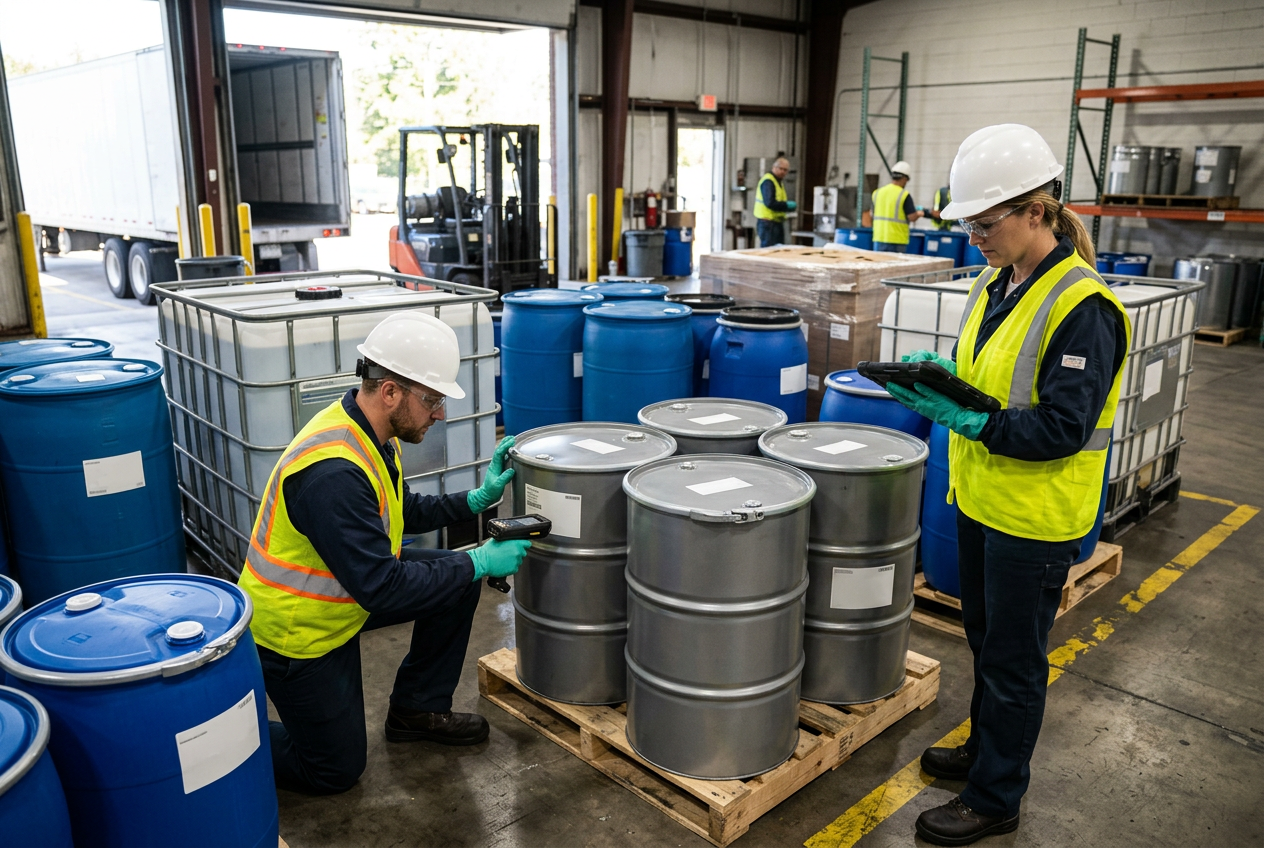
Every drum, IBC, ISO-tank and rail-car: weighed, scanned, SDS-checked, GHS-classified, DOT-verified.

The receiver scans the BOL and the supplier label, weighs against PO, checks SDS revision against the file on record, captures the GHS pictograms / signal word, validates the DOT shipping name / UN number / packing group against expected, photographs the seal, records the supplier lot and CoA. V5 mints a goods-receipt lot ID at that moment. Identity testing (FTIR / GC / HPLC / Karl Fischer / titrimetric per recipe) runs on the same kiosk and binds to the receipt lot.

Whether the lot is auto-released to inventory or held depends on the recipe's incoming-material plan — not a blanket pharma-style quarantine. A high-risk substance, a new supplier, an off-spec CoA, or an SDS revision change pushes the lot into Hold; a routine receipt from a qualified source releases on identity verification.

  • Goods-receipt lot ID minted at the dock
  • SDS revision auto-checked — drift opens a CAPA
  • DOT shipping name + UN # + PG validated against receipt expectation
  • Hold rule is per recipe × supplier, not a blanket quarantine
Regulatory anchors
  • OSHA 29 CFR 1910.1200(g)Safety Data Sheets — receipt and maintenance
  • 49 CFR 172DOT hazmat communication — shipping name, UN, PG
05

Touchpoint 3 — Hazard-segregated warehouse

Bins are zones with GHS hazard class, segregation distance, secondary containment, temperature band and release status.

V5 maintains bin attributes: hazard class (oxidiser, flammable, corrosive, water-reactive, peroxide-forming), DOT segregation table compatibility, secondary containment, ATEX zone where applicable, temperature band, and food-contact / non-food-contact status. The pick list shown to the picker only includes bins compatible with the work order. FEFO is enforced where time-bound (peroxide-formers, monomers with inhibitor decay); overrides require reason + dual e-sig.

  • Pick list filtered by DOT segregation and GHS class
  • ATEX zone surfaced to the picker where applicable
  • Inhibitor / peroxide-former expiry enforced
  • Parent/child lot genealogy through every charge, react and fill
Regulatory anchors
  • 29 CFR 1910.106Flammable liquids — storage
  • 49 CFR 173DOT hazmat packaging and segregation
  • ATEX 1999/92/ECWorker protection from explosive atmospheres
Part III

Reaction & formulation

Approved recipe lock, work-order snapshot, kiosk-led charge/react/filter/fill.

06

Touchpoint 4 — Controlled recipe = the registered substance

The recipe isn't a process card. It is the bound link between the substance you ship, the CLP / GHS label, the SDS revision, and the customer Declaration of Conformity.

Each recipe holds: substance identity (CAS / EC / UFI), the approved BOM with substance × source × impurity profile, reactor routing with step-by-step instructions, in-process control plan (assay, water, colour, viscosity, NCO%, acid value, residual monomer, particle size), packaging routing, container and closure spec, locked label artwork bound to the SDS revision in force, and DOT shipping classification.

Effectivity is two-signature: the formulator signs the change, the regulatory-affairs lead signs that the change is consistent with the registration (REACH tonnage band / SDS / CLP, TSCA Inventory, §6 / §5 SNUR). New work orders pick up the new revision; in-flight work orders keep the snapshot they were released against.

  • Recipe limits — assay outside limits = mandatory hold
  • Label artwork version locked to SDS revision
  • DOT shipping classification on the recipe, not the shipping desk
  • Container / closure spec bound to the SKU
Regulatory anchors
  • REACH Annex VIInformation requirements for registration
  • CLP 1272/2008Classification → label content
  • TSCA §5 (PMN)New substance pre-manufacture notification
07

Touchpoint 5 — Work-order release as a snapshot

Releasing a work order takes a sha256-hashed snapshot of the recipe, SDS revision and label artwork. From that moment the batch carries its own copy — frozen forever.

Recipe / substance bill of materials v3.2BOM · Routing · IPCSpec · LabelEFFECTIVE · 2-SIGSNAPon releaseWO-2026-0418Bound to Recipe / substance bill of materials v3.2Frozen at releaseRELEASED · sha256:a4f9…runs even ifRecipe / substance bill of materials revisesBatch production record (this batch)Filled by kiosk+ IPC + dev + sigsIMMUTABLERecipe / substance bill of materials v3.3 (later revision)does NOT affect WO-2026-0418
The WO carries a frozen copy of Recipe / substance bill of materials v3.2. Later revisions don't disturb this batch.

If the SDS or label is revised mid-shift, the work order keeps the snapshot it was released against. The auditor sees exactly the recipe, SDS revision, label and DOT classification this batch was built to.

Regulatory anchors
  • ISO 9001:2015 §8.5.6Control of changes
  • 21 CFR Part 11Where electronic records are used for these records
08

Touchpoint 6 — Kiosk-led charge, react, filter, fill

The kiosk is the floor's single pane of glass. Every charge, every reactor reading, every closure verification is signed and timestamped.

Charge is verified against the scale / flow / mass-flow-meter stream — high-hazard substances are dual-witness where SOP requires. The reactor step shows the target setpoints (temperature ramp, hold, vacuum, jacket, agitation) and the live in-process assay; out-of-limits trips a deviation. The fill step shows the container, the closure, the GHS label SKU + revision and the lot code. Mis-pick of closure or label hard-stops the line.

PPE display at the kiosk is driven by the SDS — operators see the required PPE, ventilation, eye-wash distance and emergency-shower distance before the step opens.

  • Scale / flow / mass-flow charge — no key-in for actives
  • Live in-process assay vs. recipe limits
  • Closure + GHS label + SDS revision validated at the kiosk before fill
  • PPE surfaced from the current SDS — never from a paper SOP
Regulatory anchors
  • OSHA 29 CFR 1910.1200Hazard Communication Standard (GHS)
  • OSHA 29 CFR 1910.132PPE — general requirements
09

Touchpoint 7 — In-process and finished-product QC

Sampling plans run on a schedule, not a reminder. Results flow back to the same work order automatically.

Assay (GC / HPLC / titrimetric / FTIR), water (Karl Fischer), residual monomer, NCO% / acid value / hydroxyl value, viscosity, density, colour (Gardner / Hazen / Pt-Co), particle size, container-closure integrity — all scheduled by the work order. OOS auto-opens a deviation, holds the lot, notifies QA. Retain samples are scheduled per recipe rules.

Regulatory anchors
  • ISO 9001:2015 §8.6Release of products
  • ISO 17025Where in-house lab is accredited
Part IV

Quality events

OOS, deviations, customer complaints, release-from-quarantine — one queue.

10

Touchpoint 8 — Deviations, OOS, complaints and CAPA in one queue

Every event lands in the same queue — OOS assay, off-spec viscosity, label misprint, customer complaint, environmental release.

A single register categorises by event type and severity. Customer complaints carry substance / CAS, lot, application context, observed defect, and route to the regulatory-affairs lead where the complaint suggests an SDS / label classification gap (REACH Annex VI re-classification, CLP change). CAPAs link to the deviation, affected lots, operators, equipment, complaints and the change-control workspace where indicated.

Regulatory anchors
  • ISO 9001:2015 §10.2Nonconformity and corrective action
  • REACH Article 22Update of registration on classification change
Part V

Pack to customer

GHS label = SDS revision in force, DOT-correct packaging, REACH/TSCA status per lot.

11

Touchpoint 9 — GHS / CLP label = SDS revision = lot

The label that goes on the drum is the CLP / GHS label generated from the SDS revision in force on the fill date — never from a Word document.

Each SKU carries: GHS pictograms, signal word, H-statements, P-statements, supplier identification, UFI (where required), net contents, batch code, REACH registration number, DOT / IMDG / IATA shipping description. V5 carries those fields from the recipe through to the printed label and the shipping documents — no manual artwork edits at packaging.

Distribution gates by jurisdiction: REACH Annex XIV authorisation, REACH Annex XVII restriction, TSCA §6 risk-management rule, US-state-specific (Prop 65) — if the destination has a restriction for this substance × use, the shipment cannot release.

  • GHS pictograms / H / P statements driven from the SDS
  • REACH UFI on every consumer-facing mixture
  • Restricted-substance distribution blocked at shipment
  • Shipping description (UN / PG / class) generated from the recipe
Regulatory anchors
  • CLP 1272/2008 Annex IClassification and labelling — content
  • REACH Annex XIV/XVIIAuthorisation / restriction lists
  • 49 CFR 172DOT communication — shipping papers + label
12

Touchpoint 10 — QA release with review-by-exception

QA reviews the exceptions, not the entire batch record. The ledger already proves the routine steps happened.

V5's batch record is built from the ledger as the line runs. The QA reviewer's queue surfaces only items the system can't auto-clear: OOS, deviations, PPE / training flags, label or SDS revision exceptions. Release requires two qualified e-signatures, both identity-verified, both bound to the snapshot.

Regulatory anchors
  • ISO 9001:2015 §8.6Release of products and services
  • 21 CFR Part 11.50/70Signed records, signature-to-record linking
13

Touchpoint 11 — Distribution, customer DoC, recall in seconds

Recall is a query, not a project. Forward from a substance lot, backward from a customer drum.

Recall / withdrawal lookback timelineFrom trigger to drafted regulator report — measured in minutes, not weeksT+0sRecall triggerQA flips lot to Stop-SaleSTEP 01T+14sBackward traceSubstance · reactor · recipeSTEP 02T+52s100% containersDrum · pallet · DCSTEP 03T+2m 40sCustomers pushBy region + reg statusSTEP 04T+10mREACH / TSCA draftAuto from ledgerSTEP 05Bidirectional from any node — unit ⇄ case ⇄ pallet ⇄ batch ⇄ lot ⇄ supplier
One ledger, one query. Forward and backward from any node.

Every container is shipped against a BOL that carries the lot, CAS, REACH registration #, DOT shipping description and SDS revision. The customer portal pulls the matching CoA, SDS and Declaration of Conformity by lot, every time. When a recall trigger fires — re-classification of the substance, off-spec assay, contamination event — V5 walks the ledger in both directions in seconds: every container made from this reactor batch, every distributor, every region.

Regulatory anchors
  • ISO 9001:2015 §8.7Control of nonconforming outputs
  • REACH Article 31Requirements for SDS supply downstream
Part VI

Quality system

ISO 9001 / 14001 / 45001 shell — quality manual, documents, training, management review.

14

Quality system — ISO 9001 + 14001 + 45001 as a live object

ISO 9001 is the quality shell; ISO 14001 covers the environmental side (RCRA, NPDES, Title V); ISO 45001 covers the OHS side (HazCom, PSM where applicable). V5 holds all three as one structured record.

Quality manual, environmental aspects-and-impacts register, OHS hazard register, interested-parties, risks-and-opportunities, objectives, processes, KPIs — all structured. Internal audit, management review, and CAPA are live workspaces, not Word documents.

Regulatory anchors
  • ISO 9001:2015Quality management
  • ISO 14001:2015Environmental management
  • ISO 45001:2018Occupational health & safety management
15

Document control — controlled, versioned, two-signature

Every SOP, work instruction, label artwork, SDS, recipe and validation report is a controlled record.

Draft → Review → Approved → Effective → Periodic Review → Superseded / Retired. Two qualified signatures effect every release. Operators see only the effective revision; superseded revisions are retained per ISO 9001 §7.5 and any applicable agency retention rule (REACH Article 36 = 10 years, TSCA 40 CFR 717 = 5 years from event).

Regulatory anchors
  • ISO 9001:2015 §7.5Documented information
  • REACH Article 36Obligation to keep information for 10 years
  • 40 CFR 717TSCA records and reports of allegations
16

Training and competency — kiosk-gated

If you're not trained on the kiosk step — and your HazCom / PSM training is current — the kiosk won't let you advance it.

V5 maintains a training matrix per role × line × hazard class. HazCom (1910.1200(h)), PSM operating-procedures (1910.119(g)), respiratory-protection (1910.134), confined-space (1910.146) and lockout/tagout (1910.147) bound to relevant kiosk actions. An expired course locks the operator out of the relevant step.

Regulatory anchors
  • OSHA 29 CFR 1910.1200(h)HazCom — employee training
  • OSHA 29 CFR 1910.119(g)PSM — training
17

Management review — assembled continuously, signed annually

Management review is not a 4-week scramble. V5 assembles it continuously from the ledger.

Management Review — continuous compilationEvery batch, IPC, OOS, deviation and complaint feeds the review as it happensJanbatch · IPCFebbatch · IPCMarbatch · IPCAprbatch · IPCMaybatch · IPCJunbatch · IPCJulbatch · IPCAugbatch · IPCSepbatch · IPCOctbatch · IPCNovbatch · IPCDecbatch · IPCManagement ReviewTrends · CpK · OOS · CAPAStability · Complaints · PVISO 9001:2015 §9.3CpK trend chartOOS / CAPA registerStability projectionSigned review PDF
Management Review assembles continuously — not a 4-week scramble at year end.

Every batch's quality signals, every CAPA, every customer complaint, every supplier scorecard, every internal-audit finding, every PSM near-miss — all stream into the management-review workspace as they happen.

Regulatory anchors
  • ISO 9001:2015 §9.3Management review
18

Internal audits, agency inspections, customer audits

Audits land in the same queue as deviations. Findings drive CAPAs; CAPAs drive effectiveness checks.

V5 schedules ISO certification audits (9001 / 14001 / 45001), OSHA / EPA / ECHA inspections, and customer audits. When the inspector arrives, the request list — SDS, label artwork, training, calibration, PSM elements, distribution records — is a query, assembled and printable in minutes.

Regulatory anchors
  • ISO 9001:2015 §9.2Internal audit
  • REACH Article 125Member State Competent Authority enforcement
Part VII

Process safety & EHS

OSHA PSM 14 elements, MOC, mechanical integrity, ATEX zones, RCRA waste, Title V air.

19

OSHA PSM — 14 elements as a live system

Where threshold quantities of OSHA-listed highly hazardous chemicals are exceeded, PSM applies. V5 holds the 14 elements as one connected workspace.

Employee Participation, Process Safety Information, Process Hazard Analysis, Operating Procedures, Training, Contractors, Pre-Startup Safety Review, Mechanical Integrity, Hot Work, Management of Change, Incident Investigation, Emergency Planning, Compliance Audits, Trade Secrets — all structured, all bound to equipment and to operator e-signatures.

Regulatory anchors
  • OSHA 29 CFR 1910.119Process Safety Management of Highly Hazardous Chemicals
  • EPA 40 CFR 68Risk Management Program — accidental release prevention
20

Management of Change and Mechanical Integrity

MOC and MI are the two elements that fail OSHA PSM audits most often. V5 makes them queryable, not bindered.

MOC: any change to the process — chemistry, equipment, procedure, personnel — opens a structured MOC with PHA impact, training impact, document-update impact, PSSR requirement and sign-off chain. MI: every PSM-covered asset has an inspection / test schedule, deficiency log, and out-of-tolerance procedure that triggers a back-look across every batch since the last passing test.

Regulatory anchors
  • OSHA 29 CFR 1910.119(j)Mechanical Integrity
  • OSHA 29 CFR 1910.119(l)Management of Change
21

ATEX / DSEAR — explosive-atmosphere zoning

Zones aren't a sign on the wall. They are a property of every kiosk step and every piece of equipment.

V5 holds the zone classification (Zone 0/1/2 gas, Zone 20/21/22 dust) per area, the equipment-category requirement (Category 1/2/3), and the ignition-source assessment. Equipment without a current ATEX category for its location can't be released to that location.

Regulatory anchors
  • ATEX 2014/34/EUEquipment for explosive atmospheres
  • ATEX 1999/92/ECWorker protection in explosive atmospheres
  • DSEAR (UK)Dangerous Substances and Explosive Atmospheres Regulations
22

Equipment cleaning and changeover — scheduled, verified

Cross-contamination between substances is a recall risk. Changeover is a documented, verified, signed procedure.

V5 holds cleaning procedures per equipment × prior-substance × next-substance matrix, with rinse volumes, swab points, residue acceptance criteria, and solvent-flush volumes for reactor lines. Changeover is kiosk-led; verification (rinse-solvent assay, swab) binds to the equipment record.

Regulatory anchors
  • ISO 9001:2015 §8.5.1Control of production — including cleaning
23

Equipment and calibration — scales, flow, reactors, analytical

Every instrument that monitors a critical control has a calibration schedule and an out-of-tolerance procedure.

Dispense scales, mass-flow meters, reactor temperature / pressure / agitation, viscometer, FTIR, GC, HPLC, Karl Fischer titrator, density meter — each is a tracked asset with calibration interval, certificate, tolerance, and an out-of-tolerance impact assessment that triggers a back-look across every batch since the last passing calibration.

Regulatory anchors
  • ISO 9001:2015 §7.1.5Monitoring and measuring resources — calibration
24

Air, effluent and waste — permits as schedules

RCRA hazardous-waste manifests, NPDES effluent, CAA Title V air — all scheduled and trended.

Stack tests, fugitive-emissions LDAR rounds, NPDES sampling, RCRA hazardous-waste accumulation start-dates and 90-day expiry, satellite-accumulation rules, manifest disposition — all scheduled and tracked. Exceedance opens a deviation and triggers the relevant agency notification clock.

Regulatory anchors
  • 40 CFR 262/264/265RCRA — generators and TSDFs
  • 40 CFR 122NPDES — effluent permits
  • 40 CFR 70CAA Title V — operating permits
25

Customer complaints — every report links to a lot

A coating-failure complaint, an adhesion complaint, a colour drift, a packaging defect — each is structured intake.

Intake captures lot, CAS, application context, customer environment, observed effect, severity. V5 binds the report to the batch, surfaces adjacent batches, and (where the complaint suggests a hazard re-classification) opens a REACH Article 22 update workspace.

Regulatory anchors
  • ISO 9001:2015 §9.1.2Customer satisfaction — complaints
Part VIII

Compliance & onboarding

Part 11 evidence, customer surface (SDS/CoA portal), onboarding, regulatory matrix.

26

21 CFR Part 11 alignment — a property of the ledger

Where electronic records replace paper for these books and records, Part 11 alignment is how V5 makes those records defensible.

Every signed event carries the actor's verified identity, signature meaning, time, and a sha256 of the record. The signature row is append-only. PDF renders are deterministic from the snapshot.

Regulatory anchors
  • 21 CFR Part 11Electronic records and signatures
  • ALCOA+Data-integrity principles
27

Customer experience — SDS / CoA / DoC on demand

Distributors and downstream users query the ledger through a scoped portal.

CoA per lot, current SDS by language and jurisdiction, Declaration of Conformity, REACH UFI lookup — all on the portal. Audit-trail of who downloaded what is automatic.

28

Onboarding and support — weeks, not quarters

V5 ships pre-configured for a typical specialty chemical plant: REACH / TSCA / CLP / GHS / HazCom / PSM templates.

A typical plant onboards in 4–10 weeks: master data import, SDS / recipe migration, kiosk training, parallel-run validation, cutover. The validation pack (URS → IQ → OQ → PQ) is built in.

29

Regulatory matrix — every clause, every touchpoint

Where every clause lands in the V5 product surface.

Abbreviated mapping. Each link opens the full readiness guide.

RegulationScopeTouchpointsGuide
EU REACH 1907/2006EU substance registration03, 06, 11Read →
EU CLP 1272/2008Classification, labelling, packaging (GHS)06, 11
US TSCAUS Inventory / PMN / §6 rules03, 06, 11
OSHA 29 CFR 1910.119Process Safety Management19, 20
OSHA 29 CFR 1910.1200Hazard Communication (GHS)04, 08, 16
DOT 49 CFR 172/173Hazmat communication + packaging04, 05, 11
ATEX 2014/34 + 1999/92Explosive-atmosphere zoning05, 21
RCRA 40 CFR 260–279Hazardous-waste management24
CAA Title V (40 CFR 70)Operating permits — air24
ISO 9001:2015Quality management systemsAll
ISO 14001:2015Environmental management14, 24
ISO 45001:2018Occupational H&S management14, 16, 19
21 CFR Part 11Electronic records / signatures alignment07, 08, 12, 26Read →

See the playbook running on your floor.

Free trial, no credit card, onboard in days, not months.