V5 Ultimate
Produce · How V5 Runs

How V5 Ultimate runs a produce packing site, end to end.

Eleven field-to-case touchpoints — grower onboarding to a sortable FSMA 204 export — sharing one immutable ledger. Mapped to 21 CFR 112, 21 CFR 117, FSMA 204, PTI / GS1-128, PrimusGFS, GLOBALG.A.P. IFA v6 and USDA Harmonized GAP Plus+.

Start free trial
21 CFR 11221 CFR 117FSMA 204PTI / GS1-128GLOBALG.A.P. IFA v6PrimusGFSHarmonized GAP+21 CFR Part 11
ONE IMMUTABLE LEDGER21 CFR 112 · 21 CFR 117 · FSMA 204 · PTI / GS1-128 · PrimusGFS · GLOBALG.A.P. · Part 1101GrowerGAP + water02Harvestblock + crew03Coolpulp temp04Wash/packppm + ORP05QC releaseSTEC / Lm06PTI labelFSMA 204 TLC07ShipCTE-5The evidence chainEvery action signs the ledger — nothing is re-keyed at the end.
Executive summary

One ledger, every touchpoint — from block to case to recall in seconds.

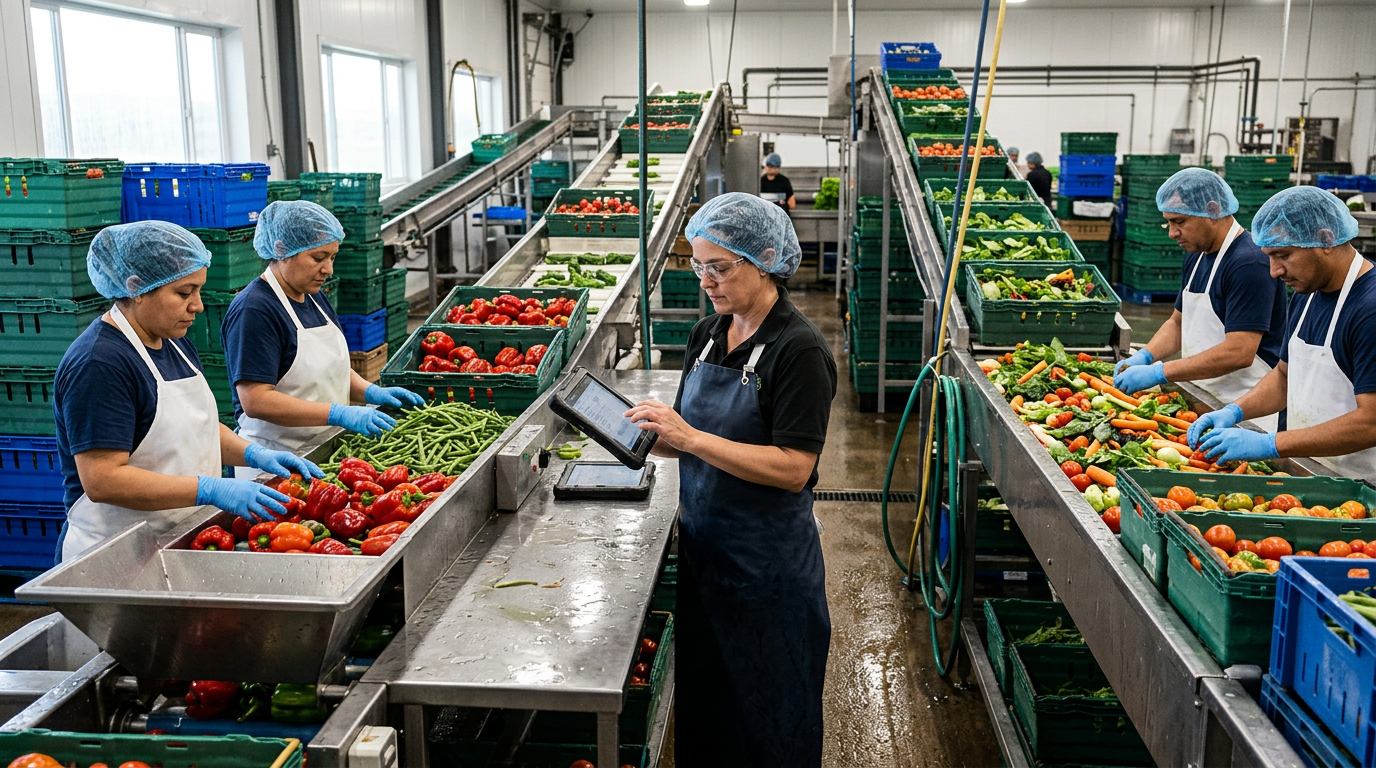
V5 Ultimate runs a produce packing site as one connected system. Grower qualification, harvest tag, cooler residence, pack plan, kiosk-led wash and pack, in-process and finished-product QC, OOS / CAPA, PTI labels with FSMA 204 TLCs, GFSI audit prep and the entire Food Safety Plan all write to the same immutable, identity-verified ledger.

The pay-off is operational: pack records reviewed by exception in 20–30 min instead of 3 hours, management review cycles compressed from 4–6 weeks to 3–5 days, and a mock recall that resolves as a query — forward and backward from any node — not a project.

This playbook walks you through 11 traceability touchpoints and the 17 quality-system modules that wrap them, grouped into 8 readable parts. Every section anchors to 21 CFR 112/117, FSMA 204, PTI and the relevant GFSI scheme.

11
Traceability touchpoints
8
Thematic parts
30+
Regulatory anchors
Part I

Foundations

Why field-to-case traceability is the spine, and the ten-node map.

01

Why field-to-case traceability is the product

In produce packing, the case that ships is the unit — but the unit a recall asks about is the lot of leafy greens, melons or tomatoes harvested from a specific block, on a specific day, by a specific crew.

Floor actionscan · weigh · e-sigactor + tsSTEP 01Append-only rowDB trigger writes oncesha256STEP 02Pack record snapshotfrozen at releaseWO boundSTEP 03PDF renderfrom snapshot onlydeterministicSTEP 04Inspector packexported on demand21 CFR 11STEP 05ALCOA+ lineageAttributable · Legible · Contemporaneous · Original · Accurate · + Complete · Consistent · Enduring · AvailableOne origin event. No re-keying. No reconciliation.
ALCOA+ in one picture: one origin event, replayable downstream.

Outbreak after outbreak — romaine, cantaloupes, cucumbers, onions — has resolved on the same lesson: the brands that could walk the chain backwards from a positive sample to a block, an irrigation event and a harvest crew were the brands that contained the recall. The brands that couldn't, lost the listing.

FSMA 204 (21 CFR 1.1300–1.1455) makes this concrete for foods on the Food Traceability List — leafy greens, melons, herbs, sprouts, tropical tree fruits, tomatoes, peppers, cucumbers (in certain forms), and more. Critical Tracking Events (CTEs) must be captured with Key Data Elements (KDEs) and produced as a sortable electronic spreadsheet inside 24 hours. Paper packing slips do not meet the bar.

V5 Ultimate treats the Traceability Lot Code as a property of the pack run, the field, the harvest crew, the cooler and the case — written into the same immutable ledger as everything else. A mock recall that took a 4-hour binder hunt resolves in under a minute.

Regulatory anchors
  • 21 CFR 112Produce Safety Rule — standards for growing, harvesting, packing, holding
  • 21 CFR 117Preventive Controls (applies to fresh-cut and value-added operations)
  • FSMA 204 (21 CFR 1.1300–1.1455)Food Traceability Rule — CTEs, KDEs, 24-hour sortable export
02

The end-to-end traceability chain at a glance

Ten touchpoints, one record. Read left-to-right. Every node writes to the same immutable ledger.

  1. 01
    Grower
  2. 02
    Harvest
  3. 03
    Cool
  4. 04
    Pack plan
  5. 05
    Run release
  6. 06
    Wash + pack
  7. 07
    Inspect / test
  8. 08
    NCR / CAPA
  9. 09
    PTI label
  10. 10
    QA release
One immutable ledger underneath. Every node writes; nothing is re-keyed.

Every node carries forward block, harvest date, crew, cooler, pack-run, operator and equipment context from the node before it. Nothing is re-keyed; nothing is reconciled at the end.

Part II

Field & inbound

Grower onboarding, harvest crew, cooling, dock-to-pack.

03

Touchpoint 1 — Grower onboarding and qualification

A grower with the wrong water test, an expired GAP cert, or a pending FDA-detected adjacency should never load a truck.

21 CFR 112 governs everything from agricultural water and biological soil amendments to worker health and equipment hygiene. V5 holds every grower as a structured object: scope by commodity × ranch × block, GAP / GLOBALG.A.P. IFA / USDA Harmonized GAP Plus+ certificates with expiry, agricultural water test history (per 112.43–112.47), biological soil-amendment records, animal-intrusion logs, and the last three sets of pre-harvest residue tests.

Re-qualification is calendar-driven and portal-led; an expired water test or GAP audit blocks inbound automatically. Grower risk scoring drives the depth of incoming inspection — a high-risk lot gets every truckload micro-tested for STEC and Salmonella; a long-trusted block ships against a reduced sampling plan with the supporting evidence kept on the ledger.

  • Block-level grower master — ranch × commodity × harvest window
  • Agricultural water test history per 21 CFR 112.43–112.47, calendar-enforced
  • GAP / GLOBALG.A.P. / USDA Harmonized GAP Plus+ certificates with expiry alerts
  • Reduced sampling regimes tied to documented grower history
Regulatory anchors
  • 21 CFR 112 Subpart EAgricultural water — quality criteria and testing
  • 21 CFR 112 Subpart FBiological soil amendments of animal origin
  • GLOBALG.A.P. IFA v6Integrated Farm Assurance — Fruit & Vegetables
04

Touchpoint 2 — Harvest, field-pack and receiving

Every bin, every tote, every super-sack: tagged with block + harvest date + crew, weighed, temperature-checked, and locked to Quarantine until cooled and released.

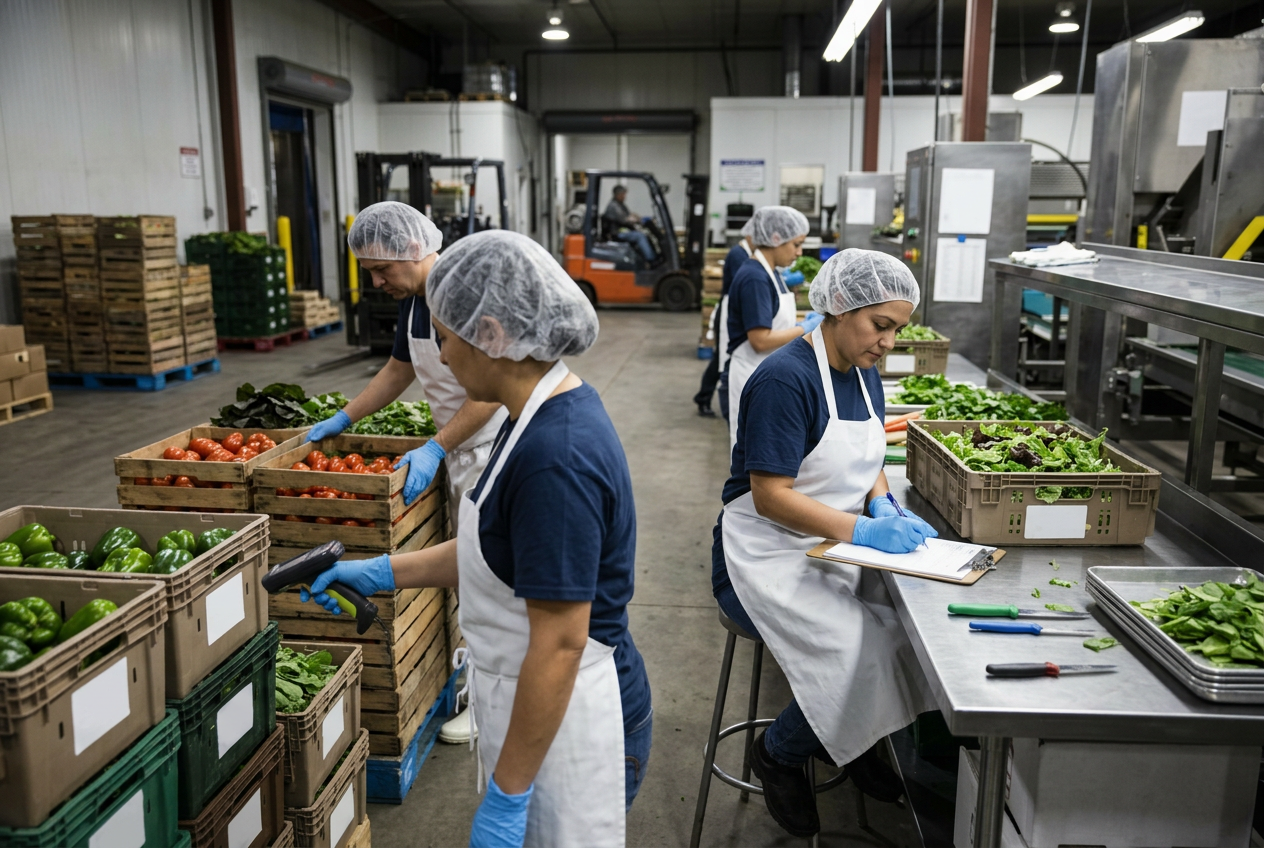
Whether field-packed or shed-packed, V5 mints a goods-receipt lot ID at the dock and ties it to the harvest tag (block, crew, date, time-window). Pulp temperature is captured at receiving; an out-of-band temperature trips a deviation and holds the lot. The supplier lot, the GAP cert in effect that day, the pre-harvest interval check, the in-field sanitation log — all link back from the receipt.

Identity verification — visual grading, sample weights, occasional pre-cooling micro testing — runs on the same kiosk. The result links to the receipt lot, the test method, the instrument, the analyst e-signature and any field documentation captured by the harvest crew.

  • Field harvest tag scans into receipt — no clipboard re-key
  • Pulp temperature captured at every drop — out-of-band = auto deviation
  • Block × crew × date carried forward as KDEs for FSMA 204 receiving CTE
Regulatory anchors
  • 21 CFR 1.1330FSMA 204 — receiving CTE KDEs
  • 21 CFR 112.122Measures to prevent contamination at harvest
05

Touchpoint 3 — Cooling, cold-chain and status-aware FEFO

Coolers are not just locations. They are zones with temperature bands, commodity compatibility and release status.

V5 maintains cooler attributes: temperature band, commodity compatibility (ethylene-producers separated from ethylene-sensitive), organic segregation, allergen profile for fresh-cut lines that handle tree-nut toppings or dairy dressings. The pick list shown to the cooler crew only includes lots compatible with the pack run being built.

FEFO is enforced by default; overrides require a documented reason and a second e-signature. Continuous temperature monitoring is bound to the lot — every probe reading is on the ledger, with out-of-band events automatically tied to the lots in residence at that time.

  • Cooler temperature bands enforced — wrong band = pick blocked
  • Continuous temperature log bound to lots in residence
  • Parent/child lot genealogy carried through every split, blend and re-pack
Regulatory anchors
  • 21 CFR 112.125Measures during packing and holding
  • FSMA 204 (transformation CTE)TLC assignment at re-pack or fresh-cut
Part III

Pack & execution

Pack plan snapshot, kiosk-led pack, in-process QC, sanitation gates.

06

Touchpoint 4 — Controlled pack plan (the produce 'recipe')

For fresh-cut and value-added, the pack plan is a regulated object. In V5 it's a versioned, signed, machine-readable record — not a Word document.

Each pack plan holds: commodity mix and BOM (lettuce varieties, dressing sachet, fork pack), routing with step-by-step instructions, in-process control plan (chlorine ppm in the wash flume, brush-roller cleanliness, weight per clam, atmosphere in MAP bags), packaging routing, label artwork version, and the Nutrition Facts panel for the SKU. Every field is queryable.

Effectivity is two-signature: a developer signs the change, the Food Safety Plan owner signs the validation impact. New pack runs pick up the new revision; in-flight runs keep the snapshot they were released against.

  • Wash-flume chlorine target lives inside the pack plan, not in a separate HACCP plan
  • MAP gas mix locked to packaging routing
  • Label artwork version locked to pack-plan revision — they cannot drift
Regulatory anchors
  • 21 CFR 117.126Food Safety Plan — written plan including process controls
  • 21 CFR 117.135Preventive controls — process, allergen, sanitation, supply-chain
07

Touchpoint 5 — Pack-run release as a snapshot

Releasing a pack run takes a snapshot of the pack plan. From that moment, the run carries its own copy — frozen forever.

Pack plan v3.2BOM · Routing · IPCSpec · LabelEFFECTIVE · 2-SIGSNAPon releaseWO-2026-0418Bound to Pack plan v3.2Frozen at releaseRELEASED · sha256:a4f9…runs even ifPack plan revisesPack record (this batch)Filled by kiosk+ IPC + dev + sigsIMMUTABLEPack plan v3.3 (later revision)does NOT affect WO-2026-0418
The WO carries a frozen copy of Pack plan v3.2. Later revisions don't disturb this batch.

If the pack plan is revised mid-shift, the pack run keeps the snapshot it was released against. The auditor sees exactly the plan the run was built to, with the sha256 of the snapshot recorded against the release event. There is no 'which version did they actually use' question.

Regulatory anchors
  • 21 CFR 117.180(c)Implementation records — including records of preventive controls
  • 21 CFR Part 11Electronic records and signatures — snapshot integrity
08

Touchpoint 6 — Kiosk-led wash, pack and seal

The kiosk is the floor's single pane of glass. Every wash cycle, every weight check, every sanitation gate is signed and timestamped.

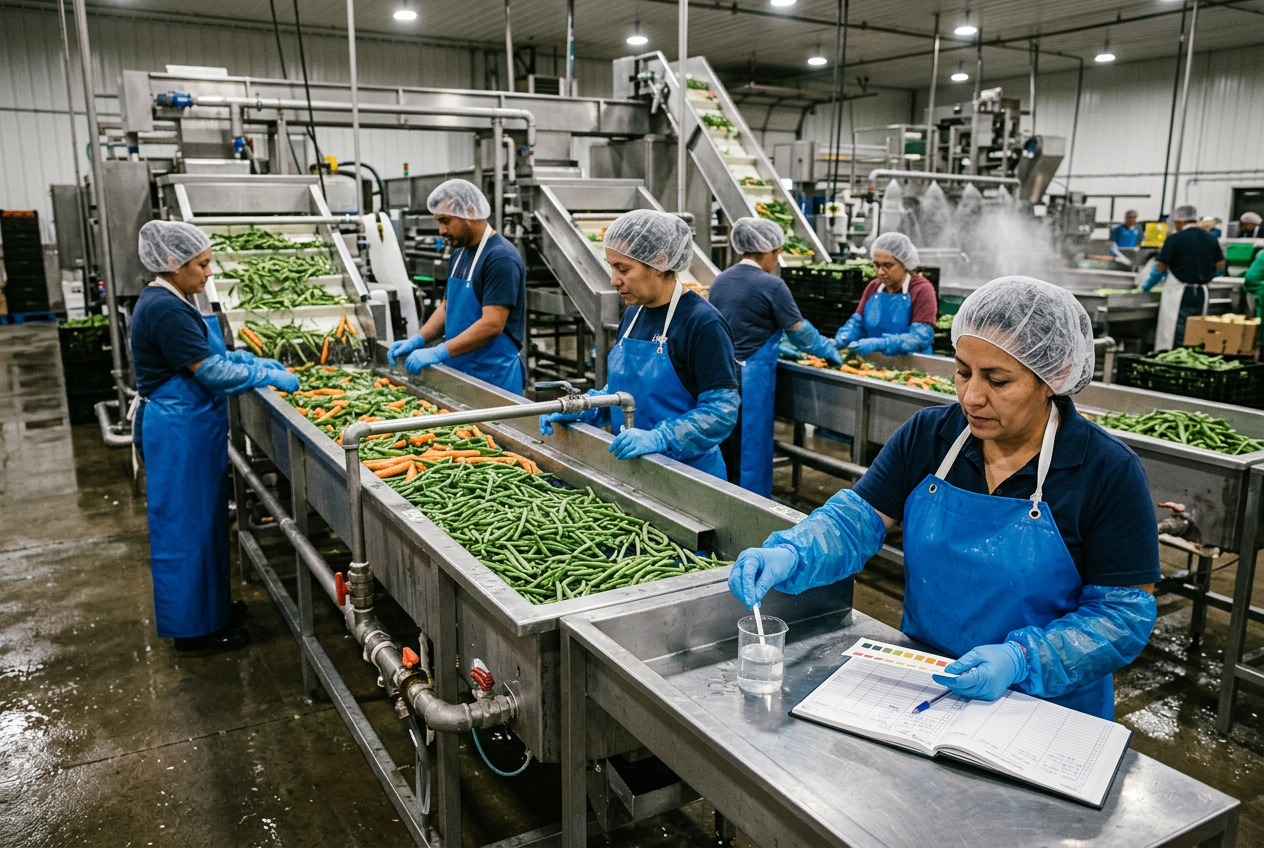
For fresh-cut, the wash-flume free-chlorine and ORP are streamed live; a drop below target trips an in-process deviation that the operator must resolve before the kiosk advances. For whole produce, the line shows the pack rate, the weight-per-case verification, and the case-label print confirmation.

Commodity changeovers are explicit, signed gates. The kiosk shows the previous run's commodity, the incoming run's commodity, the required cleaning protocol from the master, and the ATP swab result or visual verification. Both the operator and a second qualified verifier sign.

  • Live chlorine / ORP capture — auto-deviation on drop
  • Weight-per-case verified by scale stream — no key-in
  • Commodity changeover = signed, witnessed gate before next run
  • Line-clearance check required before label artwork unlocks
Regulatory anchors
  • 21 CFR 117.130Hazard analysis — biological, chemical, physical, allergen
  • 21 CFR 117.165Verification — monitoring of preventive controls
09

Touchpoint 7 — In-process and finished-product QC

Sampling plans run on a schedule, not a reminder. Results flow back to the same pack run automatically.

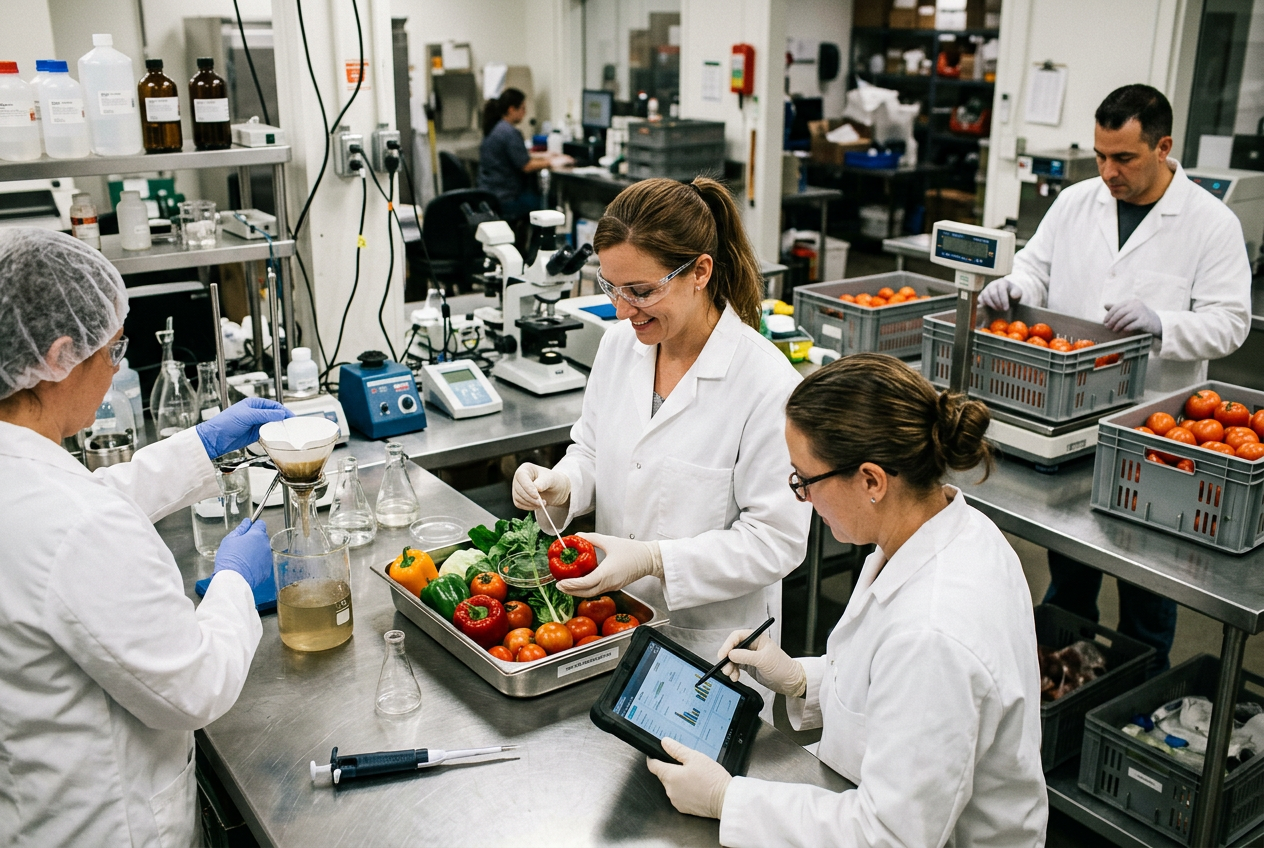
21 CFR 117 preventive controls require verification monitoring. V5 implements it as a schedule — IPC sample requests are raised by the pack run at the configured interval (every N cases, every 30 minutes, every changeover). The sample label prints with a traceable ID; the analyst's result enters at the kiosk or arrives via a LIMS bridge.

Finished-product testing — STEC, Salmonella, Listeria where required, weight, MAP gas check, sensory — runs on the same flow. Out-of-spec results auto-open a deviation, place the lot on hold, and notify QA. Statistical control limits trigger CAPA before drift becomes a failure.

Regulatory anchors
  • 21 CFR 117.155Corrective actions and corrections
  • 21 CFR 117.165Verification — instrument calibration, monitoring review, product testing
Part IV

Quality events

Pathogen positives, foreign material, deviations, CAPA — one queue.

10

Touchpoint 8 — Deviations, holds and CAPA in one queue

Every hold lands in the same queue — wash-flume excursion, pathogen positive, foreign material, sanitation fail, grower complaint.

A single deviation register categorises by hazard type (biological, chemical, physical, allergen, sanitation, equipment, labelling). Root-cause workflow uses the structured fields the auditor expects. CAPAs link automatically to the deviation, the affected lots, the operators on shift, the equipment, and any related complaints.

Effectiveness checks are calendar-driven — V5 reopens the CAPA at the configured interval, prompts evidence upload, and only closes once the QA reviewer signs.

Regulatory anchors
  • 21 CFR 117.150Corrective actions and corrections
  • 21 CFR 117.190Recordkeeping — records of corrective actions
Part V

Pack to customer

PTI labels, FSMA 204 lot codes, QA release, mock-recall in seconds.

11

Touchpoint 9 — PTI labels and FSMA 204 traceability lot codes

The label is a regulated document. V5 prints PTI-compliant GS1-128 case labels and assigns the FSMA 204 Traceability Lot Code at the transformation CTE.

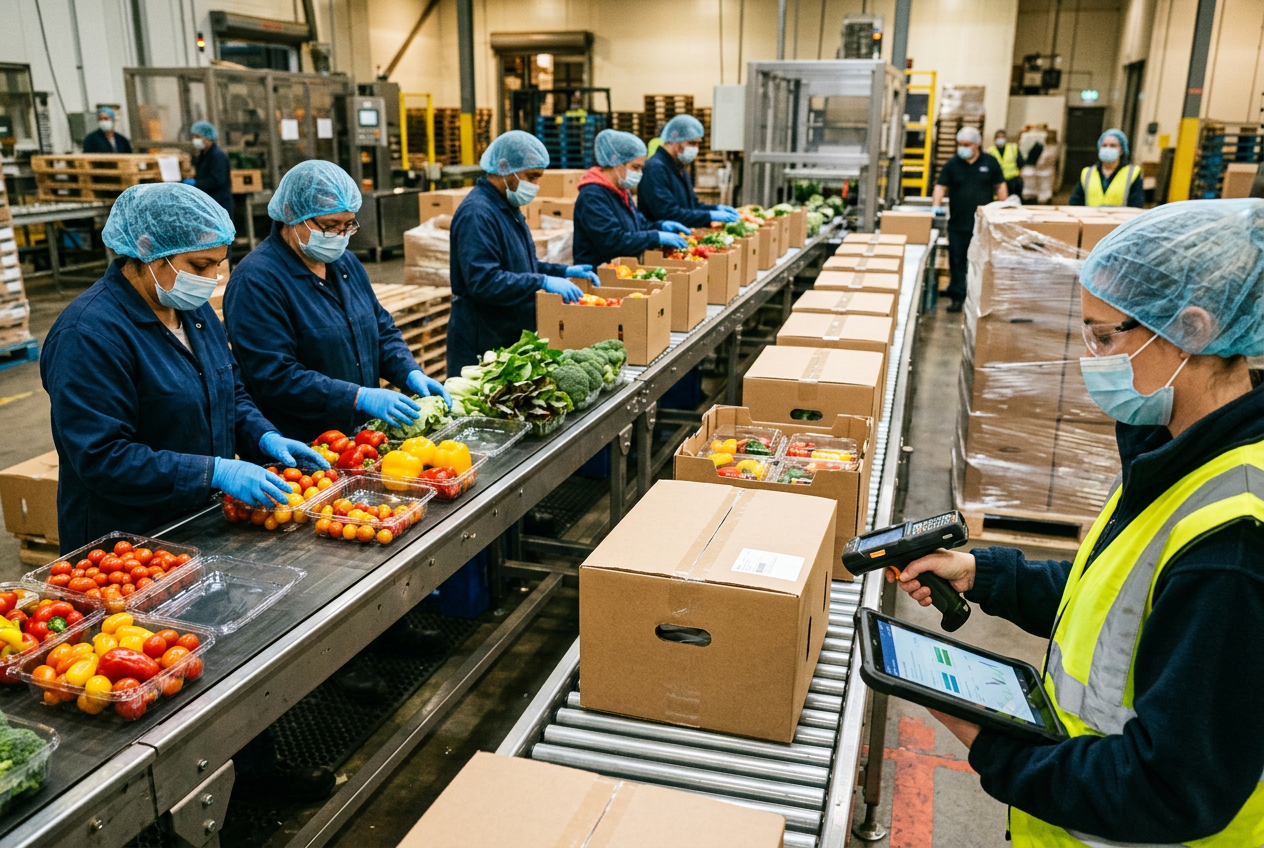
The Produce Traceability Initiative (PTI) defines the GS1-128 case label that retailers and distributors expect: GTIN, lot/batch, pack date, and (where applicable) harvest date. V5 carries those fields from the pack-run release through to the printed label — no manual artwork edits at packaging.

Under FSMA 204, the Traceability Lot Code is assigned at the FTL-defined CTE (initial packing for whole produce, transformation for fresh-cut). V5 propagates the TLC on every case and pallet and exports the FDA-preferred sortable CSV inside 24 hours.

  • GS1-128 case label printed from locked pack plan
  • TLC assigned at FSMA 204 initial-pack or transformation CTE
  • Sortable spreadsheet export ready in 24 hours, not 14 days
Regulatory anchors
  • 21 CFR 1.1300–1.1455FSMA 204 — Food Traceability Rule, KDEs, sortable export
  • PTI / GS1-128Produce Traceability Initiative — case label standard
  • 21 CFR 101Food labelling — Nutrition Facts, ingredients (fresh-cut SKUs)
12

Touchpoint 10 — QA release with review-by-exception

QA reviews the exceptions, not the entire pack run. The ledger already proves the routine steps happened.

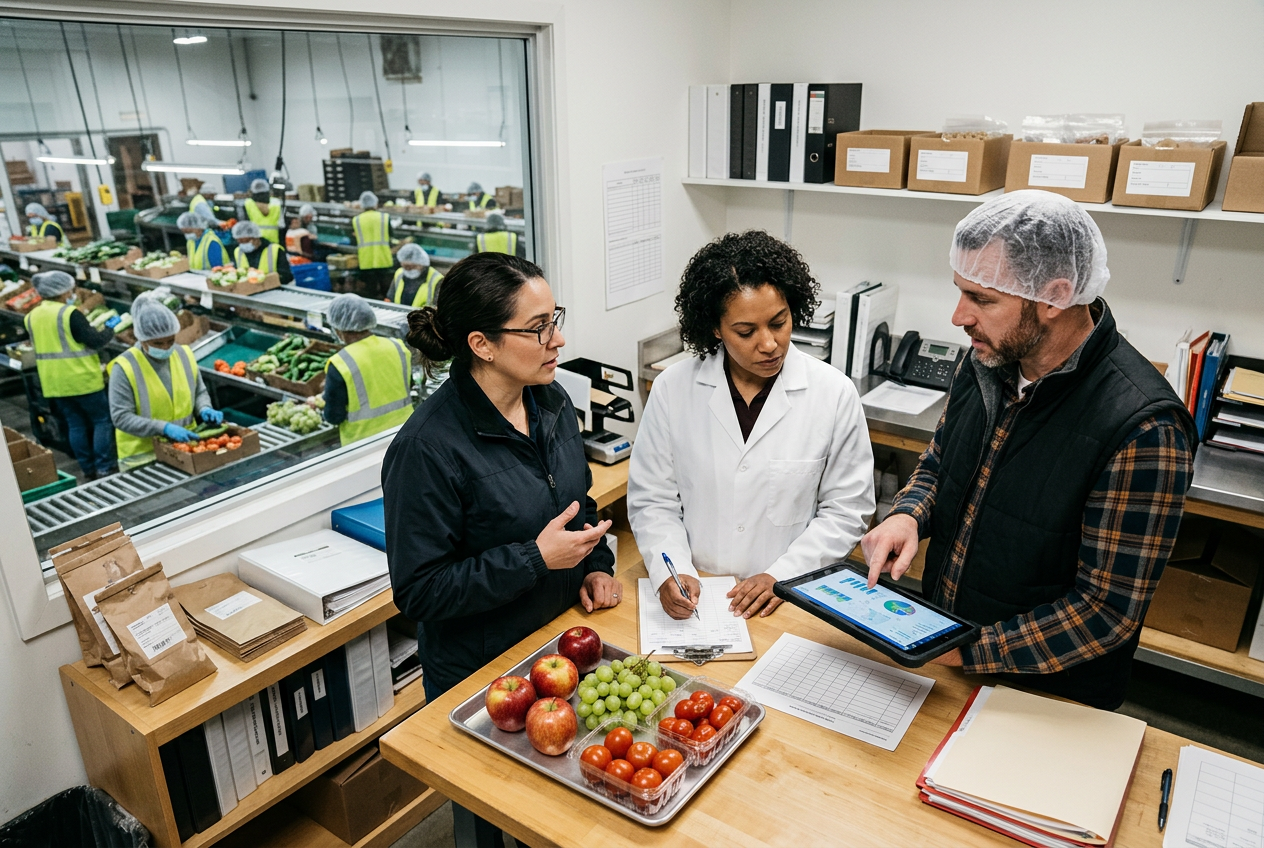
Review-by-exception is only safe if the record is complete and immutable. V5's pack record is built from the ledger as the line runs — every step accounted for, every deviation linked, every IPC result attached. The QA reviewer's queue surfaces only the items the system can't auto-clear: open deviations, OOS, missing verifications, unsigned changeovers.

Release requires two qualified e-signatures (a preparer and an approver). The released run is then disposition-locked — any future change is a deviation, not a quiet edit.

Regulatory anchors
  • 21 CFR 117.165(b)(1)Review of records — preventive controls, monitoring, corrective actions
  • 21 CFR Part 11.50 / 11.70Signed records and signature-to-record linking
13

Touchpoint 11 — Distribution and a recall in seconds

Recall is a query, not a project. Forward from a grower lot, backward from a case in a retailer's DC.

Recall / withdrawal lookback timelineFrom trigger to drafted regulator report — measured in minutes, not weeksT+0sRecall triggerQA flips TLC to RecallSTEP 01T+10sBackward traceBlock · grower · coolerSTEP 02T+38s100% cases foundCase · pallet · DCSTEP 03T+1m 52sCustomers notifiedPortal + retailer pushSTEP 04T+7mFDA RFR draftedAuto from ledgerSTEP 05Bidirectional from any node — unit ⇄ case ⇄ pallet ⇄ batch ⇄ lot ⇄ supplier
One ledger, one query. Forward and backward from any node.

Every case ships against an ASN that carries the TLC. Distribution events (ship, transfer, return) are CTEs under FSMA 204. When a recall trigger fires — internal QA disposition, grower withdrawal, retailer complaint, FDA Class I — V5 walks the ledger in both directions in seconds: every case made from this block, every customer DC it shipped to, every adjacent run that shared the wash flume.

The Reportable Food Registry submission, the recall press release draft, the mock-recall test result for the next GFSI / PrimusGFS audit — all assemble from the same ledger.

Regulatory anchors
  • 21 CFR 7.40–7.59FDA recall guidelines — Class I/II/III, scope and notification
  • Reportable Food RegistryMandatory reporting where there is reasonable probability of serious health consequences
  • FSMA 204 sortable export24-hour electronic record on FDA request
Part VI

Quality system

Food Safety Plan, documents, training, management review, GFSI audits.

14

Quality system — Food Safety Plan as a live object

21 CFR 117 (for fresh-cut) and the 21 CFR 112 farm food-safety plan are the centrepiece. V5 holds both as structured, signed, live records.

Hazards link to preventive controls, to monitoring procedures, to corrective-action procedures, to verification activities, and to the PCQI (for fresh-cut) or qualified individual (for the farm) who owns each. Re-analysis is calendar-driven (every three years or on significant change per 117.170), and the prior period's monitoring data assemble into the re-analysis workspace automatically.

Regulatory anchors
  • 21 CFR 117.126 / 117.170Food Safety Plan content, PCQI requirement, re-analysis
  • 21 CFR 112.30Records — establishment and maintenance
15

Document control — controlled, versioned, two-signature

Every SOP, work instruction, label artwork, validation report and policy is a controlled record with an effective date and an owner.

Draft → Review → Approved → Effective → Periodic Review → Superseded / Retired. Two qualified signatures effect every release. Operators see only the effective revision; superseded revisions are retained for the retention period (typically two years per 117.190 / 112.7 plus any GFSI overlay).

Regulatory anchors
  • 21 CFR 117.190 / 112.7Records — required records, retention, signature
  • GLOBALG.A.P. IFA v6 §AF.2Record-keeping and internal self-assessment
16

Training and competency — competency-gated kiosk access

If you're not trained on the kiosk step, the kiosk won't let you advance it.

V5 maintains a training matrix per role × line × hazard. Worker hygiene and health training are mandatory per 21 CFR 112.21–112.30 and 117.4. New hires move through onboarding → competency assessment → signed-off → live, with the assessor's e-signature linked to the kiosk badge.

Regulatory anchors
  • 21 CFR 112.21–112.30Personnel qualifications and training (farm)
  • 21 CFR 117.4Qualifications of individuals (facility)
17

Management review — assembled continuously, signed annually

Management review is not a 4-week scramble at year end. V5 assembles it continuously from the ledger.

Management Review — continuous compilationEvery batch, IPC, OOS, deviation and complaint feeds the review as it happensJanbatch · IPCFebbatch · IPCMarbatch · IPCAprbatch · IPCMaybatch · IPCJunbatch · IPCJulbatch · IPCAugbatch · IPCSepbatch · IPCOctbatch · IPCNovbatch · IPCDecbatch · IPCManagement ReviewTrends · CpK · OOS · CAPAStability · Complaints · PVISO 22000 §9.3 · PrimusGFS · GLOBALG.A.P.CpK trend chartOOS / CAPA registerStability projectionSigned review PDF
Management Review assembles continuously — not a 4-week scramble at year end.

Every pack run's quality signals, every CAPA, every grower scorecard, every internal-audit finding, every customer complaint, every environmental swab — all stream into the management-review workspace as they happen.

Regulatory anchors
  • ISO 22000:2018 §9.3Management review of the Food Safety Management System
  • PrimusGFS / GLOBALG.A.P.Management review and continuous improvement
18

Internal audits and GFSI / FDA inspections

Audits land in the same queue as deviations. Findings drive CAPAs; CAPAs drive effectiveness checks.

V5's audit module schedules internal audits (area scope, risk-based frequency, finding classification) and external audits (PrimusGFS, GLOBALG.A.P., USDA Harmonized GAP Plus+, customer 2nd-party). When FDA arrives, the inspector's request list is a query — the Food Safety Plan, the last three months of water-quality and EMP records, supplier verification — assembled in minutes.

Regulatory anchors
  • 21 CFR 117.165(b)(2)Verification — including internal audits
  • GFSI / PrimusGFS / GLOBALG.A.P.Recognised audit schemes for produce
Part VII

Risk & operations

HACCP, water quality, sanitation, equipment, environmental monitoring, complaints.

19

Risk, hazard analysis and HACCP

HACCP is the spine of the Food Safety Plan. CCPs are monitored on the kiosk; OPRPs are tracked alongside them.

Hazards are identified by category and source. Each gets a severity × likelihood score, a documented decision on whether a preventive control is required, the CCP / OPRP classification, the monitoring procedure and frequency, the corrective-action procedure, and verification. The kiosk enforces CCP monitoring as a hard gate — a missed CCP check holds the lot until QA resolves it.

Regulatory anchors
  • Codex CXC 53-2003Code of Hygienic Practice for Fresh Fruits and Vegetables
  • 21 CFR 117.130Hazard analysis
20

Agricultural and process water — tested, trended, tied to runs

Water is the highest-risk vector in produce. V5 holds the test protocol, the time-points, the results, and the lots in residence.

Agricultural water testing per 21 CFR 112.43–112.47 (for the farm), and process-water free-chlorine / ORP / pH for the wash flume, are tracked as scheduled events. Results trend; an excursion ties forward to every pack run that used the water in the affected window.

Regulatory anchors
  • 21 CFR 112 Subpart EAgricultural water — quality criteria and testing
  • 21 CFR 117.80Processes and controls — sanitation and water
21

Sanitation programme — scheduled, verified, ATP-anchored

Sanitation is a documented, scheduled, verified programme — not a cleaning crew's judgement call.

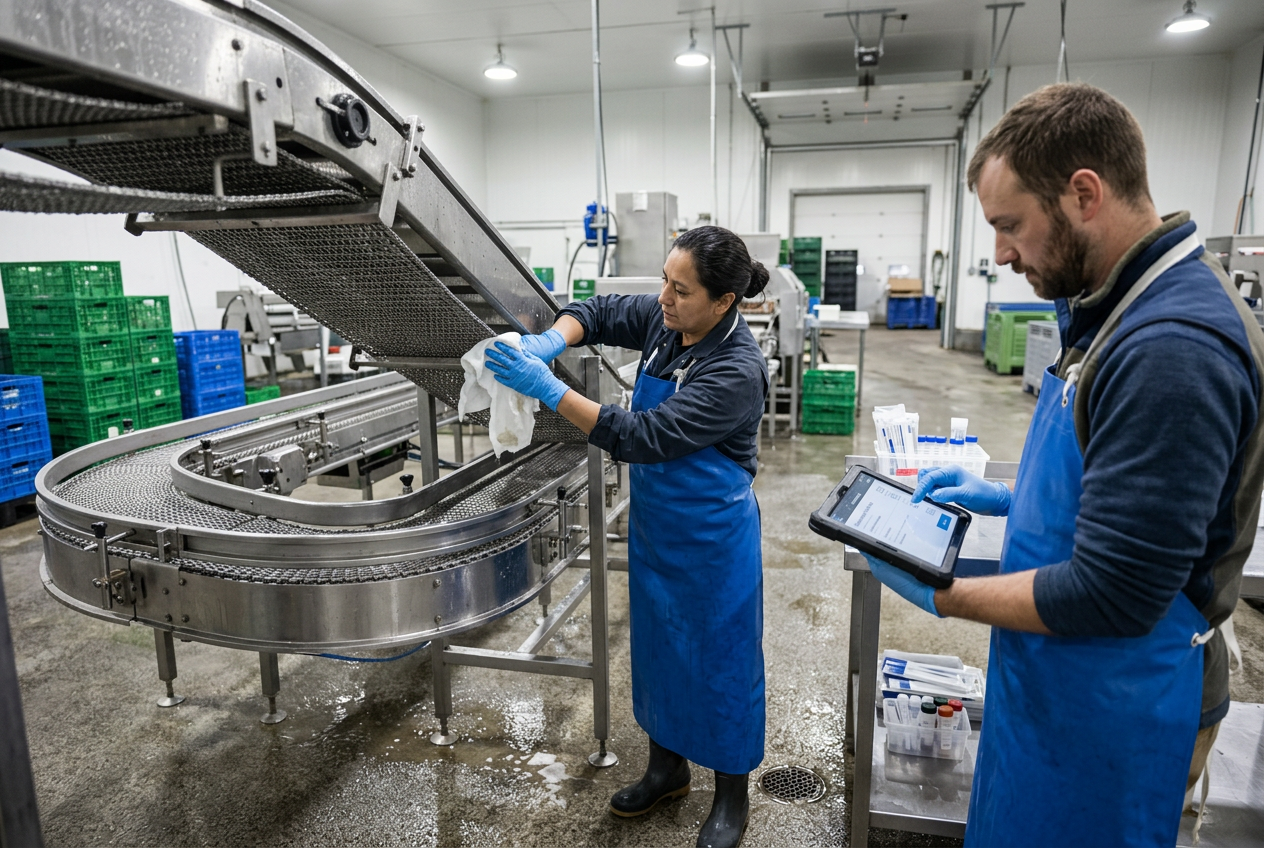
V5 holds sanitation procedures per zone × equipment × commodity, with frequency, agent, concentration, contact time, and verification (visual + ATP + microbiological swab on a defined cadence). Sanitation events are kiosk-led; results bind to the equipment record.

Regulatory anchors
  • 21 CFR 117.35 / 117.37Sanitary operations; sanitary facilities and controls
  • 21 CFR 112.123Equipment, tools, buildings — measures during covered activities
22

Equipment and calibration — flumes, scales, probes, metal detectors

Every instrument that monitors a CCP or signs an IPC has a calibration schedule and an out-of-tolerance procedure.

Chlorine analysers, ORP probes, cooler thermocouples, dispense scales, metal detectors, X-ray rejectors — each is a tracked asset with calibration interval, certificate of last calibration, tolerance, and an out-of-tolerance impact-assessment procedure. An out-of-tolerance result triggers a back-look across every run processed since the last passing calibration.

Regulatory anchors
  • 21 CFR 117.40 / 117.165(a)(2)Equipment; calibration of process monitoring instruments
23

Environmental monitoring (EMP) — Listeria and Salmonella by zone

For fresh-cut and ready-to-eat lines, EMP is non-negotiable. V5 schedules, samples, and trends by zone 1–4.

Sample sites, frequency, indicator and pathogen testing, and corrective actions on a positive (vector swabbing, intensified cleaning, re-test) are all scheduled and tracked. A Listeria positive in Zone 1 auto-holds product and opens a CAPA with a defined effectiveness check.

Regulatory anchors
  • 21 CFR 117.165(a)(3)Environmental monitoring for RTE foods exposed to the environment
  • FDA Listeria guidanceControl of Listeria monocytogenes in RTE foods
24

Complaints and consumer feedback — every complaint links to a lot

A foreign-body or illness complaint that can't be tied to a pack run is a complaint and a future outbreak investigation. V5 ties it the moment it arrives.

Complaints enter via portal, email-to-ticket or customer-service handoff. The intake form asks the questions the FDA investigator will ask later: TLC, pack date, place of purchase, nature of complaint. V5 binds the complaint to the matching pack run on intake, surfaces adjacent runs that share equipment, and trips a deviation if the pattern crosses a threshold.

Regulatory anchors
  • 21 CFR 117.150(c)Corrective actions — including complaints
  • FFDCA §417 (RFR)Reportable Food Registry — 24-hour FDA notification
Part VIII

Compliance & onboarding

Part 11 evidence, customer surface, onboarding, regulatory matrix.

25

21 CFR Part 11 — a property of the ledger

Part 11 isn't a module. It's a property of how V5 writes every record.

Every signed event carries the actor's verified identity, the meaning of the signature, the time, and a sha256 of the record being signed. The signature row is append-only. PDF renders are deterministic from the snapshot. ALCOA+ is a property of the data model, not a feature you opt into.

Regulatory anchors
  • 21 CFR Part 11Electronic records and signatures
  • ALCOA+ (FDA / MHRA)Data-integrity principles
26

Customer experience — portal, CoA, TLC export on demand

Retailers and brokers query the ledger directly through a scoped portal — no email-attached PDFs.

CoAs per lot, GAP certificates, country-of-origin documentation, FSMA 204 TLCs for the cases the customer received — all on the portal. Audit-trail of who downloaded what is automatic.

27

Onboarding and support — days, not months

V5 ships pre-configured for a typical produce packer: 21 CFR 112/117 templates, FSMA 204 CTE map, PrimusGFS / GLOBALG.A.P. overlay.

A typical packing house onboards in 4–8 weeks: master data import, pack-plan migration, kiosk training, a parallel-run validation against the existing paper record, and cutover. The validation pack (URS → IQ → OQ → PQ) is built into the implementation.

28

Regulatory matrix — every clause, every touchpoint

Where every clause lands in the V5 product surface.

This is the abbreviated mapping. Each link opens the full readiness guide.

RegulationScopeTouchpointsGuide
21 CFR 112Produce Safety Rule — full Subparts A–RAllRead →
21 CFR 117Preventive Controls (fresh-cut, value-added)AllRead →
21 CFR 1.1300–1.1455FSMA 204 — Food Traceability Rule04, 11, 13Read →
PTI / GS1-128Produce Traceability Initiative — case label11
Codex CXC 53-2003Code of Hygienic Practice for Fresh Fruits and Vegetables06, 19
GLOBALG.A.P. IFA v6Integrated Farm Assurance — Fruit & VegetablesAllRead →
PrimusGFSGFSI-benchmarked produce schemeAll
USDA Harmonized GAP+USDA Harmonized GAP Plus+03, 04
21 CFR Part 11Electronic records and signatures07, 08, 12Read →
FFDCA §417 (RFR)Reportable Food Registry — 24-hour FDA notification13, 24

See the playbook running on your floor.

Free trial, no credit card, onboard in days, not months.