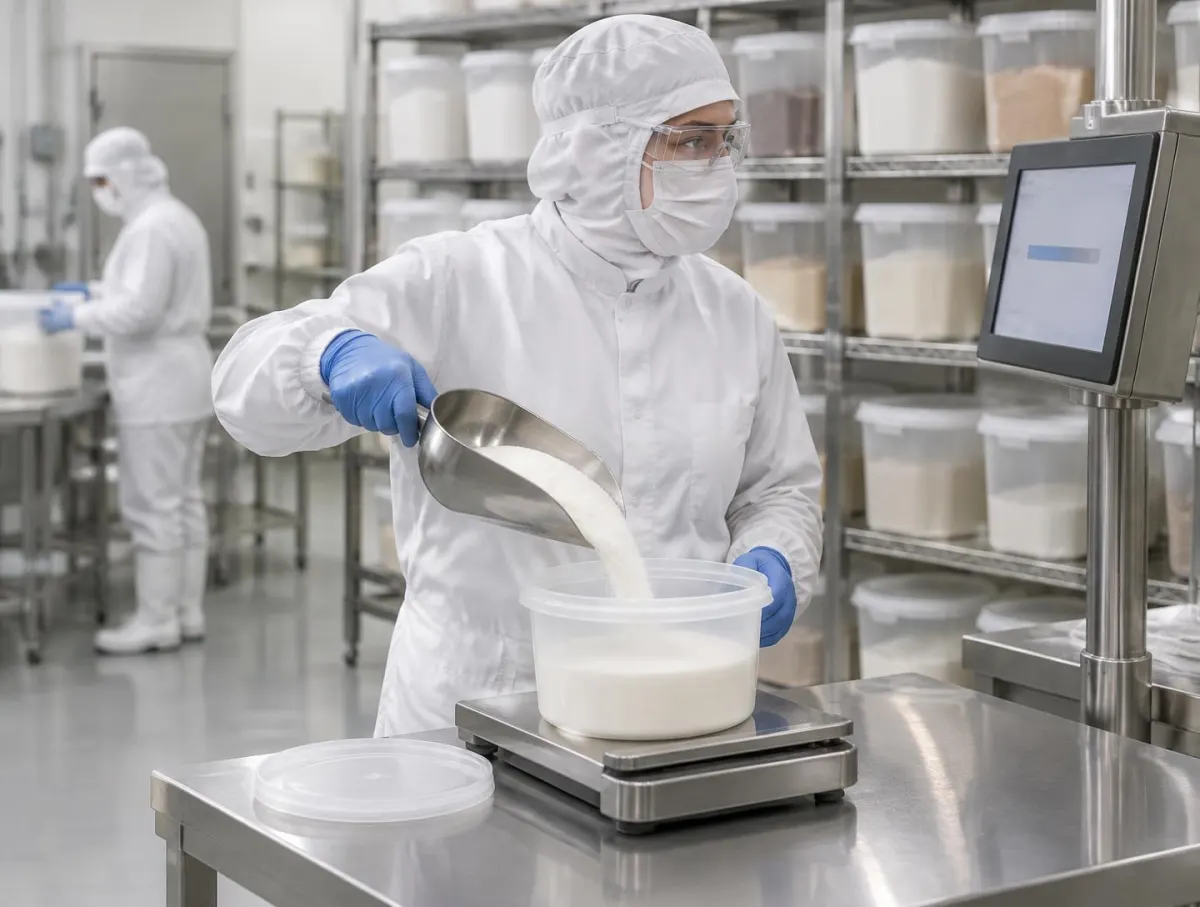
Bakery Recipe Control
Bakery Recipe Control is the site practice of defining what a bakery intends to make, selecting the appropriate approved instructions for production, and recording what actually happened.

In Short
- Bakery Recipe Control is the site practice of defining what a bakery intends to make, selecting the appropriate approved instructions for production, and recording…
- For United States operations, first establish which provisions apply to the establishment and its activities.
- As site practice, give each approved version a stable identity and an explicit effectivity rule.
It connects ingredient identities, formula quantities, processing instructions, and packaging references without treating them as interchangeable. A correct formula does not prove that the right ingredients entered the mixer, and a completed weighing sheet does not prove that the finished product received the intended label.
1. Separate approved recipe intent from batch reality
Bakery Recipe Control is the site practice of defining what a bakery intends to make, selecting the appropriate approved instructions for production, and recording what actually happened. It connects ingredient identities, formula quantities, processing instructions, and packaging references without treating them as interchangeable. A correct formula does not prove that the right ingredients entered the mixer, and a completed weighing sheet does not prove that the finished product received the intended label.
The approved master describes repeatable intent: the product, ingredient specifications, calculation basis, process sequence, permitted adjustments, and associated packaging references. The batch record describes one execution: the selected version, actual quantities, ingredient lots, equipment, observations, exceptions, and disposition. Keep both views. Replacing planned quantities with actuals destroys the comparison; copying targets into actual fields creates an apparently complete record without evidence of execution.
| Information layer | Question it answers | Useful evidence |
|---|---|---|
| Approved master | What is authorized for this product? | Version, ingredient specifications, formula basis, instructions, approval and effectivity |
| Batch instruction | What was selected for this particular run? | Batch identity, pinned version, scaled targets, equipment and packaging references |
| Execution history | What happened to the material? | Lot and container identities, actual additions, unused quantities, observations and exceptions |
| Disposition | What decisions followed? | Assessment, authorized action, affected product scope and closure evidence |
Throughout this guide, operational recommendations, diagrams, checklists, and fictional examples are proposed site practice, including the FAQs. They are not claims that food law universally mandates recipe approval signatures, version numbering, or ingredient tolerance bands. Regulatory statements are identified separately and linked to their applicable provisions. The distinction matters because a quality preference, a production instruction, and a food safety control can require different responses when something goes wrong.
Start with a practical question: could another authorized person reconstruct this batch without relying on the operator's memory? They should be able to identify the intended formula, explain every actual addition, and follow unresolved questions to a decision. Use the broader bakery and confectionery resource hub for related operational topics; this guide focuses specifically on the connection between recipe intent and batch evidence.
2. Keep recipe practice distinct from food safety law
For United States operations, first establish which provisions apply to the establishment and its activities. FDA's preventive controls rule overview explains that registered domestic and foreign food facilities generally fall within risk-based preventive controls requirements unless an exemption applies. It also expressly notes that current good manufacturing practice applicability is not dependent on registration. This FDA explanatory resource helps orient the reader; it is not a bakery recipe approval procedure.
Exemptions and modified requirements need their own assessment. Under 21 CFR 117.5(a), except as provided by subpart E, subparts C and G do not apply to a qualified facility; qualified facilities instead have modified requirements under section 117.201. Do not infer qualified-facility status from an informal description such as small bakery. Other exemptions also have specific conditions, so this guide is not an applicability determination.
Where subpart C applies, section 117.126(a) requires preparation and implementation of a written food safety plan, prepared or overseen by one or more preventive controls qualified individuals. Under section 117.130(c)(2), hazard evaluation considers factors including formulation, ingredients, manufacturing procedures, and packaging and labeling activities. These are food safety obligations, not instructions to adopt the particular document structure illustrated here.
As site practice, identify which recipe fields connect to food safety decisions and which primarily describe product quality or production efficiency. A change to flour quantity, an ingredient substitution, or a processing instruction may need different reviewers depending on its implications. Route safety-relevant questions to the site's food safety process rather than assuming that a recipe editor's approval settles them. Conversely, avoid describing every mixing preference as a legally prescribed preventive control.
Keep the authority visible beside the instruction: applicable regulation, food safety plan reference, or approved operating practice. This makes escalation more meaningful. It also avoids presenting an illustrative weighing tolerance, bake-yield expectation, cleaning arrangement, or review signature as a universal legal requirement. No generic bake temperature, sanitation cycle, or sampling protocol can replace the product-specific assessment.
3. Define when versions take effect, including work in progress
As site practice, give each approved version a stable identity and an explicit effectivity rule. Approval date and production effectivity are different facts: a version may be approved today for use next week. Define whether the cutover applies at batch release, first weighing, or another clearly observable event. A date without a time, location, and event rule can leave two shifts interpreting the same change differently.
For a fictional example, version R7 becomes effective for batches released from 10:00 onward. Batch B101 was released at 09:50 against R6. Its instructions do not silently become R7 when an operator opens a screen or prints another page. Record whether B101 continues under R6, pauses, or undergoes an authorized conversion, together with the reason and any material reconciliation needed.
- Select instructionsPin the effective version and calculation basis to the batch.
- Batch ID
- Version
- Scaled targets
- Verify materialsMatch available material to the specified ingredient and usable status.
- Ingredient
- Lot
- Container
- Weigh and stageRecord actual net quantity and intended destination.
- Unit
- Tare
- Staging identity
- Confirm chargingDistinguish material entering the process from unused material.
- Addition event
- Consumed mass
- Handoff and PackMatch product identity to process and packaging instructions.
- Clearance reference
- Applied label revision
- Reconcile and closeExplain differences and resolve outstanding decisions.
- Unused material
- Yield
- Exceptions
The continuation decision is not automatic permission to finish work affected by a safety concern. If the change addresses a suspected unsafe ingredient or process, identify and assess potentially affected material, including already-started batches. Version effectivity describes instruction selection; it does not settle food suitability.
Coordinate the cutover with staging and scheduling. Printed kits, preweighed containers, and packaging already issued may all need attention. The bakery production planning guide addresses the scheduling side; recipe control supplies the version and batch-specific boundaries that planning needs.
4. Scale baker percentages without changing their meaning
In baker percentages, total flour is the reference quantity and equals 100%. Each other ingredient is expressed relative to that flour mass, not relative to total dough. With multiple flours, define which flour components make up that reference. State the convention explicitly for preferments and composite ingredients so that flour or water is not counted once inside a component and again as a separate addition.
Fictional example: an approved practice formula uses 100 kg flour, 65 kg water, 2 kg salt, and 1 kg yeast. The total theoretical dough mass is 168 kg. The baker percentages are 100%, 65%, 2%, and 1%, totaling 168%. A baker-percentage total above 100% is expected because flour, rather than the whole dough, is the denominator.
| Ingredient | Baker percentage | 100 kg flour basis | 50 kg flour basis | Percentage of total dough |
|---|---|---|---|---|
| Flour | 100% | 100 kg | 50 kg | 59.5238% |
| Water | 65% | 65 kg | 32.5 kg | 38.6905% |
| Salt | 2% | 2 kg | 1 kg | 1.1905% |
| Yeast | 1% | 1 kg | 0.5 kg | 0.5952% |
| Total | 168% | 168 kg | 84 kg | 100.0000% |
For each ingredient, target mass equals flour mass multiplied by its baker percentage divided by 100. Halving the flour basis halves every ingredient: 50 + 32.5 + 1 + 0.5 = 84 kg. Working backward from a dough target, flour mass equals target dough mass divided by 1.68 for this formula. Thus, an 84 kg dough target requires 50 kg flour, not 84 kg flour.
The final column uses a different denominator: ingredient mass divided by 168 kg, multiplied by 100. Values are rounded to four decimal places. Water is therefore 65% in baker terms but approximately 38.69% of total dough. Labeling both columns simply percentage invites a substantial scaling error.
As site practice, check rounding at the actual dispensing unit and separately assess equipment loading. Ingredient masses may scale proportionally while mixing behavior, addition sequence, and handling constraints do not. Keep toppings, dusting flour, washes, and later fillings explicitly inside or outside the formula boundary. Do not quietly add them to the dough total after calculating the batch.
5. Preserve ingredient identity through lot changes and splits
As site practice, separate ingredient identity, supplier lot identity, and physical container identity. A flour specification answers what material is intended. A lot identifies its source grouping. A container identifies the particular sack, tub, or transfer vessel being handled. Two containers can share a lot; two lots can contribute to one recipe line. Neither relationship should disappear when quantities are totaled.
In a fictional 100 kg flour charge, lot A contributes 60 kg and lot B contributes 40 kg. Lot A is staged in containers A1 and A2 holding 25 kg and 35 kg. Record three addition events rather than assigning all 100 kg to whichever lot was scanned last. Splitting a container creates child identities that retain their source relationship; it does not create a new supplier lot.
Recipe Version
One version can govern many batches; each batch pins its selected version.
- Recipe identity
- Version
- Formula basis
Batch
One batch has multiple addition events and may produce several finished lots.
- Batch identity
- Selected version
- Target quantities
Ingredient Lot
One lot can supply multiple identified containers.
- Lot A: 60 kg contribution
- Lot B: 40 kg contribution
Container
Each example container retains its source lot through staging and use.
- A1: 25 kg from A
- A2: 35 kg from A
- B1: 40 kg from B
Addition Event
Each event links one source container to one receiving batch.
- Actual consumed mass
- Unit
- Time and person
Finished Lot
Each output identity links back to its batch and packaging evidence.
- Finished lot code
- Batch identity
- Applied label revision
A routine lot change is not necessarily a formula revision when the material remains within the approved ingredient definition. A different specification, composition, or allergen profile is a different question and needs assessment before substitution. Similar names are not evidence of equivalence.
For receiving, source records, and tracing across multiple batches, use the ingredient traceability guide. Here, the essential connection is the actual source-to-addition relationship, including partial containers and any later return or transfer.
6. Control tare, units, and tolerance decisions
As site practice, define the weighing method before defining acceptance. Gross mass includes the container; tare is the container allowance; net ingredient mass equals gross minus tare. For example, 27.4 kg gross minus 2.4 kg tare gives 25.0 kg net. A stored tare is useful only when it represents the container configuration actually used, including relevant liners or lids.
Record the unit at every transfer of a number. Five hundred grams equals 0.500 kg, not 500 kg. Do not treat liters as kilograms without an appropriate conversion basis for the material and conditions. Retain enough detail to distinguish a unit conversion from a new measurement, and avoid rounding repeatedly as values move between a recipe, scale display, worksheet, and review record.
| Fictional site setting | Accepted interval | Decision implication |
|---|---|---|
| Salt target 2.000 kg; ±0.020 kg | 1.980–2.020 kg inclusive | The absolute band equals ±1% of this target. |
| Yeast target 1.000 kg; ±0.005 kg | 0.995–1.005 kg inclusive | The absolute band equals ±0.5% of this target. |
| Same salt rule applied as ±1% to 1.000 kg | 0.990–1.010 kg inclusive | A percentage rule scales; a fixed ±0.020 kg rule would not. |
These numbers illustrate alternative rule structures, not suitable limits for a real bakery. Choose ingredient-specific tolerances through an approved site assessment of formulation sensitivity, weighing capability, batch size, and relevant safety considerations. Specify whether boundaries are inclusive, how rounding is handled, and what happens when a result lies outside the interval. A convenient display resolution alone does not establish acceptable measurement performance.
Match the weighing equipment to the task, particularly for small additions. Consider capacity, usable measuring range, operating conditions, and the site's accuracy-check arrangements. A floor scale convenient for flour may be unsuitable for a minor ingredient. Resolve that mismatch through the weighing method rather than widening acceptance merely to accommodate available equipment.
7. Separate staged mass, consumed mass, and process yield
Staging is an allocation, not proof of consumption. As site practice, distinguish material issued to a batch, material actually charged, unused material still under control, and any documented spill, sample, or other disposition. A container placed beside a mixer may never enter it. Posting every staged quantity as consumed can distort both the batch formula and the remaining ingredient balance.
Extend the fictional formula example: 102 kg flour is staged, but only 100 kg is charged. The other ingredients are staged and charged at their targets. The following reconciliation assumes no spills, samples, or other withdrawals. The unused flour remains identified pending a suitability and disposition decision; the table does not automatically authorize its return to stock.
| Material | Staged | Charged | Unused pending disposition |
|---|---|---|---|
| Flour | 102 kg | 100 kg | 2 kg |
| Water | 65 kg | 65 kg | 0 kg |
| Salt | 2 kg | 2 kg | 0 kg |
| Yeast | 1 kg | 1 kg | 0 kg |
| Total | 170 kg | 168 kg | 2 kg |
The staging balance is 170 = 168 + 2 kg. If some flour had spilled, that quantity would need its own disposition rather than being hidden inside consumption or unused stock. Record subsequent transfers separately so the same 2 kg cannot be counted as both returned material and a charge to another batch. Unresolved differences remain questions, not automatic adjustments to the recipe.
Now consider a separate bake-and-cool measurement boundary: 168 kg of dough enters, and 145 kg of cooled product leaves, with no separately measured scrap or samples in this fictional example. Measured mass reduction is 23 kg. Yield is 145 ÷ 168 × 100 = 86.31%; reduction is 13.69%. These are arithmetic results, not recommended bakery yield targets.
Baking and cooling can remove moisture and other volatile material. Lower finished mass therefore does not, by itself, establish a formula error. Define the measurement boundary and timing, then distinguish process loss, scrap, samples, and unexplained differences. Do not relabel an unexplained discrepancy as moisture loss simply because baking occurred, or alter the recorded ingredient charges to make the final yield appear normal.
9. Make mixing and packaging handoffs explicit
As site practice, the handoff into mixing should confirm more than the presence of a complete ingredient kit. Identify the receiving batch, selected instructions, staged containers, actual quantities, addition sequence, and unresolved exceptions. Record consumption when charging is confirmed, not merely when a kit leaves the weighing area. For interrupted work, leave a clear distinction between additions already made and materials still waiting.
Line clearance connects the previous run to the next one. Define how the site checks residual ingredients, work-in-process, utensils, paperwork, and packaging for the intended changeover. Reference the applicable sanitation and allergen procedures rather than inventing a cleaning cycle inside the recipe. Equipment readiness, process instructions, and material identity are related checks, but one completed check does not substitute for the others.
| Handoff point | Evidence to carry forward | Question before proceeding |
|---|---|---|
| Weighing to mixing | Batch, version, container identities and actual quantities | Which ingredients are charged, staged, or unresolved? |
| Mixing to downstream processing | Product identity, process observations and exceptions | Are the next instructions appropriate for this actual batch? |
| Changeover to packaging | Clearance reference and selected packaging materials | Have prior-run materials been addressed under site procedures? |
| Packaging to reconciliation | Finished lot, applied label revision and affected quantities | Can this packaged output be traced to the batch actually made? |
Where food allergen preventive controls apply, section 117.135(c)(2) addresses protection from allergen cross-contact and finished-food labeling, including ensuring the food is not misbranded under section 403(w). The broader program belongs in the food allergen control guide. Here, the recipe-control task is to carry accurate product and ingredient information into that program's decisions.
Match the actual batch to the packaging used, not just to the scheduled product name. A substitution, authorized rework addition, or version change may require reassessment before packaging proceeds. If one batch supplies multiple pack formats, preserve the association between each finished lot and its applied label revision. A correct ingredient kit cannot compensate for the wrong packaging, and a correct label cannot establish that an uncertain batch is suitable.
10. Preserve deviations, corrections, and decisions
As site practice, separate an execution deviation from a recording error. If 2.030 kg salt was actually weighed against the fictional 2.000 kg target and ±0.020 kg band, the result is outside that interval. If 2.030 was typed but reliable evidence shows 2.003 kg was weighed, the issue is an entry correction. These situations need different evidence and should not be made indistinguishable by editing the final number.
For an actual weighing deviation detected before charging, identify and control the affected material while deciding the permitted action. After charging, the question concerns the mixture and potentially downstream product. Do not assume that an excess ingredient can be selectively removed from mixed dough. Nor should an operator automatically enlarge the batch to restore ratios without assessing equipment capacity, other ingredients, processing implications, and authorization.
Retain the original entry, corrected value where applicable, reason, supporting evidence, time, and responsible person. Link the event to the batch, ingredient addition, and affected product scope. Record who decided the disposition and what evidence supported that decision. On paper, use a correction method that leaves the original readable; in electronic records, evaluate whether the chosen method preserves an understandable change history.
For applicable Part 117 records, section 117.305 requires accuracy, indelibility, and legibility. Its actual-monitoring-values and concurrent-recording provisions have the exception in section 117.301(c) for records required by section 117.201. Do not assume every operational recipe sheet is automatically a required Part 117 record; identify the applicable record category before assigning regulatory requirements to it.
A production-record correction is not itself a food safety disposition. Route possible safety concerns through the applicable food safety process, and keep the relationship between that assessment and batch closure visible. For recurring quality deviations, examine patterns by ingredient, scale, shift, version, and process stage. Improve instructions or equipment where justified, but do not retrospectively change targets to erase unfavorable results. Useful history explains both the problem and the response.
11. Implement a workable control routine
Begin with one representative product and follow a real batch from instruction selection through packaging reconciliation. As site practice, assign responsibility for maintaining the master, authorizing changes, selecting effective instructions, confirming additions, reviewing exceptions, and deciding disposition. These responsibilities may sit with different roles or overlap in a small operation, but an operator should know who can resolve a question before production is waiting.
| Implementation check | Evidence of a usable practice |
|---|---|
| Define formula boundaries | Flour basis, component contributions, units and later additions are unambiguous. |
| Set effectivity rules | A mid-shift change has a documented decision for already-started work. |
| Test ingredient identities | A lot change and a split container remain traceable through actual additions. |
| Approve weighing methods | Tare, conversions, suitable equipment, rounding and tolerance responses are defined. |
| Reconcile material states | Staged, consumed, unused, spilled and otherwise disposed quantities remain distinct. |
| Authorize rework deliberately | Source, suitability, destination, quantity and actual use are connected. |
| Test packaging handoff | The actual batch and applied label revision remain associated. |
| Exercise exception handling | An entry error and an actual process deviation produce distinguishable histories. |
Choose detail that supports decisions rather than collecting duplicate signatures everywhere. More granular addition records can clarify partial use but increase recording effort. Very tight tolerances can create repeated interruptions without improving control if the measurement method is unsuitable. Overly broad tolerances can conceal meaningful formulation differences. Paper can be workable with disciplined issue and correction practices; electronic records still need clear identities, responsibilities, and reliable operational use.
Test awkward cases before extending the routine: a printer copy from an old version, an interrupted charge, an unreadable container identity, a partly used kit, and an unresolved packaging mismatch. Ask whether the evidence shows both the intended action and the actual outcome. Train people on these decisions, not just on completing fields, and review the first runs for unclear instructions or unnecessary duplication.
For commercial evaluation, consult the bakery industry page, recipe management page, and weigh-and-dispense page. Ask vendors to demonstrate your defined scenarios and explain any limitations. A product category or feature name is not evidence that a particular implementation preserves version effectivity, partial consumption, or correction history.
Questions
How is a master recipe different from a batch record?
In this site's practice model, the master recipe defines approved intent for repeated production, while a batch record identifies and documents one execution. The master contains the formula basis, ingredient definitions, instructions, and relevant references. The batch record pins the selected version and adds actual lots, quantities, observations, and decisions. Keep planned targets and actual results separately visible. A master update should not rewrite the instructions historically selected for an earlier batch. Likewise, a batch-specific exception should not become a permanent master change unless it passes the site's separate change process.
Why do baker percentages add up to more than 100%?
Baker percentages use flour mass as the denominator, with total flour defined as 100%. Other ingredients are additions relative to that reference. In the fictional example, 100% flour plus 65% water, 2% salt, and 1% yeast totals 168%, corresponding to 168 kg dough from 100 kg flour. Percentage of total dough is a different calculation: water is 65 divided by 168, or approximately 38.69%. As site practice, name the denominator on worksheets and define how preferment flour and water enter the calculation so those components are not counted twice.
Should a new recipe version apply to batches already in progress?
Not automatically. As site practice, define the effectivity event and make an explicit decision for already-started work. A batch released before the cutover may retain its selected instructions, pause, or undergo an authorized conversion with material reconciliation. The choice depends on the change and its implications. A safety-related concern is not resolved merely by saying the old version was valid when work began. Preserve what was originally selected, what had already happened, and the decision governing continuation. Check staged kits and packaging as well as the mixer instructions.
Does changing an ingredient lot require a recipe revision?
A different lot of the same approved ingredient does not necessarily change recipe intent. Under the practice described here, record the new source lot and its actual contribution without rewriting the formula. A change in ingredient specification, composition, or other relevant characteristics is different and needs assessment before use. If two lots supply one ingredient target, preserve both contribution records. If one lot is split into several containers, keep the source relationship for each container. Neither a matching ingredient name nor a final total quantity alone establishes that the correct material was used.
What tolerance should a bakery use for ingredient weighing?
There is no recommended universal band in this guide. The illustrated tolerances are fictional site settings, not legal limits. Choose and approve tolerances alongside the weighing method, considering ingredient sensitivity, batch size, equipment capability, and relevant safety decisions. Define whether the rule is an absolute mass, a percentage of target, or another assessed structure. Also specify units, rounding, inclusive boundaries, and the response to an out-of-band result. Do not widen a tolerance simply because the available scale cannot measure the intended addition appropriately, or treat acceptance as permission to change the formula.
Can unused staged ingredients be returned to stock?
Only after the site's applicable suitability and disposition decision; staging alone neither proves consumption nor authorizes return. Keep unused material identified with its source, container, quantity, and handling status. Consider whether exposure, storage, mixing with other material, or loss of identity affects the intended return. Record the return as a separate movement so it cannot also appear as consumed by the original batch. For a partially used container, distinguish the quantity actually charged from the remainder. If the remainder's identity or condition is uncertain, segregate it for assessment rather than assuming it is unchanged stock.
Does a low bake yield mean the recipe was wrong?
Not by itself. Finished mass can differ from dough mass because of moisture and other volatile losses, scrap, samples, and the measurement boundary used. As site practice, compare like-for-like measurements taken at defined stages and times. First confirm actual ingredient additions and account for known withdrawals. Then investigate unexplained differences rather than assigning them automatically to evaporation. Piece counts, average piece mass, retained work-in-process, and packaging boundaries can also affect comparisons. Do not change recorded ingredient consumption or revise the formula solely to make an unexpected finished-product yield resemble a historical target.
What evidence should someone reviewing a completed batch be able to follow?
As site practice, the reviewer should be able to follow the selected recipe version to scaled targets, actual ingredient sources and additions, relevant processing observations, packaging identity, and material reconciliation. Exceptions should lead to supporting evidence and an authorized decision, not just a closed status. The records can be distributed across connected paper or electronic documents if their relationships are clear and usable. Avoid demanding one oversized form when reliable references work better. Administrative completion should also remain distinguishable from any product suitability or food safety decision needed before the affected material proceeds.
Sources
Practical orientation, not legal advice. Rules differ by jurisdiction; your quality and compliance team decides what applies.