
Bakery Waste and Yield Control
Bakery Waste and Yield Control connects ingredients, work in process, recoverable material, rejects, and good finished output.
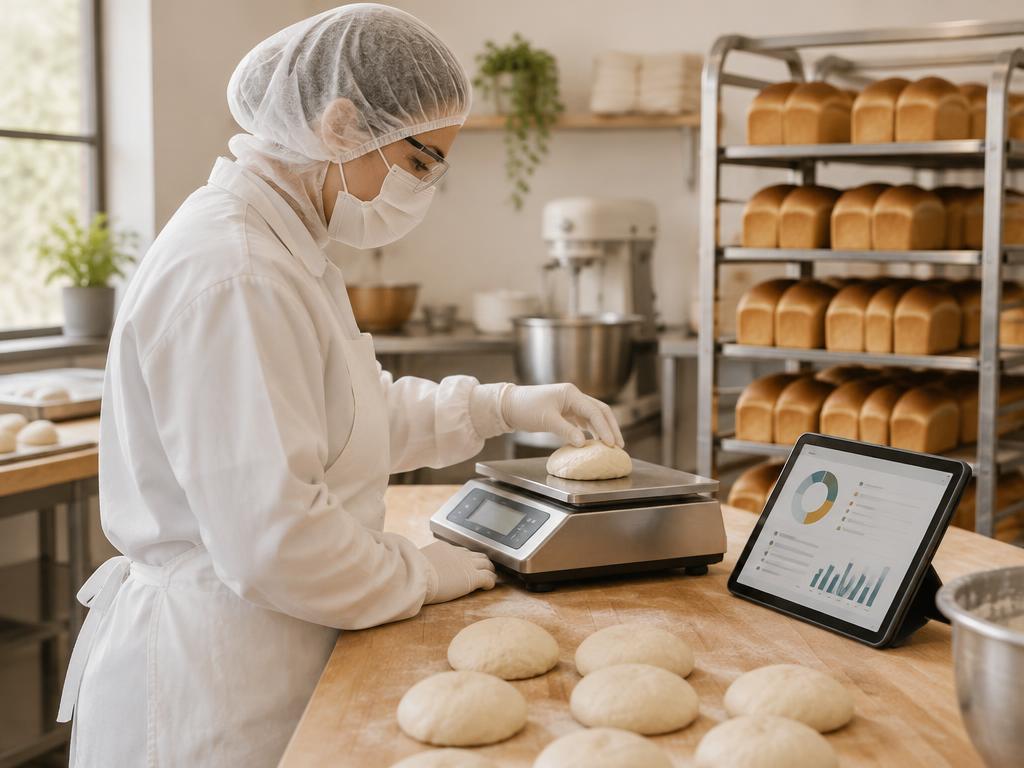
In Short
- Bakery Waste and Yield Control connects ingredients, work in process, recoverable material, rejects, and good finished output.
- Theoretical yield is a calculated reference, not proof that a line physically produced that quantity.
- A single miscellaneous-waste bin makes collection simple but investigation difficult.
Its practical purpose is to explain where material went and which losses deserve attention. A useful system does not treat every kilogram missing from a finished loaf as waste: water leaves during baking, dough may move into authorized rework, and some product remains unfinished when a shift closes.
1. Start with a boundary, not a waste percentage
Bakery Waste and Yield Control connects ingredients, work in process, recoverable material, rejects, and good finished output. Its practical purpose is to explain where material went and which losses deserve attention. A useful system does not treat every kilogram missing from a finished loaf as waste: water leaves during baking, dough may move into authorized rework, and some product remains unfinished when a shift closes.
Start each comparison by naming the product, batch or production interval, input boundary, output boundary, and measurement basis. For example, a dough-to-packed-loaf boundary starts with dough released to the divider and ends with accepted packed loaves. It excludes earlier ingredient spills unless those are separately brought into scope. An ingredient-to-dispatch boundary is broader, but it needs additional records for mixing, inventory movements, and finished stock. Neither boundary is inherently better; they answer different questions.
This guide presents operating practices, not statutory waste limits or FDA guidance. In the United States, 21 CFR 101.7(a)) requires a net-quantity declaration on the principal display panel of food in package form. Section 101.7(g)) addresses accurately revealing food quantity exclusive of wrappers and other packed material. Those labeling requirements are distinct from an internal production-yield calculation.
Keep legal net-contents inspection in the separate bakery pack-weight control guide. Likewise, use bakery production planning for capacity and scheduling decisions, and bakery recipe control for formula approval and version management. Waste evidence can inform those activities without replacing them. Here, the focus is measurement, reconciliation, cause investigation, and authorized recovery across the physical process.
2. Define theoretical and actual yield at each stage
Theoretical yield is a calculated reference, not proof that a line physically produced that quantity. At dividing, it might be available dough mass divided by target piece mass. At slicing, it might be the number of accepted cooled loaves presented to the slicer. Define the assumptions explicitly: full pieces only, no opening work in process, one loaf per pack, or another basis appropriate to the operation.
Actual yield uses observed accepted output. A local stage yield compares accepted output with the material entering that stage on a compatible basis. A cumulative yield compares accepted output at a later boundary with the original reference. Both are useful, but they are not interchangeable. A slicer can perform consistently while cumulative packed yield falls because more loaves were already rejected at the oven.
- Theoretical full pieces = whole-number portion of available dough mass ÷ target dough-piece mass, using matching units.
- Local count yield = accepted pieces leaving a stage ÷ pieces entering that stage × 100.
- Cumulative reference yield = accepted final pieces ÷ theoretical full pieces at the chosen starting boundary × 100.
- Mass reconciliation = measured input plus opening work in process, less measured outputs, transfers, losses, and closing work in process.
Mass yield needs particular care across baking. Comparing packed bread mass with dough mass includes normal moisture reduction as well as rejects and other losses. That percentage can be useful for material accounting, but it should not be labeled avoidable waste. Similarly, target-weight equivalents are planning quantities; they are not substitutes for measured dough weights when reconciling actual material.
As a practice, retain both the original theoretical reference and the measured stage entries. Do not silently reduce the denominator after a bad run or revise historical targets to make performance improve. When product specifications or operating conditions legitimately change, show the change beside the comparison. Close or explicitly carry forward unfinished pans, cooling racks, and held packs so that a shift boundary does not manufacture a loss.
3. Find waste where it actually arises
A single miscellaneous-waste bin makes collection simple but investigation difficult. Separate the location where a loss is found from the cause believed to have created it. A loaf rejected at packing might have been damaged by handling, poorly sliced, or misshapen much earlier. Recording packing as the detection stage does not establish that the packing team caused the problem.
| Stage | Observable category | Cause to investigate |
|---|---|---|
| Ingredient handling | Spilled flour, damaged sacks, retained material | Transfer method, storage condition, emptying technique |
| Dough or batter processing | Mixer residue, transfer loss, rejected mix | Discharge method, mixing condition, incorrect addition |
| Dividing and rounding | Trim, malformed pieces, sticking | Feed consistency, setup, dough condition |
| Proofing | Collapsed, stuck, or misshapen pieces | Proof conditions, pan preparation, handling |
| Baking | Burned, pale, or structurally rejected loaves | Oven conditions, loading, upstream variation |
| Cooling | Damaged or held loaves | Rack handling, release timing, cooling conditions |
| Slicing | Crushed loaves, torn slices, crumbs | Loaf condition, blade setup, handling |
| Packing and returns | Damaged bread, failed packs, returned stock | Transfer damage, sealing issue, distribution or demand |
Treat these causes as investigation prompts, not automatic diagnoses. For each category, define what operators can reliably observe: a torn bag is observable, while an assertion that the dough was overmixed may need supporting process evidence. Keep an unknown or pending-review cause available so that staff do not have to invent an explanation to finish a record.
Separate food loss from packaging waste, even when both arise from one event. A failed bag can generate one packaging scrap record and, only if the bread is rejected, a food-loss record. The event connection matters more than forcing unlike materials into one weight total. Make the same distinction between crumbs collected during normal slicing and whole-loaf rejects.
Ingredient handling deserves its own upstream view when the main yield boundary starts at dough release. Practices discussed in bulk bag and sack management can help structure that investigation. Do not charge an upstream spill to a downstream batch unless the accounting boundary and allocation method support doing so.
4. Measure category, cause, quantity, and shift together
Build a small, usable loss record before building a dashboard. As an operating practice, each record should identify the batch or production interval, product, detection stage, timestamp, shift, quantity, unit, category, disposition, and cause status. Record who entered it and whether the quantity came from weighing, counting, or estimation. An estimated dough loss and a measured dough loss should remain distinguishable.
Make weighing practical at the collection point. Identify containers, establish their tare, and keep food waste separate from liners, tools, water, and packaging unless the measurement explicitly includes them. Check that the scale is suitable for the quantities being recorded. If waste is accumulated across several batches, either separate collection or label the later allocation as an estimate rather than assigning false precision.
- Use one event identifier when several records describe the same incident.
- Record pieces as pieces and kilograms as kilograms; retain both when both are measured.
- Distinguish the detection stage from the suspected origin stage.
- Keep disposition separate from cause: held, discarded, authorized rework, or another defined route.
- Record corrections with an explanation rather than silently replacing the original observation.
- Assign losses crossing a shift change through a documented handover, not whichever team empties the bin.
Avoid counting a reject twice. A loaf removed at slicing and later weighed in a waste tote is one physical loss with two measurements, not two losses. Equally, transferring dough into a rework container is not both waste and recovered output. Link subsequent measurements and disposition decisions to the original material or event.
Use shift comparisons to find conditions worth examining, not to rank people without context. Product mix, startup activity, cleaning transitions, hold time, and measurement coverage can change the reported rate. Review a sample of records with operators and compare the recorded total with physical collection. If collection coverage changed, annotate the trend before concluding that actual performance changed.
5. Separate bake loss from avoidable waste
Baking changes product mass even when every loaf remains acceptable. For yield analysis, keep the moisture-related mass change separate from physical rejects, trim, spills, and damage. Otherwise, a lighter finished loaf may be reported as scrap even though no loaf was discarded. Conversely, calling every unexplained kilogram bake loss can hide a missing transfer or an incorrect dough-stage measurement.
A useful practice is to weigh identified pieces before baking and again at a defined post-bake point, excluding pan weight. Record the elapsed cooling time and weighing conditions. The calculation is pre-bake mass minus post-bake mass, divided by pre-bake mass, multiplied by 100. Weighing immediately after the oven and weighing after extended cooling describe different boundaries, so keep the endpoint consistent.
In an illustrative paired measurement, a piece weighs 580 g before baking and 512 g at the defined post-bake endpoint. The difference is 68 g, and 68 ÷ 580 × 100 = 11.724%, reported as 11.7% bake loss. This is an example, not an industry benchmark or recommended target. Operationally, the weight difference is used as a moisture-loss indicator; loose product loss during handling would need separate consideration.
Cooling also deserves a visible boundary. Changes in weighing time, rack residence, or product temperature can make a mass comparison appear to deteriorate without creating additional rejected pieces. Investigate those conditions alongside product acceptance. Do not shorten baking or cooling simply to retain more mass: yield improvement is not established if the change produces an unacceptable product or shifts losses to slicing and packing.
Keep the paired-weight sample identifiable. A selected 580 g piece does not establish that every divided piece weighed 580 g, and one paired result does not establish total batch evaporation.
6. Fictional example: reconcile the loaf counts
The following sandwich-bread example is entirely fictional, with explicitly illustrative quantities. One batch starts with 1,000 kg of dough and a divider target of 580 g. The theoretical calculation is 1,000,000 ÷ 580 = 1,724.1379 pieces: 1,724 full target pieces and approximately 0.14 of a piece, unusable as another full target piece. The exact theoretical remainder is 80 g, not an additional measured waste event.
The fictional count record also shows 1,724 actual pieces formed. These are counted pieces, not proof that each weighed the 580 g target. That distinction is essential because the batch also has dough-stage removals, reconciled in the next section. Assume no opening or closing work in process and one accepted loaf per final pack.
| Stage or reference | Entering pieces | Rejected pieces | Accepted pieces | Local count yield |
|---|---|---|---|---|
| Theoretical reference | Not applicable | Not applicable | 1,724 full pieces | Reference only |
| Actual divider output | Not applicable | Recorded separately by mass | 1,724 counted pieces | Not inferred from target |
| Proofing and baking combined | 1,724 | 41 | 1,683 | 97.6% |
| Slicing | 1,683 | 17 | 1,666 | 99.0% |
| Packing | 1,666 | 11 | 1,655 | 99.3% |
The piece rejects total 41 + 17 + 11 = 69. Accepted packed output is 1,724 − 69 = 1,655, and overall actual count yield against the theoretical reference is 1,655 ÷ 1,724 × 100 = 95.9977%, rounded to 96.0%. No separate cooling rejects occur in this fictional count record.
- Dough release → dividing1,000 kg input; 580 g target
- 28.0 kg divider trim/rejects
- 9.0 kg authorized rework
- 3.1 kg floor/pan waste
- Dividing → proofing/baking1,724 actual pieces; 959.9 kg measured dough
- 41 pieces rejected
- Moisture measured separately
- Cooling → slicing1,683 pieces enter slicing
- 17 pieces rejected
- 1,666 proceed
- Packing → accepted output11 pieces rejected at packing
- 1,655 good packed loaves
The 96.0% figure describes count conversion against a target-based reference. It does not demonstrate satisfactory divider targeting, mass efficiency, or legal pack quantity. Those questions require their own evidence.
7. Fictional example: reconcile dough mass without hiding a contradiction
The fictional dough-stage records identify 28.0 kg of divider trim and rejects, 9.0 kg of trim transferred out as authorized rework, and 3.1 kg of floor/pan waste. The 28.0 kg category excludes the separately recorded 9.0 kg recovery. These quantities must not be added to a claim that all 1,724 actual pieces weighed 580 g: that would require more dough than the batch contains.
To make this fictional case physically consistent, an independent measurement records 959.9 kg in the 1,724 pieces entering proofing. Their actual mean dough weight is therefore 959.9 ÷ 1,724 = 0.5567865 kg, approximately 556.8 g per piece, below the 580 g production target. The count yield consequently masks a targeting problem. The target is a reference, not an assertion about actual piece weights.
| Dough-stage destination | Measured quantity | Accounting treatment |
|---|---|---|
| Actual divided pieces entering proofing | 959.9 kg | Includes pieces later accepted and rejected |
| Divider trim and rejects | 28.0 kg | Discarded dough-stage material |
| Authorized rework transfer | 9.0 kg | Recovery outside this batch boundary |
| Floor/pan waste | 3.1 kg | Discarded dough-stage material |
| Total accounted input | 1,000.0 kg | 959.9 + 28.0 + 9.0 + 3.1 |
The tempting target-based check is 1,000 − (1,655 × 0.580 + 28) = 1,000 − (959.9 + 28) = 12.1 kg. Here, that 12.1 kg is explained by dough-stage records: 9.0 kg authorized rework plus 3.1 kg floor/pan waste. It is not oven moisture. However, 1,655 × 0.580 is only target-equivalent arithmetic; it does not measure the dough embodied in the good packed loaves.
The equality between that target-equivalent quantity and the independently measured 959.9 kg is a coincidence built into this illustration. The latter includes all 1,724 formed pieces, including the 69 later rejected. Their downstream rejected mass would require weighing; do not invent it by multiplying counts by the divider target.
The separate illustrative 580 g-to-512 g paired bake measurement gives 11.7% bake loss, but does not represent this batch's mean divider weight. Actual piece weights can vary around the measured mean. A reviewer would investigate the low mean before changing the recipe, process settings, or target.
9. Review variance before changing targets or processes
A variance is a reason to investigate, not an instruction to alter a formula. First check whether the compared runs share a boundary, product, unit, target basis, and work-in-process treatment. Then verify scale readings, piece counts, tare, duplicate records, and unrecorded transfers. A calculation error should not become a production change.
| Observation | Evidence to review | Decision to avoid rushing |
|---|---|---|
| Low packed count yield | Stage counts, holds, rejects, unfinished stock | Changing the recipe before locating the loss |
| High dough-stage difference | Tare, actual divider mass, residue, rework transfers | Calling the difference oven moisture |
| Stable counts but low actual piece mass | Divider weight distribution and sampling coverage | Declaring success from count yield alone |
| More slicing rejects | Loaf condition, cooling endpoint, blade setup | Adjusting mixing without downstream checks |
| More material sent to rework | Authorization, actual reuse, later discards | Reporting all transferred material as recovered |
| Shift-specific spike | Product mix, startup events, collection coverage | Attributing the result to operator performance |
Production targeting involves a trade-off between excess material per acceptable unit, often called giveaway, and producing pieces below the intended production target. Raising the divider target may reduce some low-weight production outcomes while consuming more dough per loaf. Lowering it may increase the theoretical piece count while worsening product consistency. These are production decisions, not a legal net-contents inspection method.
Review the distribution of actual piece weights, not just the average. A line can average its target while producing both oversized and undersized pieces. Stabilizing feed, dough condition, or equipment setup may be more useful than moving the target. Any proposed change should consider downstream baking, cooling, slicing, and acceptance rather than optimizing the divider in isolation.
As a practice, document the evidence, working explanation, authorized action, responsible owner, and follow-up comparison. Where a trial is appropriate, define its boundary and acceptance criteria beforehand. Keep unresolved differences visible. A human reviewer should decide whether the evidence supports a process adjustment, a controlled recipe review, a maintenance action, or simply a correction to the measurement system.
10. Include returns and economics without distorting production yield
Returns occur after the packed-output boundary and should not silently rewrite the original production result. Keep the factory's accepted packed count intact, then add a downstream view for returns, customer rejects, or unsold stock. Link returned units to the relevant dispatch cohort where practical. Comparing today's returns with today's production can mix bread made on different days and create a misleading percentage.
Separate return reasons that can be observed from explanations that remain uncertain. Damaged packaging, visible product defects, date-related withdrawal, and excess ordered quantity describe different problems. A returned loaf should enter a defined review and disposition process; it is not automatically eligible for rework. Avoid combining commercial returns with manufacturing scrap under a single unexplained label.
For economic review, distinguish physical quantity from assigned cost. Early dough waste and packed-loaf waste have passed through different amounts of processing and packaging. State whether a report uses ingredient cost, accumulated production cost, or another internal basis. Potential sales value is not the same as avoidable cash cost, and recovering material does not automatically recover labor, energy, or selling opportunity.
Review comparable products and boundaries before prioritizing projects. A large kilogram category may be low-value material, while a smaller late-stage loss may represent more processing effort. Nevertheless, financial ranking should not override product acceptance or food-safety decisions. Examine recurring causes and the practicality of prevention, not just the largest total on a chart.
- Can a proposed system preserve measured and estimated quantities separately?
- Can it link counts, mass, disposition, and corrections to one event?
- Can buyers inspect how rework transfers and receiving batches are reconciled?
- Can reviewers distinguish original production yield from later returns?
These are neutral evaluation questions for paper records, spreadsheets, or software. When considering food traceability software, ask for a demonstration using your own boundary definitions and a deliberately imperfect sample dataset. Do not assume that a dashboard percentage proves the underlying material balance is correct.
11. Implement a small, reviewable control loop
Start with one product family and a boundary the team can physically reconcile. A narrow, dependable dough-to-packed-loaf record is more useful than a site-wide report built from inconsistent estimates. Explain that the purpose is to expose losses and uncertainties, not to reward low reported waste. Otherwise, material may migrate into miscellaneous bins, unrecorded rework, or unfinished-stock adjustments.
Assign practical ownership. Operators record observable events, supervisors reconcile the shift handover, and designated reviewers decide disposition and investigate variance. The same person may hold several roles in a small bakery, but the decisions should still be explicit. Set review frequency according to the operation and the significance of the issue rather than adopting an unsupported universal interval.
- Define the input and output boundaries, product acceptance basis, and count or mass units.
- Document theoretical-yield assumptions and preserve the target used for each comparison.
- Map collection points from ingredient handling through packing, with returns reported separately.
- Provide suitable containers, identification, tare methods, and usable scales or counters.
- Create short category lists, separate cause status, and an honest unknown option.
- Identify opening and closing work in process, holds, and batch or shift transfers.
- Record rework authorization, destination use, remaining quantity, and final disposition.
- Reconcile a trial batch using actual counts and measured mass, not target weights alone.
- Review discrepancies with operators before authorizing recipe or process changes.
- Check the next comparable runs and retain the action, result, and unresolved questions.
After the first trial, remove fields that nobody uses and add only those needed to resolve real ambiguities. Keep examples near the recording point: a duplicate reject, a rework transfer, a cooling-stage weighing, and an unfinished rack at handover. Those examples make definitions more concrete than a long list of reporting codes.
Expand only when records explain the physical flow. The desired result is a repeatable review cycle: measure, reconcile, investigate, authorize, and check. Better visibility is valuable even when it initially increases reported waste by exposing losses that were previously missed.
Questions
What is the difference between yield loss and avoidable bakery waste?
Yield loss is a difference between a defined input or reference and accepted output. Depending on the boundary, it can include moisture reduction, rejected pieces, transfers, and unfinished product. Avoidable waste is a narrower operational judgment about material that could reasonably have been prevented from becoming a loss. Do not assume the entire difference is avoidable. First reconcile actual movements and expected process changes, then investigate causes. A dough-to-packed-mass comparison and a divided-piece-to-packed-piece comparison answer different questions, even when both are described informally as yield.
Why does the fictional example need an actual divider-weight measurement?
Because 1,724 pieces all weighing 580 g would consume 999.92 kg before allowing for the stated dough-stage removals. That cannot coexist with 40.1 kg leaving a 1,000 kg batch before proofing. The fictional case therefore specifies an independently measured 959.9 kg across the 1,724 formed pieces, giving an actual mean of approximately 556.8 g. This preserves the stated counts and mass destinations while exposing a production-targeting problem. The theoretical count remains a reference; it does not establish actual piece weight or prove that the batch performed acceptably.
Can the 12.1 kg difference be called bake loss?
No. In the fictional example, the 12.1 kg is accounted for at the dough stage as 9.0 kg of authorized rework and 3.1 kg of floor/pan waste. Oven moisture loss occurs later and needs a separate measurement boundary. Also, the calculation using 1,655 packed loaves multiplied by the 580 g divider target is only a target-equivalent check, not a complete physical reconciliation. The valid dough balance uses independently measured divided-dough mass and measured destinations. Calling an unexplained residual moisture would hide rather than resolve the accounting question.
Should authorized rework improve the original batch's packed yield?
Not when that yield is defined as accepted packed loaves from the original batch divided by its theoretical pieces. Material transferred out for later use is not packed output from that boundary. Report it separately as authorized recovery, then track actual consumption or final discard. A receiving batch records the recovered material as an input. For a broader site-level material balance, eliminate the internal transfer to avoid double counting. This practice allows recovery performance to be visible without artificially increasing the original batch's accepted count or treating every recovery tote as successful reuse.
How should a bakery compare shifts fairly?
Compare like products, boundaries, and measurement methods, and identify differences in startup activity, changeovers, holds, and product mix. Check whether every shift collects the same categories and whether waste accumulated before handover was assigned consistently. Use both quantities and rates with visible denominators; a large production shift may have more kilograms of waste but a lower comparable rate. Discuss unexplained differences with the people who handled the product. Shift reporting is most useful as a way to identify conditions for investigation, not as evidence that one team caused every loss discovered during its hours.
Is increasing divider weight a reliable way to improve yield?
It depends on the metric and the problem. Increasing target weight consumes more dough per piece and therefore reduces theoretical full-piece output from a fixed dough mass. It may address some production-target shortfalls, but it can also increase excess material per unit without correcting variation. First examine actual piece-weight distribution, feed consistency, dough condition, and downstream results. Keep legal net-contents inspection separate from this production decision. A target change should be authorized and evaluated against defined product acceptance and material-use objectives, rather than justified by one favorable percentage.
Do bakeries need specialized software to begin measuring waste?
Not necessarily. A clearly defined record, suitable weighing or counting method, and consistent review can establish a useful starting point. The important questions concern evidence: can records distinguish measured from estimated quantities, link duplicate observations, reconcile rework, preserve corrections, and explain unfinished stock? Software evaluation should test those needs with realistic examples rather than assume a particular product provides them. Start with the physical flow and reporting definitions. Adding automation before resolving ambiguous categories or boundaries can make inconsistent data easier to distribute without making the conclusions more dependable.
Which metric should a bakery improve first?
Choose the issue supported by credible evidence and a practical prevention opportunity, rather than chasing a universal benchmark. A recurring late-stage reject, an unexplained dough difference, or a poorly documented recovery stream may each deserve priority for different reasons. Establish the baseline boundary, investigate the cause, and define how a change will be judged. Include product acceptance and downstream effects alongside material use. If the measurements are unreliable, improve them first. A lower reported waste percentage is not a genuine improvement when losses have merely moved into rework, returns, or unrecorded inventory.
Sources
Practical orientation, not legal advice. Rules differ by jurisdiction; your quality and compliance team decides what applies.
Keep reading
 Bakery Label and Date Code Control: a Practical US Guide
 Bakery Pack Weight Control: Net Weight, Tare, and Sampling
 Bakery Recipe Control: Versions, Scaling, and Batch Evidence
 Supplement Allergen Control: Validated Cleaning and Labelling
 Bakery Complaints and Internal Audits: a Practical US Guide
 Bakery Production Planning: Capacity, Queues and Rescheduling