Bottled-water CGMP and quality-standard readiness
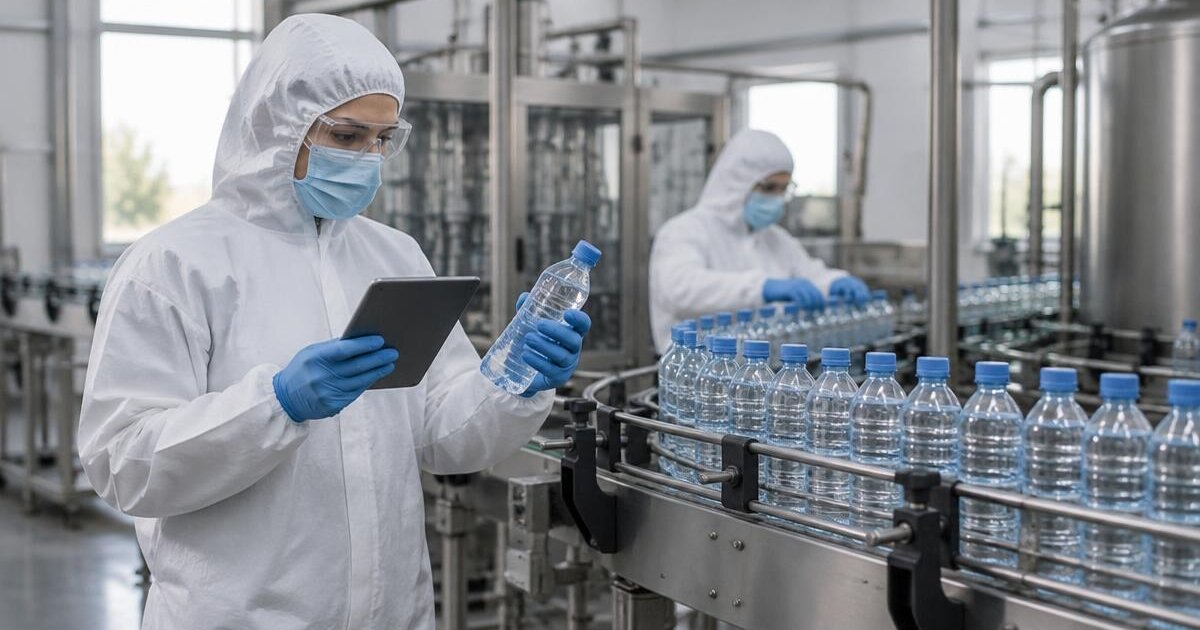
Readiness means being able to connect the water source, treatment, containers, production code and analytical results to a defensible plant decision.
In Short
- For US bottled drinking water, 21 CFR 129.1 applies the applicable criteria in parts 110 and 117 alongside §§ 129.20, 129.35, 129.37, 129.40 and 129.80 to…
- For US bottled-water plants, 21 CFR 129.35(a)(1)–(2) requires approved sources for the product-water supply and any separate operations-water supply, with safe,…
- For US bottled water, 21 CFR 129.35(a)(3)(i) treats E. coli-positive source water as not of safe, sanitary quality.
This guide helps quality, food-safety and plant leads organize that review without confusing source-water evidence with finished-product evidence.
Separate plant CGMP from product identity and quality
For US bottled drinking water, 21 CFR 129.1 applies the applicable criteria in parts 110 and 117 alongside §§ 129.20, 129.35, 129.37, 129.40 and 129.80 to processing, bottling, holding and shipping. For US bottled water, 21 CFR 165.110 separately addresses identity in paragraph (a), quality in paragraph (b), substandard-quality labelling in paragraph (c), and adulteration in paragraph (d). These provisions are related, but they are not a single combined standard.
For US bottled-water plants, 21 CFR 129.3(i) makes shall mandatory and should recommended or advisory. The obligation map below distinguishes legally required records from practical ways to demonstrate operating conditions.
| Requirement | Provision | Frequency or condition | Record or supporting evidence |
|---|---|---|---|
| LAW: Separate the bottling room from other operations and storage by tight walls, ceilings and self-closing doors | 21 CFR 129.20(a) | Plant construction and operation | PRACTICE: Layout drawing and inspection of room boundaries |
| LAW: Use suitable equipment and utensils; product-water contact surfaces must be nontoxic, nonabsorbent and adequately cleanable and sanitizable | 21 CFR 129.40(a) | Equipment selection and use | PRACTICE: Equipment specifications and contact-material information |
| LAW: Keep product-water contact surfaces clean and adequately sanitized; inspect and remedy unsanitary conditions, scale, residue or oxidation before use | 21 CFR 129.37(a) | Inspection as often as necessary; immediate cleaning and sanitizing before use when defects are found | PRACTICE: Surface inspection and corrective cleaning log |
| LAW: Make treatment effective for its intended purpose, using equipment and substances that do not adulterate the bottled product | 21 CFR 129.80(a) | Whenever product water is treated | LAW: Type and date of equipment inspections, conditions found, performance and effectiveness |
| LAW: Sample and test cleaning and sanitizing solutions | 21 CFR 129.80(c) | As often as necessary to assure adequate cleaning and sanitizing performance | LAW: Records of the solution tests |
PRACTICE: Give each obligation an owner and a retrievable record location. For co-packers, separate records maintained by the bottling plant from information exchanged with the brand owner. Broader production context is available in the beverages and liquids industry overview.
Keep source, process and finished-product sampling distinct
For US bottled-water plants, 21 CFR 129.35(a)(1)–(2) requires approved sources for the product-water supply and any separate operations-water supply, with safe, sanitary water and properly located, protected and operated sources. For US bottled-water plants, the presence in the plant of current approval certificates or notifications from the responsible government agencies constitutes approval of the source and supply under 21 CFR 129.3(a).
| Stage | Sampling coverage | Minimum timing or condition | Provision |
|---|---|---|---|
| Source water: chemical and radiological | Each source in use | As often as necessary; chemical contaminants at least once each year and radiological contaminants at least once every 4 years | 21 CFR 129.35(a)(3)(i) |
| Source water: total coliform | Water obtained from other than a public water system | At least once each week | 21 CFR 129.35(a)(3)(i) |
| Processed product water before bottling | Samples after processing and before bottling to assess process uniformity and effectiveness | As often as necessary | 21 CFR 129.80(a) |
| Finished bottled water: total coliform | Representative sample from a batch or continuous-run segment for each type produced during a day's production; primary containers or unit packages | At least once a week | 21 CFR 129.80(g)(1) |
| Finished bottled water: chemical, physical and radiological | Representative sample from a batch or continuous-run segment for each type produced during a day's production | At least annually | 21 CFR 129.80(g)(2) |
For US bottled-water source samples, detection of any coliform organisms triggers follow-up testing to determine whether any are E. coli under 21 CFR 129.35(a)(3)(i). For US finished bottled-water samples, the corresponding follow-up requirement appears in 21 CFR 129.80(g)(1).
For US bottled-water plants, 21 CFR 129.80(g)(3) requires finished-product sampling records to identify the sampling date, product type, production code and analytical results. PRACTICE: Identify the sampling stage on every laboratory request and report index so a source result cannot be mistaken for a packaged-product result.
Handle source failures and testing exceptions precisely
E. coli-positive source water
For US bottled water, 21 CFR 129.35(a)(3)(i) treats E. coli-positive source water as not of safe, sanitary quality. Before reusing that source for US bottled water, the bottler must rectify or otherwise eliminate the contamination's cause sufficiently to prevent recurrence; the source is considered E. coli-negative after five samples collected over a 24-hour period from the same originally positive sampling site test E. coli-negative. For US bottled-water source recovery, analysis of those five samples must be conducted under part 1, subpart R, as specified in 21 CFR 129.35(a)(3)(iii).
For US bottled-water plants, source approval records, plant-responsibility sampling and analysis records, and records describing E. coli corrective measures are to remain on file at the plant under 21 CFR 129.35(a)(3)(i). PRACTICE: Link the corrective action, sampling-site identity, collection times and laboratory reports before recording a source-return decision.
Conditional source-testing exceptions
- LAW — Public water system: US bottled-water firms using a public water system as their source may substitute that system's testing results, or certificates showing full compliance with all EPA National Primary and Secondary Drinking Water Regulation provisions pertaining to chemical contaminants in 40 CFR parts 141 and 143, for the source testing in § 129.35(a)(3), under 21 CFR 129.35(a)(4)(i).
- LAW — Documented waiver: US bottled-water firms not using a public water system may reduce source-testing frequency and the number of chemical contaminants tested if they document that the reduction is consistent with a State-issued waiver under EPA regulations in 40 CFR parts 141 and 143, under 21 CFR 129.35(a)(4)(ii).
- LAW — Disinfectant treatment condition: US bottled-water firms not using a public water system need not test source water for the residual disinfectants and disinfection byproducts listed in § 165.110(b)(4)(iii)(H) if the source water has not been treated with a chlorine-based disinfectant or ozone. For those US bottled-water firms whose source water has received such treatment, testing must cover the listed residual disinfectants and byproducts likely to result from that treatment, under 21 CFR 129.35(a)(4)(iii).
For US bottled water, these are source-testing provisions, not exceptions to the finished-product sampling schedule above. Under 21 CFR 129.35(a)(4)(iv), US finished bottled water must still comply with § 165.110(b) and the adulterated-food provisions of section 402(a)(1) and (a)(3) of the Federal Food, Drug, and Cosmetic Act.
Connect sanitation evidence to containers and filling
For US bottled-water plants, cleaned multiservice containers, utensils and disassembled piping and equipment must be transported and stored to permit drainage and protect against contamination under 21 CFR 129.37(b). For US bottled-water plants, single-service containers and caps or seals must remain in sanitary closures in a clean, dry place until use, then be examined and, as necessary, washed, rinsed and sanitized under 21 CFR 129.37(c).
- LAW — For US bottled water, multiservice primary containers must be adequately cleaned, sanitized and inspected just before filling, capping and sealing; unsanitary or defective containers must be reprocessed or discarded under 21 CFR 129.80(b)(1).
- LAW — For US bottled-water plants, filling, capping or sealing equipment performance must be monitored, and filled containers visually or electronically inspected for soundness, proper closure, coding and labelling under 21 CFR 129.80(f). For US bottled-water plants under that provision, unsatisfactory containers must be reprocessed or rejected, and only nontoxic containers and closures may be used.
For US bottled-water plants, 21 CFR 129.80(d) requires adequate sanitization and sets minimum times and intensities by sanitizing route. For US bottled-water plants under that provision, recording sanitizing-agent intensity and surface-contact duration is recommended, rather than expressed as a mandatory record requirement.
For US bottled-water plants, 21 CFR 129.80(f) recommends a bacteriological swab and/or rinse count at least once each 3 months from at least four containers and closures selected just before filling and sealing. For US bottled-water plants, that advisory frequency does not change the same provision's mandatory container-and-closure sampling and inspection duty or its requirement that all such bacteriological samples be free of coliform organisms.
Support the water name before approving the label
For US bottled water, 21 CFR 165.110(a)(2) permits bottled water or drinking water as the food name, or an appropriate alternative listed below. The table summarizes key naming conditions rather than every labelling provision.
| Name | Key identity conditions | Provision |
|---|---|---|
| Artesian water or artesian well water | Well tapping a confined aquifer with the water level above the aquifer's top; external force may assist collection | 21 CFR 165.110(a)(2)(i) |
| Ground water | Subsurface saturated zone at pressure equal to or greater than atmospheric pressure; not under the direct influence of surface water as defined in 40 CFR 141.2 | 21 CFR 165.110(a)(2)(ii) |
| Mineral water | Not less than 250 ppm total dissolved solids; protected underground source tapped through bore holes or springs; constant mineral and trace-element levels and relative proportions at emergence, allowing natural fluctuations; no added minerals | 21 CFR 165.110(a)(2)(iii) |
| Purified water or demineralized water | Produced by distillation, deionization, reverse osmosis or another suitable process, and meeting the USP purified-water definition incorporated by reference | 21 CFR 165.110(a)(2)(iv) |
| Sparkling bottled water | After treatment and possible carbon-dioxide replacement, contains the same amount of carbon dioxide from the source as at emergence | 21 CFR 165.110(a)(2)(v) |
| Spring water | Natural flow from an underground formation to the surface; collection at the spring or a bore hole tapping its feeding formation; external-force collection subject to same-stratum, hydraulic-connection, pretreatment-equivalence and continued-natural-flow conditions | 21 CFR 165.110(a)(2)(vi) |
| Sterile water or sterilized water | Meets the USP Sterility Tests requirements incorporated by reference | 21 CFR 165.110(a)(2)(vii) |
| Well water | Water from a bored, drilled or otherwise constructed hole tapping an aquifer | 21 CFR 165.110(a)(2)(viii) |
For US bottled-water identity purposes, 21 CFR 165.110(a)(1) excludes food ingredients declared in ingredient labelling as water, carbonated water, disinfected water, filtered water, seltzer water, soda water, sparkling water and tonic water. For US bottled-water quality purposes, 21 CFR 165.110(b) includes water used as a beverage ingredient except those described by these listed declarations.
Evaluate quality separately from the sampling schedule
For US bottled water, 21 CFR 165.110(b)(2)(i) applies microbiological criteria to a sample consisting of equal-volume analytical units. The limits below are regulatory acceptance criteria, not a substitute for the sampling schedule.
- LAW — For US bottled water evaluated by multiple-tube fermentation, not more than one analytical unit may have an MPN of 2.2 or more coliform organisms per 100 milliliters, and no analytical unit may have an MPN of 9.2 or more per 100 milliliters, under 21 CFR 165.110(b)(2)(i)(A)(1).
- LAW — For US bottled water evaluated by membrane filtration, not more than one analytical unit may have 4.0 or more coliform organisms per 100 milliliters, and the sample's arithmetic mean coliform density may not exceed one organism per 100 milliliters, under 21 CFR 165.110(b)(2)(i)(A)(2).
For US bottled water below the prescribed quality standard, 21 CFR 165.110(c) prescribes substandard-quality statements, including “Contains Excessive Bacteria” for failure of the total-coliform criteria. For US bottled water, 21 CFR 165.110(d) deems injurious, filthy, putrid, decomposed or otherwise unfit water adulterated regardless of a substandard-quality label; E. coli presence means the bottled water is adulterated. A substandard-quality label therefore never cures adulteration of US bottled water.
PRACTICE: Route unresolved source, process, identity and finished-result discrepancies to designated people for disposition. A useful release review identifies the affected production codes, the unresolved issue, the supporting results and the person's decision; it does not treat a completed testing calendar as sufficient by itself.
Build a retrievable production and evidence trail
For US bottled water, 21 CFR 129.80(e) requires each unit package to carry a production code identifying the batch or continuous-run segment and production day. For US bottled-water plants under that provision, records must cover product kind, volume produced, production date, lot code and distribution to wholesale and retail outlets.
For US bottled-water plants, 21 CFR 129.80(h) requires records mandated by §§ 129.1, 129.20, 129.35, 129.37, 129.40 and 129.80 to remain at the plant for not less than 2 years. For US bottled-water plants under that provision, current source-and-supply approval certificates or notifications for product water and operations water must also remain on file at the plant, and required documents must be available for official review at reasonable times.
- Approved sourceIdentify the supply and its current approval.
- Source identifier
- Approval reference
- Source samplingAssociate source results with the applicable schedule or documented exception.
- Sampling site
- Source results
- Exception basis
- Treatment and product-water checksConnect treatment equipment evidence with pre-bottling checks.
- Treatment record
- Process-check results
- Container sanitation and fillingConnect container preparation with filling and closure checks.
- Sanitation evidence
- Container disposition
- Production codeIdentify the batch or continuous-run segment and production day.
- Product type
- Production code
- Finished samplingLink packaged-product results to the sampled production.
- Sampling date
- Analytical results
- Release decision by peopleA designated person reviews issues and records the disposition.
- Reviewer
- Decision
- At least 2-year plant recordsKeep the required record set retrievable at the plant.
- Record index
- Plant retrieval location
PRACTICE: Test retrieval by selecting a production code and following its links back to the source, treatment, container and laboratory records. For a co-packing arrangement, agree who assembles the review and who communicates disposition without losing the plant-level record trail.
Worked cases: five readiness decisions
These fictional exercises assume US bottled-water production subject to the provisions discussed above. Concentrations are in parts per million (ppm), and the retention example compares calendar months. The facts illustrate decisions; they are not compliance evidence.
| Case | Assumed facts | Decision | Evidence to request |
|---|---|---|---|
| BW-A | BW1 uses its own spring, not a public water system; weekly source testing finds coliform and follow-up finds E. coli | Source unsuitable for use: apply the recovery sequence above—rectify the cause, obtain five E. coli-negative samples over 24 hours from the same site, and use part 1, subpart R analysis under 21 CFR 129.35(a)(3) | Corrective measures, recurrence-prevention basis, site identity, collection times, five results and laboratory documentation |
| BW-B | BW2 uses a municipal public water system with qualifying full-compliance certificates and asks to stop finished-product coliform sampling | Source-testing substitution only; the finished-product schedule in 21 CFR 129.80(g)(1) still applies | Certificate coverage and finished-product sampling records for each type produced |
| BW-C | A finished lot is E. coli-positive; the plant proposes “Contains Excessive Bacteria” labelling | Adulterated; the proposed label does not cure the result under 21 CFR 165.110(d) | Result-to-production-code linkage and a documented investigation and disposition |
| BW-D | A candidate labelled mineral water measures 180 ppm TDS | 180 ppm is below 250 ppm, so the candidate does not qualify for the mineral-water name under 21 CFR 165.110(a)(2)(iii) | Source and identity assessment supporting an appropriate alternative name |
| BW-E | In November 2026, an auditor requests BW1 finished-product sampling records from March 2025 production | 20 months have elapsed: the records remain within the not-less-than-2-years plant-retention requirement in 21 CFR 129.80(h) | At-plant records identifying sampling date, product type, production code and results |
Questions
How should a bottler and brand owner divide a readiness review?
PRACTICE: Use a responsibility list covering source information, plant records, laboratory reporting, label review and disposition communications. Name the person assembling each item and the person reviewing it; do not assume a commercial handoff also transfers the plant's recordkeeping work.
What makes a laboratory report useful for production review?
PRACTICE: Connect it to the sampling stage, source or product identity, collection date and relevant production code. Resolve ambiguous identifiers before using the report in a disposition decision. The statutory finished-product record fields are covered in the sampling section.
How can a team distinguish a missing record from a failed control?
PRACTICE: Describe the gap precisely: unavailable approval, overdue scheduled activity, incomplete result linkage, failed result or unresolved corrective action. Assign an owner and next action rather than marking all gaps simply incomplete.
Where can beverage teams find related reference material?
Use the beverages and liquids resource collection for adjacent manufacturing topics. Keep this guide's US bottled-water scope separate from requirements for other beverage categories.
Sources
- 21 CFR 129.1 — Current good manufacturing practice (eCFR as of 2 Nov 2026)
- 21 CFR 129.3 — Definitions
- 21 CFR 129.20 — Plant construction and design
- 21 CFR 129.35 — Sanitary facilities (source water)
- 21 CFR 129.37 — Sanitary operations
- 21 CFR 129.40 — Equipment and procedures
- 21 CFR 129.80 — Processes and controls
- 21 CFR 165.110(a) — Bottled water identity
- 21 CFR 165.110(b) — Quality: scope and microbiological standard
- 21 CFR 165.110(c)–(d) — Substandard label statements and adulteration
Practical orientation, not legal advice. Rules differ by jurisdiction; your quality and compliance team decides what applies.
The Pharmaceutical Operations Guide
Right material. Right record. Released by a person.
- Who decides, and who may not
- Supplier to finished bulk
- Test, review, investigate
- Packs, serialisation and recall
Plus Evidence map and four worksheets.
Get the pharmaceutical guideWe ask for your name and email so we can handle this request. The full guide then opens on this site, ready to translate, print or save. Privacy policy. Practical orientation, not legal advice; your quality unit decides which rules apply.
 Ultimate
Free guide
The Pharmaceutical Operations Guide
Right material. Right record. Released by a person.

Keep reading
 21 CFR 111 Readiness: Identity, Master and Batch Records
 21 CFR Part 211 Guide: Scope, Batch Controls and QCU Review
 21 CFR 212 PET Drug cGMP Readiness: Production Evidence Guide
 CMO CDMO Quality Systems: Responsibilities and Handoffs
 Cord Blood Bank cGMP Readiness: 1271, BLA and FACT-NetCord
 Cosmetic Microbiological Quality (ISO 17516) Readiness Guide