
Readings you can trust, and a person who reviews them.
Temperature, humidity, pressure and flow readings are logged against limits you set. An excursion alerts someone, who reviews the evidence and records the decision.
7-day free trial, no card required. Sensors & IoT is in Professional and Enterprise.

Your limits.
Bands, delay and sample rate are yours.
Gaps tested.
Agree how a missing reading shows before go-live.
People decide.
No automatic quarantine; a reviewer disposes.
Follow one cold room for a day
Cold room CR-1 holds finished stock at 2–8 °C. One sensor, one excursion, one review. Four stages.
Calm readings, one excursion, a person decides
Try it: open the door, acknowledge the alert, then review the evidence.
This is a threshold you configure. AI anomaly detection is coming soon and works differently. V5 doesn't decide whether stock is affected; your procedure does. Sensor models and gateways are confirmed before setup.
Explore the details: every stage, with limits and set-up notes
Tap a step below to see what happens.Choose a step below to see what happens.
Step 1 of 4
- ConnectionMQTT · live test passed
- Band2.0 – 8.0 °C
- Sample rateEvery 5 min
- LocationCold room CR-1
Every sensor, one list, its own limits.
The sensor joins one register
- Each sensor has a location, a band and a sample rate.
- Guided pairing includes Modbus TCP, OPC-UA and MQTT, with a live test.
Confirm your sensor models and gateways with us before setup.
More on register: full record and set-up
Also on this record
- Calibration
- Probe · in date
Probe calibration sits beside the sensor.
- Readings
- Temperature, humidity, pressure and flow streams are supported.
Equipment, Monitoring & Response Buyer Guide
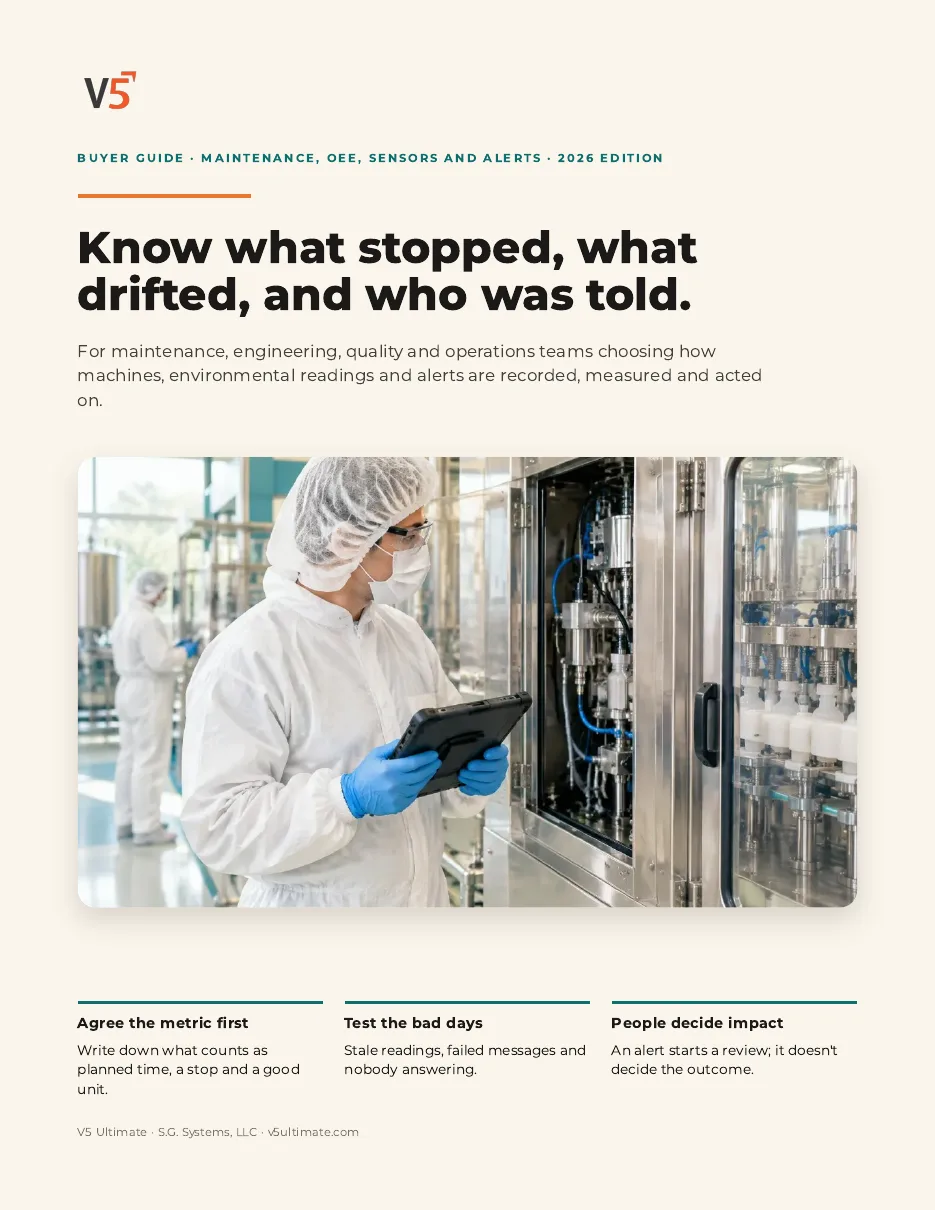
For maintenance, engineering, quality and operations teams choosing how machines, readings and alerts are recorded and acted on. Use it with or without V5.
- 1Agree the metric first.
- 2Test stale readings and failed sends.
- 3People decide the impact.
See what's inside
- What's native vs your procedure
- Asset, PM and calibration roles
- Downtime reasons people use
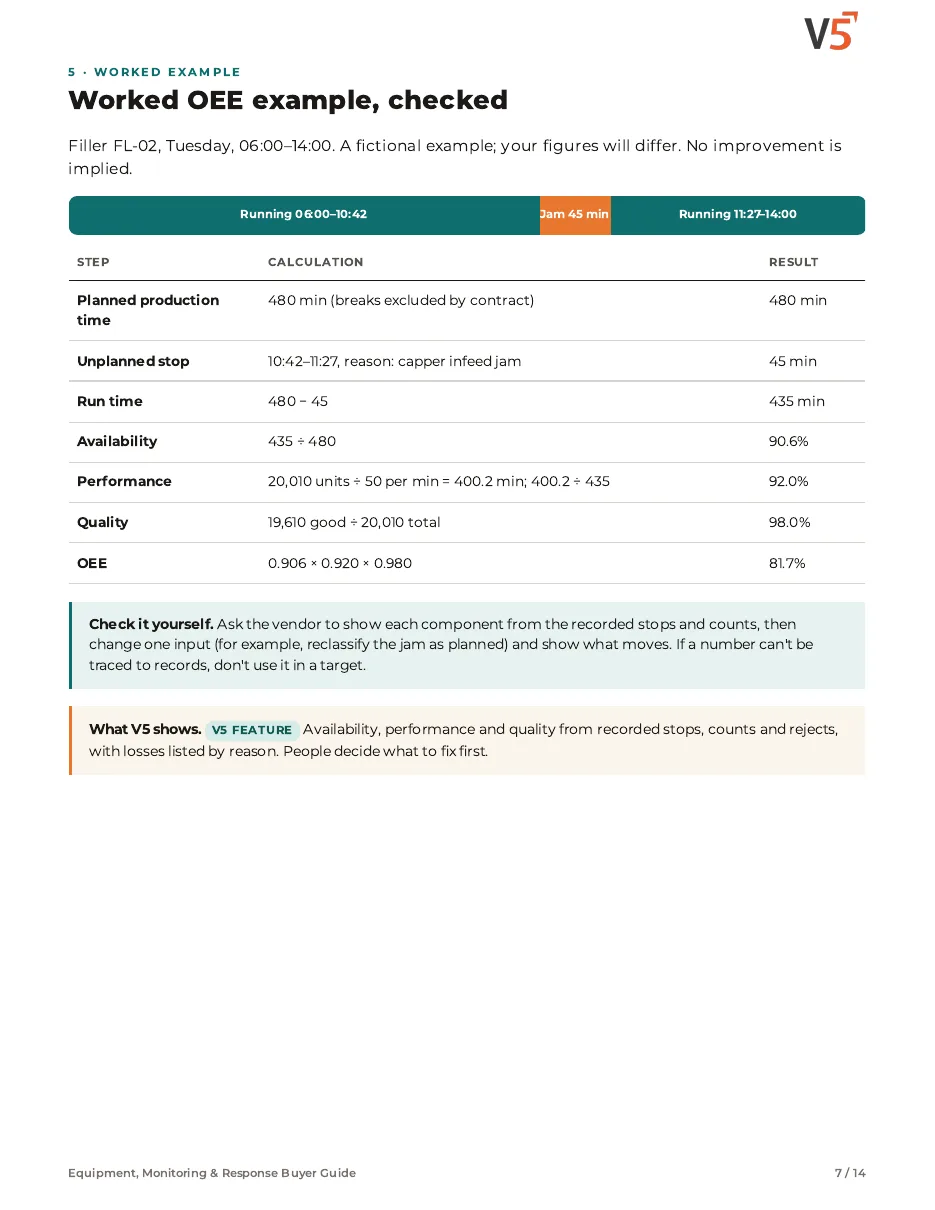
- OEE metric contract and worked maths
- Stale, missing, time and unit tests
- Thresholds vs anomaly detection
- Excursion to human disposition
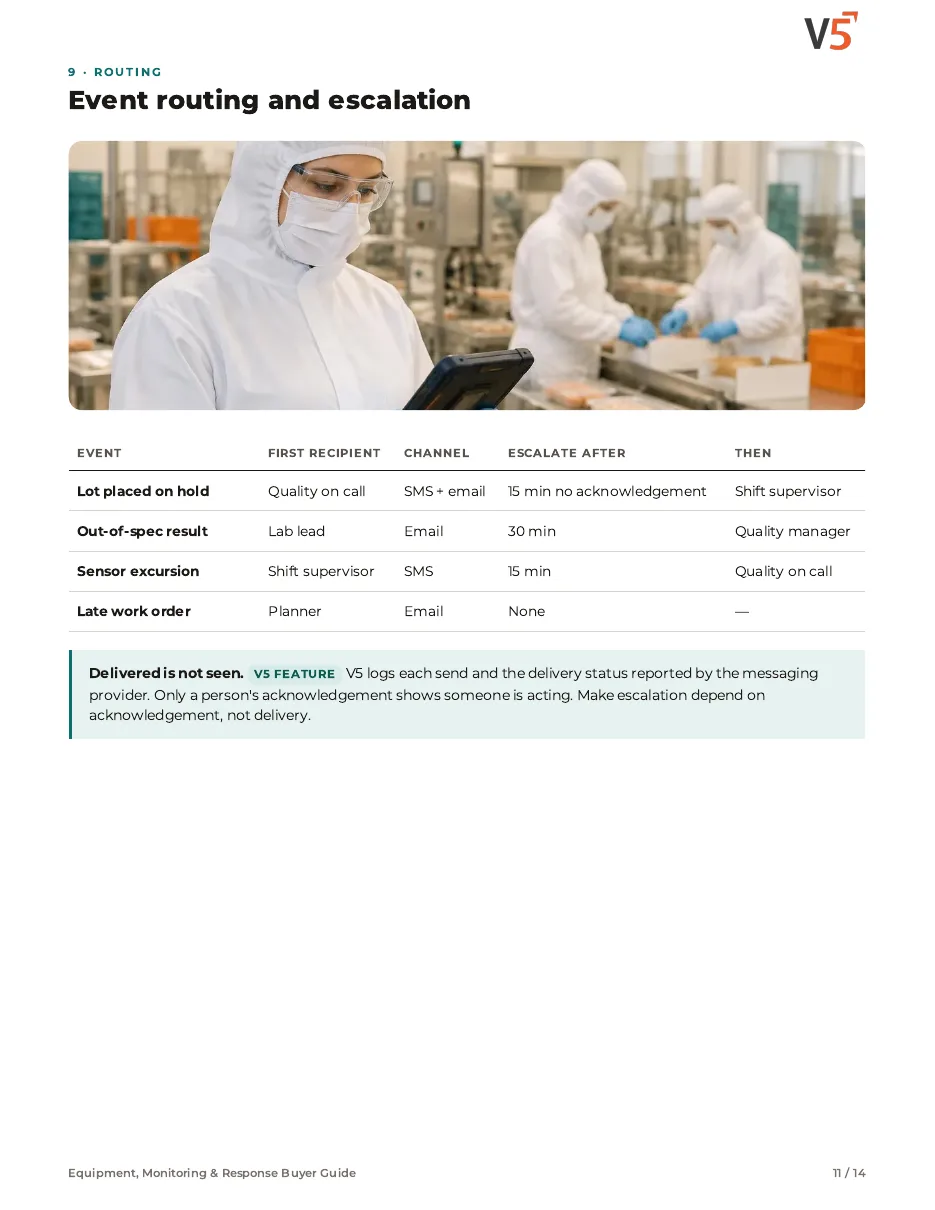
- Routing, escalation, failed messages
- Commissioning RFP matrix
We ask for your name and email so we can handle this request. The PDF downloads in your browser. Privacy policy
Readings support quality and maintenance
Excursions lead to deviations; probes need calibration; machines need maintenance.
What's included
What sensors use, and which plan each item needs. Compare plans
Connected readings
Register, log, alert, review.
Sensors & IoT · Guided device pairing · Deviation management
Explore sensors
Connected readings
Register, log, alert, review.
Sensors & IoT · Guided device pairing · Deviation management
- Sensors & IoTProfessional and EnterpriseStreams, bands, alerts, logging.
- Guided device pairingLive ingest test per device.
- Deviation managementProfessional and EnterpriseWhen an excursion needs one.
- CalibrationProbe due dates.
AI anomaly detection: coming soon, not available today. Alerts go to people. People decide on stock.
Try sensors on one room or line.
Start your free trialOr (you can edit the question before sending) or .