V5 Ultimate
Guide

FDA Form 483 and Warning Letter Response: 15-Day Timeline, Root-Cause Discipline and CAPA Closure

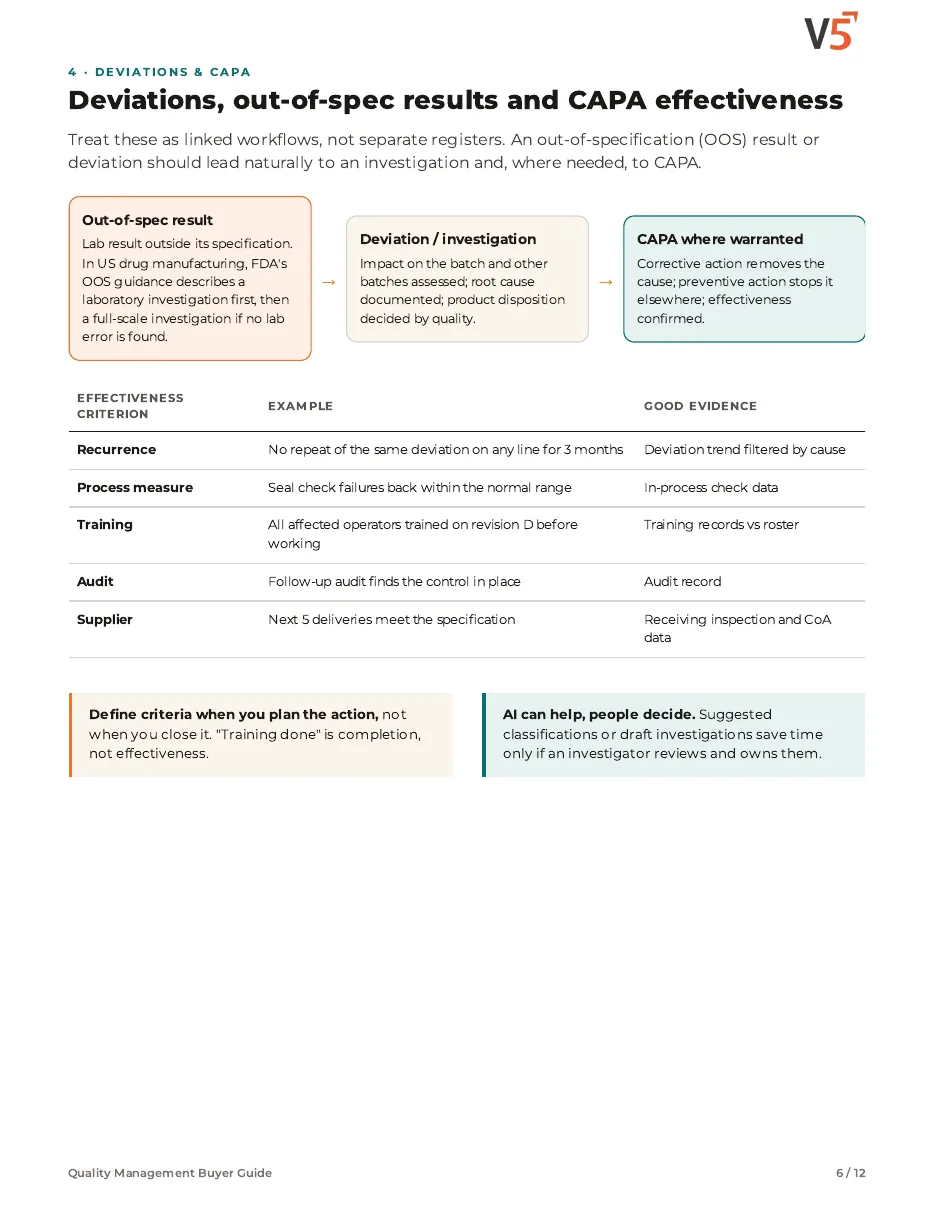
An FDA Form 483 is the inspectional observations document issued at the close-out of an FDA inspection — the inspector's findings of conditions or practices that, in the inspector's judgement, may constitute violations of the FD&C Act and related regulations (21 CFR 210/211 for drugs, 21 CFR 820 for devices, 21 CFR 111 for supplements, 21 CFR 117 for food). A Warning Letter is the formal compliance escalation issued by the FDA District Office or Center after a 483 response is deemed inadequate or after independent significant violations are identified. Both demand fast, evidence-based, executive-owned responses with documented root cause, corrective and preventive action (CAPA), commitments, and verification of effectiveness. This playbook covers the response timeline, response-letter discipline, root-cause and CAPA methodology, executive escalation and re-inspection readiness — the operational pattern that distinguishes a 483 closed without Warning Letter from a 483 that escalates to Warning Letter, Consent Decree or Application Integrity Policy enforcement.

Start free trial Free trial, no credit card, onboard in days, not months.

The 15-business-day clock and the response structure FDA expects

FDA's stated expectation is a written response to a Form 483 within 15 business days of the close-out meeting (per FDA's 2009 policy update on 483 response timing); responses received within that window are considered in the agency's enforcement decision-making, while later responses are evaluated separately. The response letter is addressed to the District Office or Center that conducted the inspection, copies the inspector(s), and references the inspection FEI number and 483 issuance date. Structure each observation response with: verbatim restatement of the observation; immediate corrective action with completion date and evidence; root-cause analysis with the methodology used (5-Why, fishbone, fault tree) and identified root cause; CAPA with action owner, target completion date and effectiveness-verification plan; interim controls in place during CAPA execution; assessment of similar systemic risk across other products, sites or processes (the 'broader applicability' question FDA always asks); and a commitments tracker summarising every action, owner and date in tabular form. The response avoids defensive language, does not contest the observation as written (challenges go through separate appeal channels), and provides supporting evidence (procedures, records, photographs, training records, validation reports) either embedded or attached. Most 483s receive a response of 30-120 pages depending on observation count and complexity.

Root-cause analysis and CAPA discipline that closes 483s without escalation

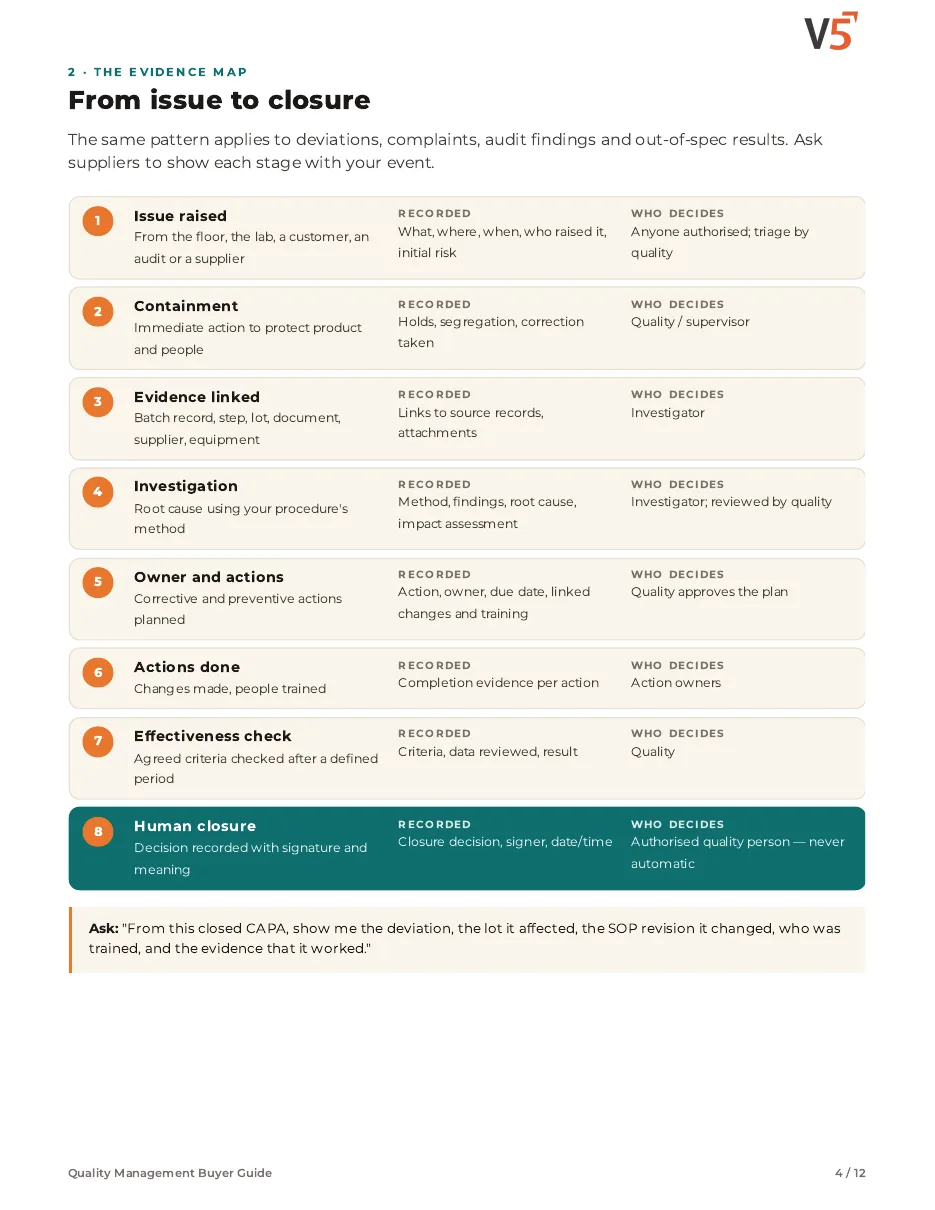
FDA escalates 483s to Warning Letter most often when responses recite immediate corrections without credible root-cause analysis, propose CAPA without effectiveness verification, fail to address systemic applicability across other products/sites/processes, or commit to dates that subsequently slip. Effective root-cause analysis identifies the failure mode (what went wrong), the proximate cause (immediate trigger), the systemic root cause (why the proximate cause was possible — typically procedure gap, training gap, supervision gap, system-design gap or culture gap) and the broader applicability (where else could the systemic root cause manifest). CAPA addresses the systemic root cause — not just the proximate cause — with corrective action (fix the existing defect), preventive action (prevent recurrence at all in-scope products/sites/processes) and effectiveness verification (objective evidence the CAPA works, typically 3-6 months post-implementation with defined metrics). Common CAPA failure modes include: 'retraining' as the sole CAPA (FDA reads this as accepting the same systemic root cause will recur next time individuals turn over); CAPA scoped to the inspected product only when the systemic root cause spans the platform; CAPA with no effectiveness-verification metric defined; CAPA target dates set unrealistically and subsequently slipped; and CAPA closed on completion of action rather than on verification of effectiveness. Mature quality systems run the 483 CAPA as a senior-management-reviewed program with monthly progress reporting until verification closure.

Warning Letter response: executive ownership, commitments tracker and credibility recovery

Warning Letters carry materially higher stakes — they are public on FDA's Warning Letter database within days of issuance, are read by customers, investors, partners and other regulators, and reset the FDA enforcement clock. The response is due within 15 working days, signed by the most senior responsible executive (typically CEO for small/mid-cap, GM or division president for divisions of large companies), and demonstrates credible CAPA, systemic remediation and committed dates. The Warning Letter response repeats the 483 response structure with elevated discipline: every commitment from the original 483 response is restated with current status; every new commitment is dated with a defined owner; a commitments tracker is provided in tabular form (the FDA reviewer's primary monitoring tool); third-party expert engagement (independent quality consultancy with FDA enforcement experience) is typical for credibility and is referenced in the response; the response is closed with an executive commitment paragraph and a re-inspection readiness statement. Concurrent commercial actions include voluntary recall where appropriate, voluntary import alert review, supplier notification, customer notification under contract terms and SEC disclosure for material adverse-event public companies. Post-response, the company runs monthly internal review of every commitment, monthly written status updates to FDA where appropriate, and re-inspection readiness rehearsal (mock inspection) before the FDA returns. FDA typically re-inspects 6-18 months after Warning Letter response to verify closure; observed slippage triggers Consent Decree consideration with court oversight, restricted distribution and substantial financial penalty.

Re-inspection readiness and the close-out cycle

FDA re-inspection following a Warning Letter or significant 483 verifies CAPA implementation and effectiveness. Readiness preparation includes: full review of every original observation with documented evidence of CAPA completion and effectiveness verification; mock inspection conducted by an independent third party with FDA-inspector experience, simulating the original inspection scope and probing for the systemic root causes identified in the CAPA; cross-training of operators, supervisors and quality staff on the original observations and CAPA so any individual interviewed by the FDA inspector demonstrates understanding; document-retrieval rehearsal against likely inspector requests with target retrieval times (most inspectors expect documents in 15-30 minutes for routine requests); facility walk-through with attention to housekeeping, equipment status, and any visible drift from the controlled state; and an inspection-management playbook covering inspector-reception protocol, daily debrief discipline, scribe assignment, real-time commitment tracking and senior-management close-out coordination. Re-inspection outcomes include: clean re-inspection (Warning Letter closed via FDA close-out letter); re-inspection with minor 483 observations (additional CAPA cycle, generally not escalating); re-inspection with significant findings (Consent Decree consideration, criminal referral for fraud findings, Application Integrity Policy invocation for data-integrity findings). FDA's Compliance Status Information System (CSIS) and FDA enforcement reports provide industry benchmarks of typical close-out timelines (12-36 months for Warning Letters depending on severity) and consequences for failed re-inspection.

Where this lives in V5 Ultimate

The clauses above aren't theoretical — every one maps to a shipped module and an industry profile. Jump to the parts of the product that turn this guide into evidence on a Monday morning.

Frequently asked

What if we miss the 15-business-day response window?
A late response is still evaluated by FDA but loses the policy-stated 'considered in enforcement decision-making' protection. Late responses are read in the context of an already-escalating enforcement posture and are more likely to be accompanied by Warning Letter, import alert or other enforcement action. If you cannot deliver a complete response within 15 business days, the disciplined approach is to submit a partial response on time covering the immediate corrections, root-cause-analysis methodology and CAPA framework, with a defined date for delivery of full CAPA detail and effectiveness-verification plans. Silence past the 15-day window is a credibility failure that FDA reviewers remember through subsequent interactions.
Should we challenge or dispute observations in the 483 response?
No — the 483 response is not the appropriate forum for disputing observations. The response addresses each observation on its merits, even where the company disagrees with the inspector's characterisation. If the company has substantive disagreement (factually incorrect observation, observation outside FDA jurisdiction, observation reflecting a regulation the FDA inspector misinterpreted), the response can note the disagreement professionally while still committing to CAPA addressing the underlying concern, and pursue the substantive disagreement through the District Office Director or appropriate Center compliance branch through separate correspondence. Defensive or argumentative response letters significantly raise the probability of Warning Letter escalation.
Do we need to disclose a Form 483 to customers, investors or other regulators?
Disclosure obligations depend on the company's contractual, securities and regulatory commitments. Public companies typically disclose material adverse FDA actions under SEC continuous-disclosure rules (Form 8-K in the US, Listing Rules disclosure in UK/EU/AU markets) — materiality assessment depends on observation severity, product/site materiality to the business and likely enforcement trajectory. Customer disclosure is typically governed by quality agreements and supply contracts (which often require notification of significant regulatory observations or actions affecting supplied product). Other regulators (EMA, Health Canada, PMDA, MHRA) typically learn of FDA Warning Letters through information-sharing arrangements and may initiate parallel review of products supplied to their markets from the affected site. Pre-emptive transparent disclosure is generally lower-risk than reactive disclosure after the information emerges through FDA's public Warning Letter database.

See it on your shop floor.

Free trial, no credit card, onboard in days, not months.

Spot something off? .