V5 Ultimate
Food Processing · How V5 Runs

How V5 Ultimate runs a food processing site, end to end.

Eleven touchpoints — from ingredient/raw-material supplier to a queried RFR — that share one immutable ledger. Mapped to 21 CFR 117 (Preventive Controls), FSSC 22000, FSMA 204, FDA Food Facility Registration / FDA Reportable Food Registry and Part 11. Read it as a playbook, audit it as a checklist.

Start free trial
21 CFR 117FSSC 22000FSMA 20421 CFR Part 11FDA Food Facility RegistrationFDA Reportable Food RegistrySubparts A–G21 U.S.C. §350f (RFR)
ONE IMMUTABLE LEDGERFSSC 22000 · FSSC 22000 · Food Safety Plan · 21 CFR 117 (Preventive Controls) · FSSC 22000 · Part 11 · batch code / FDA Food Facility Registration01Supplierqual'd02Receivequarantine03Master Manufacturing Recorddesign ctl04Kioskassemble05Micro releasemicro criteria06Batch Production Record + batch code2-sig07Shipbatch code / FDA Food Facility Registratione-sige-sig2-sige-sigThe evidence chainEvery action signs the ledger — nothing is re-keyed at the end.
Executive summary

One ledger, every touchpoint — from supplier to recall in seconds.

V5 Ultimate runs a food processing site as one connected system, not a stack of integrations. Ingredient receipt, Master Manufacturing Record / Batch Production Record, kiosk-led batching and filling, in-process checks and finished-product QC, OOS / CAPA, micro release, packaging with batch code and ingredient labeling, QA release, distribution and the entire QMS (FSP, documents, training, internal audits, Management Review, stability, claims dossier, equipment / calibration, complaints and food safety surveillance) all write to the same immutable, identity-verified ledger.

The pay-off is operational: review-by-exception Batch Production Records reviewed in 20–40 min instead of 4 hours, Management Review cycles cut from 4–6 weeks to 3–5 days per brand, and a market action that resolves as a query — forward and backward from any node — not a project.

This playbook walks you through 11 traceability touchpoints and the 17 quality-system modules that wrap them, grouped into 8 readable parts. Every section anchors to the relevant articles and annexes of 21 CFR 117, the 17 chapters of FSSC 22000, FSMA 204 and 21 CFR Part 11.

11
Traceability touchpoints
8
Thematic parts
30+
Regulatory anchors
Part I

Foundations

Why traceability is the spine, and the eleven-node map.

01

Why traceability is the product, not a feature

In food manufacturing, the unit that ships is the batch — but the unit a regulator audits is the evidence chain behind it.

Floor actionscan · weigh · e-sigactor + tsSTEP 01Append-only rowDB trigger writes oncesha256STEP 02Batch Production Record snapshotfrozen at releaseWO boundSTEP 03PDF renderfrom snapshot onlydeterministicSTEP 04Inspector packexported on demand21 CFR 11STEP 05ALCOA+ lineageAttributable · Legible · Contemporaneous · Original · Accurate · + Complete · Consistent · Enduring · AvailableOne origin event. No re-keying. No reconciliation.
ALCOA+ in one picture: one origin event, replayable downstream.

Every component lot, every cleaning record, every operator e-signature, every deviation, every counter-reading on a filling/packaging line: if it isn't connected forward to the released batch and backward to the lot of starting material that fed it, the batch is unsafe at law. ISO 22000:2018 8.9 doesn't ask for 'a record' — it asks for a traceability system that provides the complete history. 21 CFR Part 117 Subpart F (Records) requires appropriate records to be established and maintained.

Most food-safety stacks treat traceability as an afterthought — bolt-on reports stitched together at audit time from paper logbooks, MES exports, LIMS spreadsheets, and a hand-typed Batch Production Record. V5 Ultimate inverts that: traceability is the spine the platform is built around. Every action on the floor, in QC, in the warehouse, on a supplier portal — writes one immutable record, with the lot, batch, operator, instrument, and timestamp baked in at the moment it happens.

The customer experience that follows is the obvious one: a recall that takes seconds, an inspector who asks for the Batch Production Record and gets a tab-complete answer, a CAPA that closes with linked evidence instead of a Word document and a prayer.

Regulatory anchors
  • ISO 22000:2018 8.9Traceability system — end-to-end lot/batch linkages
  • ISO 22000:2018 7.5Documented information — control and retention of records
  • FSSC 22000Food Safety Management System lifecycle
02

The end-to-end traceability chain at a glance

Eleven touchpoints, one record. The diagram below is the map — the rest of this page is the legend.

  1. 01
    Supplier
  2. 02
    Receive
  3. 03
    Warehouse
  4. 04
    Master Manufacturing Record
  5. 05
    Build release
  6. 06
    Bulk batching
  7. 07
    Inspect / Test
  8. 08
    NCR / CAPA
  9. 09
    Micro release
  10. 10
    Fill + pack
  11. 11
    QA release (Batch Production Record)
One immutable ledger underneath. Every node writes; nothing is re-keyed.

Read left-to-right. Every node writes to the same immutable ledger, and every node carries forward the lot, batch, operator, and instrument context from the node before it. Nothing is re-keyed; nothing is reconciled at the end.

Part II

Materials in

Supplier → quarantine → warehouse, status-controlled.

03

Touchpoint 1 — Supplier onboarding & qualification

An ingredient or packaging supplier isn't approved until their evidence is on file and their CoCs land in the right place automatically.

V5 holds the supplier master with the qualification status, scope (material × site × grade), audit dates, and approved alternates. New suppliers go through a portal-driven onboarding: company info, regulatory licences, GMP/GDP certificates, allergen and BSE/TSE statements, change-notification commitments. Quality reviews, signs, and the supplier moves to 'Approved (scoped)'.

Re-qualification runs on a calendar — V5 chases expiring certificates automatically through the supplier portal and escalates if a document misses its window. The release engine refuses to consume any material whose supplier × material combination isn't currently approved. There is no 'override and ship' button; there is a quarantine-pending review.

  • Scoped approval: supplier × material × site × grade
  • Auto-chased re-qualification with portal acks
  • CoCs auto-attach to receipt by lot
  • Audit trail of every change to supplier status
Regulatory anchors
  • ISO 22000:2018 8.4Control of externally provided processes, products or services (supplier approval)
  • FSSC 22000 v6 AR 2.5Management of purchased materials (including specifications for ingredients and packaging)
04

Touchpoint 2 — Receiving, sampling & quarantine

Every receipt lands in quarantine and stays there until QC says otherwise. The system enforces the wall, not a sticker.

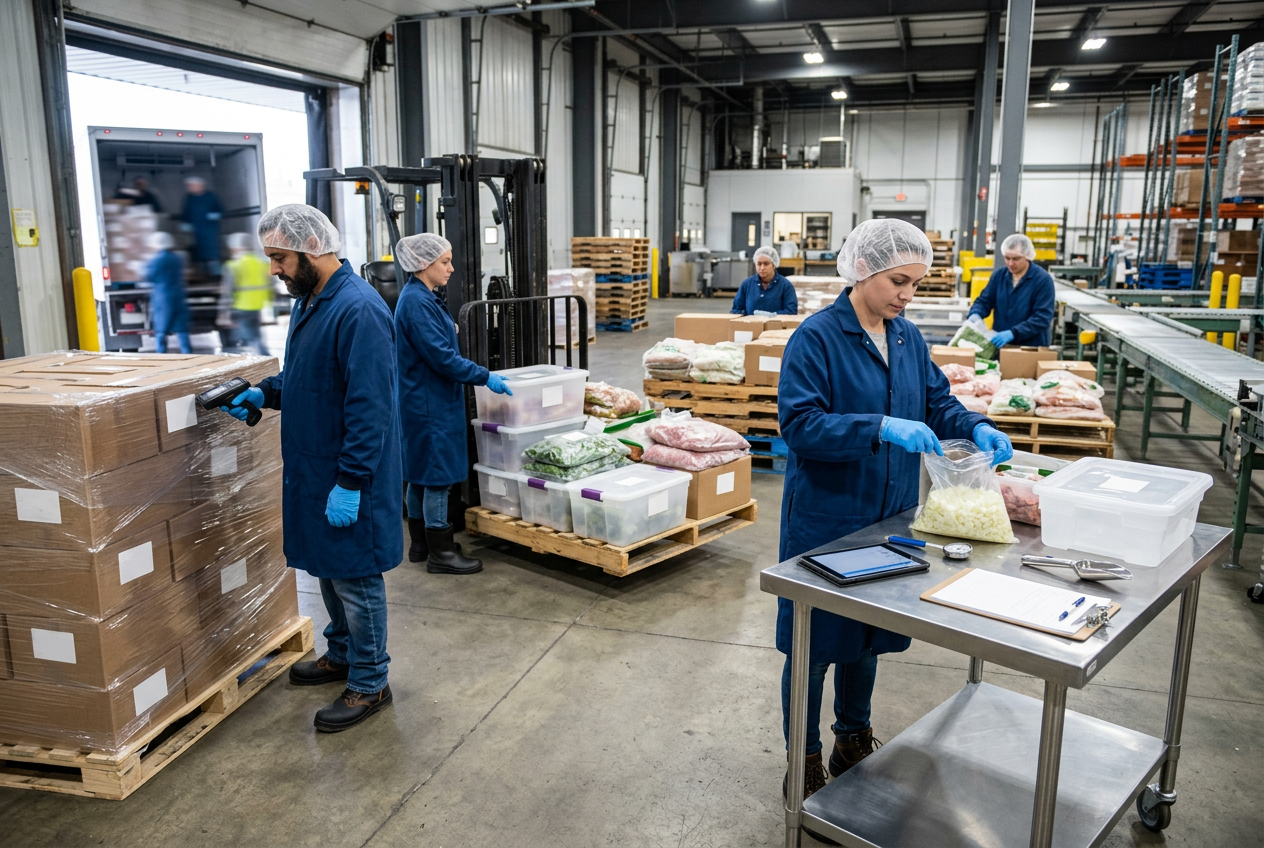
A receiving operator scans the delivery, V5 checks the supplier/material combination against the approved master, prints (or e-stamps) a quarantine label per container, and creates lot records with a 1:1 link to the CoC, the PO, the carrier's docs, and the temperature log if the material is cold-chain. Status is Quarantine until QC dispositions it.

Sampling is driven by a sampling plan derived from material risk class (e.g., high-risk ingredient, allergen-containing, primary packaging, label). V5 generates the sample request, prints the sample labels with traceable IDs, and the LIMS bridge carries the results back to the same lot. Disposition flips the lot to Released, Rejected, or Conditional — and every kiosk in the plant sees the change in real time.

  • Quarantine is a status, not a sticker — enforced at every consume event
  • CoC, carrier docs, temperature logs all attached at the lot level
  • LIMS results return to the same lot record automatically
  • Conditional release supported with mandatory close-out
Regulatory anchors
  • 21 CFR 117.80(b)Raw materials and other ingredients — receipt, inspection, and segregation
  • ISO/TS 22002-1 (PRPs)Sampling and testing of raw materials
05

Touchpoint 3 — Warehouse, lots & status control

Lot status drives what the warehouse can pick. The pick gun is the policy engine, not a barcode scanner.

Every bin, every container, every split lot carries a status: Quarantine, Released, On-Hold, Quarantine-Excursion, Rejected, Expired. Pickers see only what's pickable for the current work order — V5 hides the rest. FEFO is enforced by default; overrides require a documented reason and a second signature.

Movements (putaway, transfer, decant, split) write to the same ledger as the rest of the platform. A lot can be split into N child containers, each inheriting parentage; when you trace forward later, every child remembers the parent and the operator who did the split.

Cycle counts, recall sweeps, and stock-take reconciliations are filterable by status and supplier — a recall doesn't start with a spreadsheet, it starts with a query.

  • Status-aware FEFO with documented overrides
  • Parent/child lot genealogy on every split
  • Cycle count + recall filterable by supplier × lot
Regulatory anchors
  • 21 CFR 117.93Warehousing and distribution — storage and segregation
Part III

Recipe & execution

Master Manufacturing Record, snapshot, kiosk, in-process QC.

06

Touchpoint 4 — Master Production Record (formulation and processing instructions)

The Master Manufacturing Record is the controlled recipe. In V5 it's a versioned, signed, machine-readable object — not a Word document.

The Master Manufacturing Record for a finished product holds the BOM with target weights and tolerances, the routing (stations, instruments, environmental conditions), the in-process checks with sampling rules, the cleaning protocol between batches, the labelling artwork, and the release specification. Every field is a structured slot the kiosk can render and the Batch Production Record can snapshot.

Master Manufacturing Records go through a two-signature approval workflow (author + QA approver, identity-verified e-signatures, Part 11). Once Effective, the Master Manufacturing Record is locked; any change goes through change control (see §10) and produces a new minor or major version with effective dates. The release engine binds the work order to a specific Master Manufacturing Record version; you cannot 'use the latest' by accident.

  • Structured BOM, routing, IPC, cleaning, artwork, spec
  • Two-signature, Part 11 e-signatures, immutable once Effective
  • Versioned with effective-date binding to work orders
Regulatory anchors
  • ISO 22000:2018 7.5Documented information — control of specifications and instructions
  • ISO 22000:2018 8.5Control of production and service provision — processing instructions
07

Touchpoint 5 — Work order release & Master Manufacturing Record snapshot

Releasing a work order takes a snapshot. From that moment, the batch carries its own copy of the recipe — frozen forever.

Master Manufacturing Record v3.2BOM · Routing · IPCSpec · ArtworkEFFECTIVE · 2-SIGSNAPon releaseWO-2026-0418Bound to Master Manufacturing Record v3.2Frozen recipeRELEASED · sha256:a4f9…runs even ifMaster Manufacturing Record revisesBatch Production Record (this batch)Filled by kiosk+ IPC + dev + sigsIMMUTABLEMaster Manufacturing Record v3.3 (later revision)does NOT affect WO-2026-0418
The WO carries a frozen copy of Master Manufacturing Record v3.2. Later revisions don't disturb this batch.

When planning releases a work order, V5 binds it to a specific Master Manufacturing Record version and copies that version into the batch's Batch Production Record shell. Even if the Master Manufacturing Record is revised next week, this batch will always reference what was Effective at release time. The snapshot includes BOM, tolerances, instrument requirements, IPC plan, cleaning, artwork, and spec.

Operator availability, training currency, instrument calibration status, and hygienic zoning/environmental conditions status are all checked at release. A work order cannot be released to a station with an out-of-cal scale or an operator whose training expired yesterday. The check is automated and immutable.

  • Immutable Batch Production Record snapshot at the moment of release
  • Operator training + instrument calibration gated at release
  • Concurrent batches kept logically isolated by work order
Regulatory anchors
  • ISO 22000:2018 7.5Documented information — procedures and records
  • 21 CFR 117.40Equipment and utensils — design and maintenance (including automated systems)
08

Touchpoint 6 — Kiosk build-step & weighing

The kiosk is the floor. Every weight is verified against the Batch Production Record tolerance the moment it lands on the scale.

An operator scans the work order, V5 walks them through the build list step by step: scan the lot, scan the container, place on the validated scale, wait for stable, V5 captures the reading directly from the instrument. The reading must fall inside the tolerance from the snapshotted Batch Production Record — if it doesn't, the kiosk holds and forces a deviation or a re-build-step before continuing.

Every event writes to the Batch Production Record in real time, identity-verified. Operators can't skip a step, can't proceed past a hold, and can't enter a value by hand for a connected instrument. The Batch Production Record fills itself; the operator does the work.

  • Direct instrument capture — no hand-entered weights for connected scales
  • Hard stop on out-of-tolerance with mandatory deviation
  • Identity-verified e-sig on every step (Part 11)
  • Concurrent-station support with logical isolation per work order
Regulatory anchors
  • ISO/TS 22002-1 (PRPs)Weighing and measuring of ingredients
  • FSSC 22000Calculation of yield
  • 21 CFR Part 11Electronic records & signatures
09

Touchpoint 7 — In-process and finished QC

QC is not a parallel system. The IPC plan from the Master Manufacturing Record drives the sampling, and the result returns to the Batch Production Record.

In-process checks (fill weights/weight control, pH or Brix, metal detection/foreign material checks, processing temperatures, microbial sampling on a production line) are scheduled by the Batch Production Record's IPC plan. V5 raises the sample request, prints the sample label with traceable ID, and accepts the result — either entered at the kiosk by a trained tester or returned from a LIMS bridge.

Out-of-spec triggers an automatic hold on the affected sub-lot and a deviation record. Trending across batches is continuous (CpK, control charts) so a drift toward spec gets escalated before a single batch goes out-of-spec.

  • IPC plan driven by Master Manufacturing Record; sampling auto-scheduled
  • OOS triggers sub-lot hold + deviation automatically
  • Trending (CpK, control charts) continuous across batches
Regulatory anchors
  • FSSC 22000Sampling & testing of in-process materials
  • 21 CFR 117 Subpart CFood Safety Plan — hazard analysis and preventive controls informing sampling
Part IV

Quality events

Every hold lands in one queue.

10

Touchpoint 8 — Deviations, NCRs, CAPA & change control

Every hold raised on the floor lands in the same quality module. No second system, no copy-and-paste, no orphans.

When the kiosk holds on an out-of-tolerance build-step, an OOS IPC, or a temperature excursion, V5 opens a Deviation linked to the work order, the step, the operator, the instrument, and the affected lot. QA triages, classifies (planned / unplanned, minor / major / critical), runs an impact assessment against other batches, and routes for CAPA if needed.

CAPAs are tracked to root cause with effectiveness checks at agreed intervals. Change control governs everything from Master Manufacturing Record revisions to supplier substitutions to instrument firmware upgrades — each change with a risk assessment, validation impact, training impact, and a controlled effective date.

  • Deviation auto-linked to work order, step, operator, instrument, lot
  • Classification + impact assessment workflow (planned/unplanned, minor/major/critical)
  • CAPA tracked to root cause with timed effectiveness checks
  • Change control with risk, validation, training, and effective date
Regulatory anchors
  • ISO 22000:2018 10.2Nonconformity and corrective action (CAPA)
  • ISO 22000:2018 6.1Actions to address risks and opportunities
  • FSSC 22000Production record review & deviations
Part V

Pack to customer

Serialisation, release, distribution, recall.

11

Touchpoint 9 — Packaging, labelling & serialization

The serialised unit is the smallest customer-facing record. V5 carries the Batch Production Record all the way down to it.

Packaging routings run the same way as manufacturing: a kiosk-led step list, reconciled label counts, line-clearance checks before any new batch enters the line, and a verified label artwork against the Master Manufacturing Record. Serialisation (GS1 SGTIN, aggregation through bundle / case / pallet) writes to the same ledger; every SSCC carries the parent batch and a full hierarchy upward.

21 CFR 101 food labeling (including batch/lot codes where used) and FSMA 204 Food Traceability Rule KDE/CTE records are first-class outputs, not adapters. When a customer asks 'which case this unit is in, on which pallet, on which truck?' the answer is one query.

  • Line clearance with photographic evidence before each new batch
  • Reconciled label counts (issued / applied / destroyed / returned)
  • GS1 SGTIN serialisation + full aggregation hierarchy
  • FDA Food Facility Registration (21 CFR Part 1 Subpart H) + US FSMA 204 KDE/CTE recordkeeping — built-in
Regulatory anchors
  • FSSC 22000Materials examination & usage criteria — packaging & labelling
  • FSMA 204 (21 CFR Part 1 Subpart S)Food Traceability Rule — key data elements and critical tracking events
  • 21 CFR Part 101Food labeling — lot/batch coding and required label elements
12

Touchpoint 10 — QA review & batch release (Batch Production Record)

Review by exception. The Batch Production Record is built as the line runs, not assembled afterwards.

By the time the last step is signed, the Batch Production Record is complete: every build-step, every IPC, every deviation, every CAPA reference, every cleaning record, every operator e-signature, every instrument calibration evidence. QA reviews by exception — V5 highlights anything that wasn't a clean pass, and the reviewer disposition is the second of the two-signature release per ISO 22000:2018 8.8.

Release is gated by: all deviations dispositioned, all OOS closed, all open CAPAs assessed for impact, expiry date calculated from the established shelf-life model, and a stability commitment registered if applicable. A released batch generates the Certificate of Analysis from the same data — no re-typing.

  • Review-by-exception highlights anything not green
  • Two-signature release (preparer + independent QA), Part 11
  • DoC generated from the same data — never re-typed
  • Shelf-life model drives expiry calc and stability registration
Regulatory anchors
  • ISO 22000:2018 8.8Verification of monitoring and measuring results prior to release
  • FSSC 22000Production record review
  • ISO 22000:2018 7.5Documented information — control and retention of records
13

Touchpoint 11 — Distribution, complaints & recall

A recall in V5 is a query, not a project. The lookback is forward and backward from any node.

Recall lookback timelineFrom recall trigger to drafted FDA report — measured in minutes, not weeksT+0sRecall triggerQA flips lot to RecallSTEP 01T+12sBackward traceSupplier · lot · Master Manufacturing RecordSTEP 02T+43s100% units foundBottle · case · palletSTEP 03T+2m 11sCustomers notifiedPortal + FSMA 204 KDE/CTE data pushSTEP 04T+8mFDA report draftedAuto from ledgerSTEP 05Bidirectional from any node — bottle ⇄ case ⇄ pallet ⇄ batch ⇄ lot ⇄ supplier
One ledger, one query. Forward and backward from any node.

Released batches ship with full pedigree under FSMA 204 Food Traceability Rule (where applicable): every unit's lot/batch chain of custody is in the ledger before the truck leaves. Complaints land via a customer portal or a CSM ticket, route to QA, and link forward to a complaint investigation file that can spawn deviations and CAPAs.

When a recall is triggered, V5 answers four questions instantly: which lots of which materials are implicated, which batches consumed them, which units shipped from those batches, and which customers received which units. A trigger from any node propagates in seconds; no analyst, no spreadsheet, no overnight reconciliation.

  • Full pedigree shipped before the truck leaves
  • Recall lookback forward & backward from any node
  • Complaint → investigation → deviation → CAPA — one chain
Regulatory anchors
  • FSSC 22000Distribution records
  • FSSC 22000Complaint files
  • 21 CFR 117.139Recall plan (Preventive Controls for Human Food)
Part VI

Quality system

QMS, documents, training, Management Review, audits.

14

Quality system controls underpinning every step

The QMS (FSSC 22000) isn't a separate module — it's the substrate every other workflow sits on.

User roles & permissions, training matrix with currency enforcement, instrument calibration with auto-hold on lapsed cal, validated cleaning protocols with verification swab results, environmental monitoring with trended alert/action limits, supplier qualification status, deviation & CAPA workflow, change control, internal audit program, management review with KPI dashboards. Each is a first-class object with its own lifecycle and audit trail.

The platform doesn't 'support' the QMS — the QMS is what the platform is. Every action everywhere checks the QMS state and refuses to proceed if a control is missing or expired.

  • Training currency enforced at the kiosk, not on paper
  • Calibration auto-hold on lapsed instrument cal
  • EM trending with alert/action limit escalations
  • Internal audit program + management review dashboards
Regulatory anchors
  • FSSC 22000Food Safety Management System
  • 21 CFR 117 Subpart BCurrent Good Manufacturing Practice — personnel and operations
15

Document control & SOP lifecycle

Every controlled document — SOP, policy, work instruction, form, spec — lives inside V5 with author / reviewer / approver workflow, periodic review, and Part 11 e-signatures.

V5 ships a full Document Management System: hierarchical taxonomy (Quality Manual → Policy → SOP → Work Instruction → Form), document numbering rules per site, draft / in-review / effective / superseded / obsolete statuses, and configurable workflow (e.g. author → SME → QA → site head). Read-acknowledgement assignments push the new SOP to every affected role and block kiosk login until the operator has signed the read-and-understood.

Periodic review is calendar-driven — V5 raises a review task at the configured cadence (typically 12, 24 or 36 months), routes it to the document owner, and escalates if it slips. Change requests link to deviations, CAPAs, audit findings, or change controls so the 'why' is always inside the file. Redlines are diff-tracked between versions; the audit trail captures who saw what, when, on which device.

  • Draft → review → approve → effective workflow with Part 11 e-sigs
  • Read-and-understood assignments tied to roles, blocking access until signed
  • Periodic review schedule with auto-escalation
  • Version diffing with full audit trail of who saw which revision
  • Linked source-of-change (deviation / CAPA / audit / change control)
Regulatory anchors
  • FSSC 22000General requirements for records & reports
  • ISO 22000:2018 7.5Documented information — creation, updating, and control
  • ISO 22000:2018 7.5Documented information within the FSMS
16

Training & competency management

Training isn't a folder of certificates — it's a live matrix that gates every action on the floor.

V5 holds the training matrix as role × competency × currency. New hires get a curriculum auto-assigned on day one (induction, GMP basics, gowning, site safety, role-specific SOPs); completion is recorded with quiz scores, observation sign-offs from a qualified trainer, and a re-qualification interval. Competencies are linked to physical actions: weigh-out, IPC, line clearance, batch review, supplier audit.

The kiosk and Batch Production Record enforce the matrix at the moment of action. An operator whose 'filling/packaging line operation' competency expires at midnight can't start a press / weld shift the next morning until requalified. Trainer qualifications are themselves competencies — only qualified trainers can sign off another operator's competency record. Re-training is auto-scheduled when an SOP is revised, when a deviation root cause cites training, or when a metric (e.g. operator-attributable defects) trends adverse.

  • Role × competency × currency matrix, machine-readable
  • Curriculum auto-assignment on hire and on role change
  • Kiosk gate: expired competency = no action permitted
  • Trainer qualification chain (qualified-to-qualify)
  • Re-training triggered by SOP revision, deviation, or trended drift
Regulatory anchors
  • FSSC 22000Personnel qualifications & training
  • ISO 22000:2018 7.2Competence — training program
  • ISO 22000:2018 7.2Competence — trained personnel
17

Management Review (Management Review)

Year-on-year product quality is a query, not a project. V5 assembles the Management Review continuously and renders it on demand.

Management Review — continuous assemblyEvery batch, IPC, OOS, deviation and complaint feeds the review as it happensJanbatch · IPCFebbatch · IPCMarbatch · IPCAprbatch · IPCMaybatch · IPCJunbatch · IPCJulbatch · IPCAugbatch · IPCSepbatch · IPCOctbatch · IPCNovbatch · IPCDecbatch · IPCManagement ReviewTrends · CpK · OOS · CAPAStability · Complaints · PVISO 22000:2018 9.3 · FSSC 22000CpK trend chartOOS / CAPA registerStability projectionSigned Management Review PDF
Management Review assembles continuously — not a 4-week scramble at year end.

ISO 22000:2018 clause 9.3 requires a documented management review covering, at a minimum: FSMS performance and effectiveness, changes that could impact the FSMS, trends in monitoring and measurement results, nonconformities and corrective actions, verification and validation results, audit findings, and opportunities for improvement.

Because every one of those data points is already in the ledger, V5 maintains a live Management Review workspace per product per year. Trend charts (CpK, OOS rate, deviation by category, recovery yield) refresh nightly. At year-end, QA reviews the assembled draft, adds the executive summary and the proposed actions, signs the report, and exports a regulator-ready PDF — typically a week of work instead of a quarter.

  • Per-product, per-year workspace continuously assembled from the ledger
  • Trended CpK, OOS rate, RFT, deviation categories, yield
  • Stability results, returns, complaints, recalls, changes — all pre-loaded
  • Reviewer-led completion with two-signature sign-off
  • Export pack: PDF + appendix datasets for regulators
Regulatory anchors
  • FSSC 22000Management Review
  • ISO 22000:2018 9.3Management review
  • ISO 22000:2018 9.3Management review of FSMS performance and effectiveness
18

Audit & inspection management

Internal audits, supplier audits, and regulatory inspections all run through one program — with findings, CAPAs, and verification linked to the same ledger.

V5 holds the audit programme: scope (internal area, supplier, contract manufacturer), risk-based frequency, lead auditor assignment, checklist library aligned to FSSC 22000, ISO 19011, and applicable GMP chapters. Audit execution captures findings inline with photographs, evidence references, classification (critical / major / minor / observation), and immediate corrections.

Findings auto-route to the affected area, link to the CAPA workflow, and stay open in the management dashboard until effectiveness is verified at the configured interval. Regulatory inspections (FDA, EMA, MHRA, local authority) use a dedicated Investigator Mode — a read-only scoped view with one-click evidence export, an inspection log capturing every document shown, and a real-time response workspace for the inspection team to draft, review, and submit Form 483 responses or equivalent.

  • Internal + supplier + contract manufacturer audit programme
  • Risk-based frequency with auto-scheduling
  • Findings → CAPA → effectiveness verification, one chain
  • Investigator Mode: read-only scoped view + evidence export log
  • Real-time 483-response workspace with version control
Regulatory anchors
  • FSSC 22000Records review
  • ISO 22000:2018 9.2Internal audit programme
  • ISO 22000:2018 9.2Internal audit
  • ISO 19011Auditing management systems
Part VII

Risk & operations

Risk, stability, EM, cleaning, equipment, complaints.

19

Risk management & FMEA

Food Product Safety Report is lived in every workflow — the risk register isn't a spreadsheet, it's a first-class object the rest of the platform consults.

V5 holds product risk assessments (FMEA, HACCP-style hazard analysis, PHA), process risk assessments per routing, supplier risk profiles, and computer-system risk assessments per FSSC 22000. Each risk has owner, severity / occurrence / detectability scores, current controls, residual risk, mitigation actions, and review cadence.

Risk drives behaviour. Sampling plans are scaled to material risk class. Change controls inherit a default risk assessment template by change type. Validation depth (URS → IQ/OQ/PQ effort) scales to GAMP category. Audit frequency for a supplier scales to that supplier's risk profile and historical performance. When residual risk crosses a threshold, V5 raises a CAPA automatically.

  • FMEA, HACCP, PHA, GAMP risk assessments — one repository
  • Risk scores drive sampling, validation depth, audit frequency
  • Auto-CAPA when residual risk crosses configured threshold
  • Periodic re-assessment scheduling per risk type
Regulatory anchors
  • Codex Alimentarius CXC 1-1969 — HACCPHACCP system and guidelines for its application
  • ISO 22000:2018 6.1Actions to address risks and opportunities
  • ISO 22000:2018 8.5.3Validation of control measure(s)
20

Stability programme management

Stability protocols, pull schedules, sample inventory and trended results — managed natively, regulator-ready.

V5 hosts the stability programme per product family / pack configuration / storage conditions (shelf-life studies per product specification and guidance). Protocols are versioned: accelerated and real-time shelf-life studies per product specifications. The pull schedule is generated automatically and surfaces in the QC kiosk on its due date; samples carry the originating batch context so any trended drift can be traced to its source.

Results land in the same trend engine as in-process QC — Arrhenius and shelf-life projection models flag any test approaching spec before it crosses. Out-of-trend (OOT) triggers an investigation; out-of-spec (OOS) triggers a market-impact assessment, a stability commitment review and, if warranted, a controlled recall workflow.

  • Protocol library: long-term, accelerated, real-time, in-use (where applicable), packaging interaction
  • Auto-generated pull schedule per condition × time point
  • Trend engine: Arrhenius / shelf-life projection with OOT alerts
  • OOS triggers market-impact assessment + recall workflow if warranted
Regulatory anchors
  • ISO 22000:2018 9.1Monitoring, measurement, analysis and evaluation — shelf-life verification
  • ISO 22000:2018 8.5.3Validation of control measure(s) — shelf-life studies
  • ISO 22000:2018 7.5Documented information — shelf-life records
21

Environmental monitoring (EM) & utilities

Viable, non-viable, temperature, humidity, differential pressure, water and gases — all streamed to the same ledger as production.

V5 ingests EM data from particle counters, viable air / surface plates, RODAC sampling, glove-print monitoring, and continuous instruments (T, RH, ΔP, dew point, TOC for potable/process water, microbial / endotoxin trends). Sampling plans are gridded to the hygienic zoning map and scheduled per area classification (high/medium/low hygiene zones).

Alert and action limits are codified per location; excursions auto-route to QA, link to the batches in production at the time, and gate release if the impact assessment is open. Hygienic zoning and environmental monitoring strategy is supported as a living document — each control referenced back to the data feed and the SOP that owns it.

  • Live ingestion: particle, viable, ΔP, T/RH, potable/process water, gases
  • Hygienic-zoning-aware sampling plan gridded to the site zoning map (per Codex/PRPs)
  • Alert / action limit excursions tied to in-flight batches automatically
  • Hygienic zoning and environmental monitoring strategy as a living document
Regulatory anchors
  • ISO 22000 / Codex HACCPMicrobiological control in food production
  • 21 CFR 117 Subpart BCurrent Good Manufacturing Practice — sanitary operations and environmental monitoring (as appropriate)
  • ISO 14159 (hygienic equipment design)Safety of machinery — hygiene requirements
22

Cleaning validation & changeover control

Product-to-product and campaign-to-campaign changeovers run on a verified protocol — never on memory.

V5 manages the cleaning matrix: every product pair × shared equipment train, with the carry-over limit based on allergen and soil risk assessment (food safety-based carryover), the worst-case soil, the validated cleaning SOP, swab and rinse sample plans, and the analytical method. Changeover at the kiosk follows the protocol step by step; results return from the lab and a clean-status flag flips on the equipment train.

Released equipment carries a 'clean window' — if the next run isn't kicked off inside it, V5 forces a re-clean or a hold-time validation reference. Periodic re-validation is calendar-driven and re-triggered automatically when a new product enters the train or a cleaning SOP is revised.

  • Product changeover cleaning matrix with allergen/soil-based carryover limits
  • Kiosk-led changeover protocol with swab / rinse sample capture
  • Clean-window expiry with auto-hold for over-due re-clean
  • Auto re-validation trigger on new product or SOP revision
Regulatory anchors
  • ISO/TS 22002-1 (PRPs)Cleaning and sanitation — validation and verification
  • 21 CFR 117.35Sanitary operations — cleaning and sanitizing of utensils and equipment
  • 21 CFR 117 Subpart CAllergen cross-contact preventive controls — cleaning validation
23

Equipment lifecycle, calibration & preventive maintenance

Every asset on the floor has a digital twin record — qualification, calibration, PM, breakdowns, parts and disposition.

V5 holds the asset register: equipment ID, location, manufacturer, model, qualification status (DQ / IQ / OQ / PQ with linked validation packs), calibration plan, PM plan, change history, criticality classification. Calibration certificates are stored with as-found / as-left values; any out-of-tolerance triggers a back-look assessment against batches the instrument touched since the last successful calibration.

PM is scheduled by runtime hours, calendar, or condition (vibration, particle count). Open work orders for an instrument prevent its scheduling on a production routing. Spare-parts inventory is linked; minimum stocks per critical asset trigger a purchase requisition before a breakdown. Decommissioning is a controlled workflow with data-archive and verification.

  • DQ / IQ / OQ / PQ pack per asset, linked to qualification status
  • Calibration with as-found / as-left and automatic back-look on OOT
  • PM scheduled by runtime / calendar / condition
  • Spare-parts inventory with min-stock auto-PR
  • Controlled decommissioning with data-archive verification
Regulatory anchors
  • FSSC 22000Equipment design, size & location
  • 21 CFR 117.40Equipment and utensils — design and maintenance (including automated systems)
  • ISO 22000:2018 7.1.5Monitoring and measuring resources — calibration
24

Complaints, returns & food safety surveillance intake

Market signal lands in one queue — triaged, investigated, linked to batch evidence, and (for safety signals) escalated to PV.

V5 ingests complaints from the customer portal, sales / CSM channels, and a generic component for external case-management or call-centre systems. Each case opens with reporter, product, lot / serial (look-up enforced), category (quality / labelling / packaging / suspected adverse event), severity and reportability assessment. The case auto-links to the Batch Production Record for the implicated batch and to any other open complaints on the same lot.

Investigations route to QA with a structured root-cause workflow (5-Why, fishbone, Ishikawa templates). Returns are reconciled against the original shipment, with disposition (re-stock / re-work / destroy) recorded against the same ledger. Suspected adverse events feed a food safety surveillance intake module — case narrative, CFSAN CAERS coding, expedited reporting decision (FDA RFR / CFSAN CAERS), and audit trail of every regulator transmission.

  • Multi-channel intake: portal, CSM, component into one queue
  • Lot / serial look-up enforced — no orphan complaints
  • Auto-link to Batch Production Record + other open cases on the same lot
  • Structured RCA templates (5-Why, fishbone, Ishikawa)
  • PMS intake module with CFSAN CAERS coding
Regulatory anchors
  • FSSC 22000Complaint files (US)
  • 21 U.S.C. §350f (RFR)Reportable Food Registry — mandatory reporting of reportable food
  • ISO 22000:2018 9.1Monitoring, measurement, analysis and evaluation (complaints and feedback)
Part VIII

Compliance, experience & onboarding

Part 11 evidence, customer surface, onboarding, full regulatory matrix.

25

Data integrity & 21 CFR Part 11 evidence map

ALCOA+ in nine letters; in V5, in every record. Here's where the evidence lives.

Attributable — every action is bound to an identity-verified user account. Legible — every record renders in human-readable form on demand, with the original raw value retained. Contemporaneous — actions write at the moment they happen, not at end-of-shift. Original — raw instrument readings are captured and retained; transformations are versioned. Accurate — tolerances, calculations, and validation rules are codified, not described.

Plus: Complete (no fragmenting across spreadsheets), Consistent (one ledger), Enduring (immutable audit trail, time-stamped), Available (queryable for the full retention period). Risk-based validation approach — focused on food safety impact (GAMP 5 aligned), with documented evidence the system does what the URS says.

  • Identity-verified e-signatures (username + password + second factor where required)
  • Tamper-evident audit trail — append-only, time-stamped
  • Raw instrument data retained alongside transformed values
  • Validation pack: URS → FS → DS → IQ → OQ → PQ → traceability matrix
Regulatory anchors
  • 21 CFR Part 11Electronic records & signatures (US)
  • 21 CFR Part 117 Subpart FRecords — use of electronic records consistent with Part 11
  • GAMP 5Risk-based validation approach for computerized systems
  • MHRA Data IntegrityMHRA & FDA Data Integrity guidance
26

What the customer sees — portals, reports, audits

The customer-facing surface is small on purpose: a few portals, a few reports, instant evidence on demand.

Supplier portal for CoCs, audits, change notifications, and document acknowledgements. Customer portal for DoCs, shipment pedigree, complaint submission, and document subscriptions. QA dashboard for KPIs (RFT, OOS rate, deviation cycle time, CAPA closure rate, audit-finding age). Investigator-mode for FDA / EMA / MHRA / local inspectors — read-only, scoped to the inspection window, with one-click evidence export.

Reports are generated from the live ledger, not built from an export. When a regulator asks 'show me batch X', the answer is a URL, not a PDF emailed at 11pm.

  • Supplier portal — CoC upload, audit ack, change notification
  • Customer portal — DoC + pedigree + complaint submission
  • Investigator-mode for read-only scoped inspections
  • Live reports — no export-and-format step
Regulatory anchors
  • ISO 22000:2018 5Leadership — transparency and oversight
27

Onboarding & support model

Onboarding in days, not months. A CSM owns your readiness for the first 90 days.

Onboarding follows a fixed playbook: site discovery → import of supplier master / material master / Master Manufacturing Record library → role mapping → kiosk hardware list → validation pack tailored to your products → operator training → go-live walk-through. Most sites are running first batches on V5 inside three weeks; full QMS migration completes inside a quarter.

Support is tiered: a 24/7 incident channel for floor-stopping issues, a CSM for adoption and change control, a regulatory advisor for inspection prep, and a quarterly platform review to surface emerging risks and KPI drift.

  • Fixed onboarding playbook — predictable cost and timeline
  • 24/7 incident channel for floor-stopping issues
  • Dedicated CSM for the first 90 days, ongoing for paid tiers
  • Quarterly platform review with regulatory advisor
28

Appendix A — Regulatory cross-reference matrix

Where every clause lands in the V5 product surface. Short version below; the full matrix is on the relevant guides.

This is the abbreviated mapping. Each link below opens the full readiness guide for that regulation.

RegulationScopeTouchpointsGuide
21 CFR 117 (Preventive Controls)FDA preventive controls — PCQI, Food Safety Plan, hazard analysis, supplier verificationAllRead →
FSSC 22000 v6Food safety system certification — FSMS, PRPs, HACCP, food safety cultureAllRead →
FSMA 204 (21 CFR Part 1 Subpart S)Food Traceability Rule — key data elements and critical tracking eventsAllRead →
21 CFR Part 11Electronic records & signatures (where US-bound)06, 08, 12, 15Read →
21 CFR Parts 170–180Food additives and ingredient approvals — conditions of use03, 06
21 CFR 182 & 184GRAS substances and direct food substances affirmed as GRAS03, 06
21 CFR 73 & 74Color additives — listings and certification03, 06
21 CFR 101Food labeling — required label elements (ingredient statement, nutrition facts, allergen labeling)11, 13
21 U.S.C. 343 & 21 CFR 101 Subpart ELabeling and claims — truthful and not misleading; nutrition and health claims06, 13
21 U.S.C. §350f (RFR)Reportable Food Registry — mandatory reporting to FDA15, 18
UK Food Safety Act 1990 + FDA Reportable Food RegistryGB-market parallel regime — UK Food Safety Act duties; FDA Reportable Food Registry notification11, 13
ISO 22005 (feed/food chain traceability)Traceability in the feed and food chain — general principles and basic requirements03, 06
ISO 14159 (hygienic equipment design)Safety of machinery — hygiene requirements21

See the playbook running on your floor.

Free trial, no credit card, onboard in days, not months.