
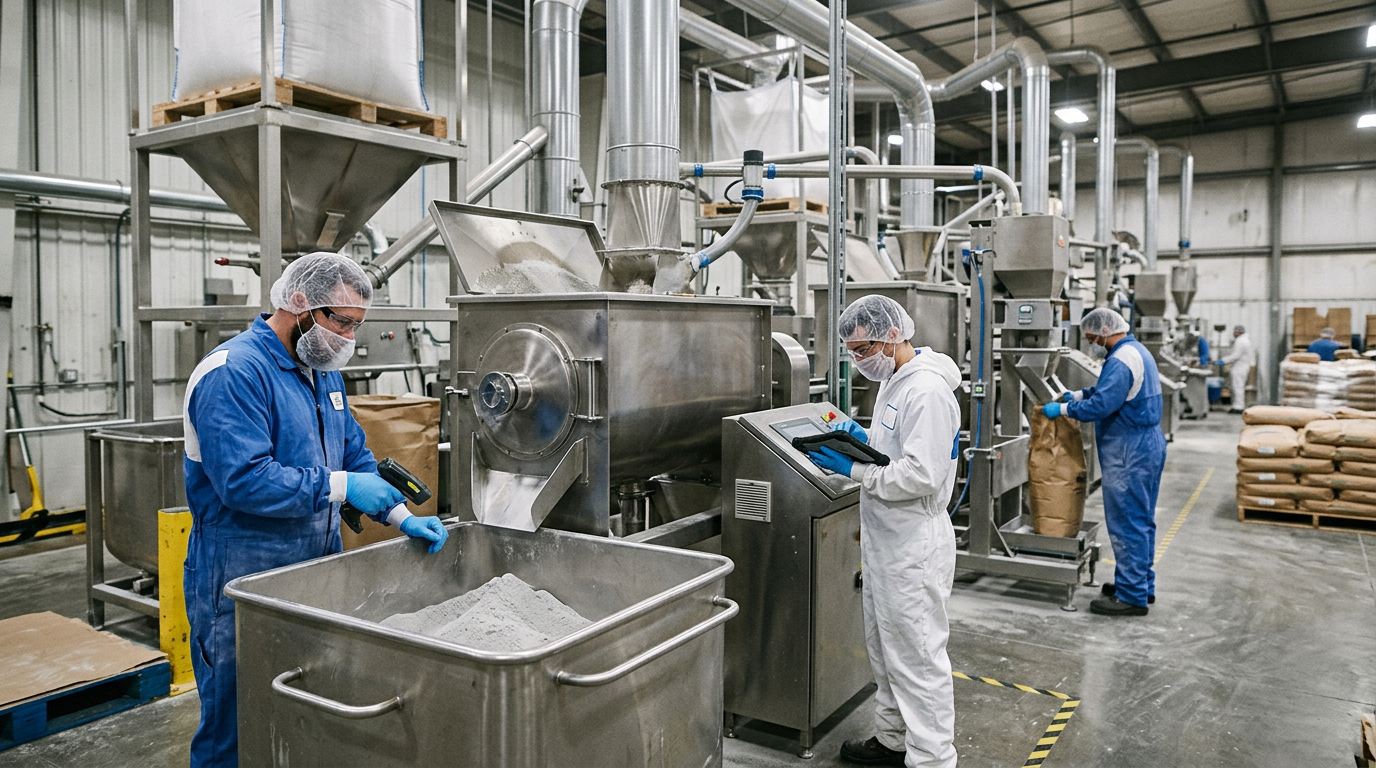
From FIBC unload to sealed customer bag — one auto-generated CoA your customer's QA already trusts.
V5 Ultimate runs every step your regulated-manufacturer customers audit — Approved Supplier + FSVP qualification, barcode-scanned receipt of every super-sack, gravimetric dispense against the locked formula, ribbon-blender uniformity, moisture / aw / particle size / micro in the LIMS, per-customer release specs, kosher / halal / organic / non-GMO chain of custody, and an auto-generated customer-CoA in your customer's format at bag-off. No retyping, no Excel drift, no rejection at the customer's incoming QA.
Built for FSMA preventive controls, customer specifications, and Kosher / Halal / Organic certifications.
The same blend record — seen the way you run the plant.
For a B2B blender or custom-formula house, the small wins compound with every super-sack. Finance sees higher yield on premium proteins and premixes. Operations sees the next changeover clear the ATP swab on time. Quality sees a CoA your customer's incoming QA will accept without a phone call.
Higher first-pass yield on premium proteins and premixes — dispense drift squeezed, customer rejections killed, and true cost per bag finally on the page.
- Per-blend actual cost: powders, premixes, packaging, labour and rework — visible in $, today.
- Lower giveaway from gravimetric dispense and in-blender uniformity checks — no over-add of expensive premixes.
- Fewer customer incoming-QA rejections from CoA transcription errors and spec-column drift.
- Most blenders see V5 pay back inside year one and keep compounding.
From the FSVP-qualified super-sack to the customer's incoming-QA CoA — one formula-locked thread.
Follow one blend. Every step below is a single screen in V5 — and the FSMA Preventive Controls, allergen matrix, kosher / halal / organic chain of custody and customer-specific spec library run underneath them all.
Qualified supplier, verified super-sack, certification chain intact — before a scoop reaches the blender.
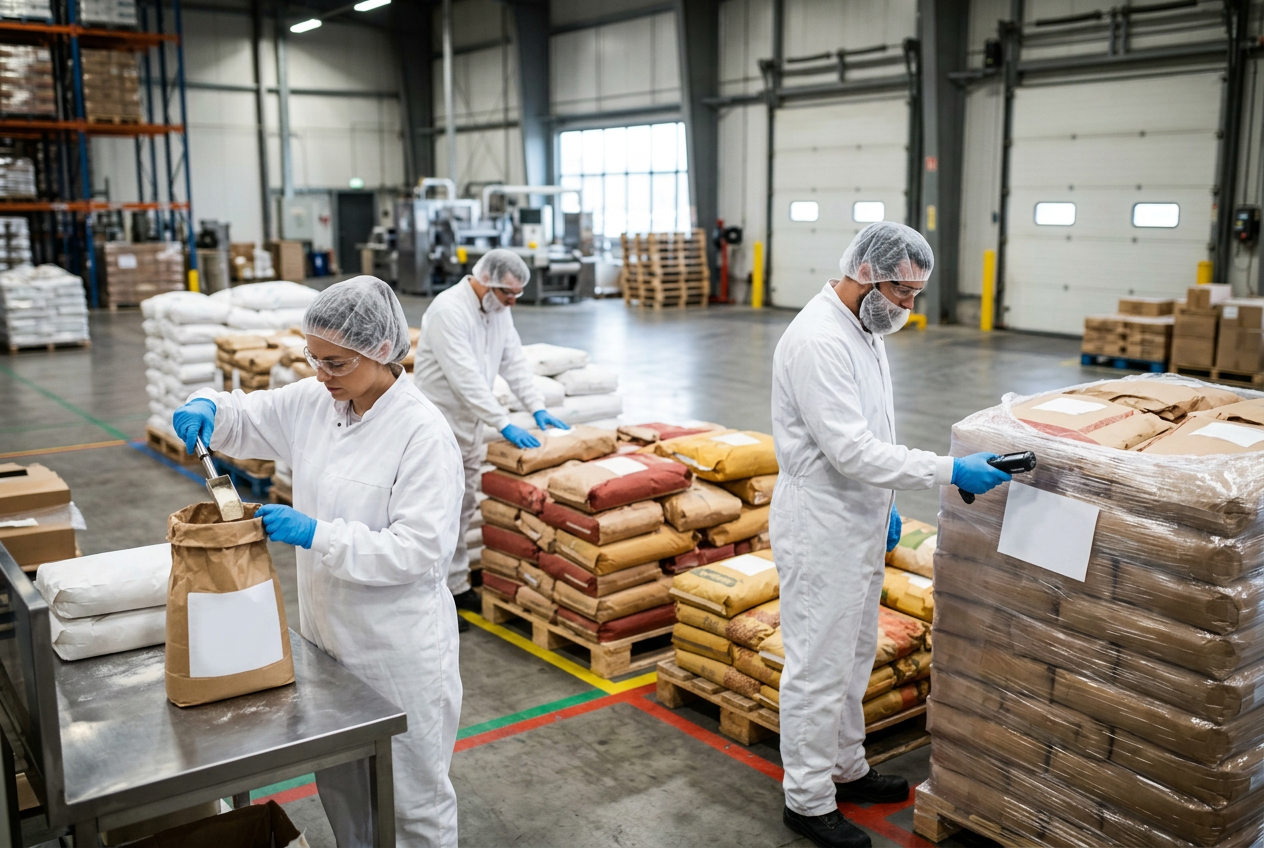
The only formula the line can run is the released, customer-approved version — drift from the spec is physically impossible.
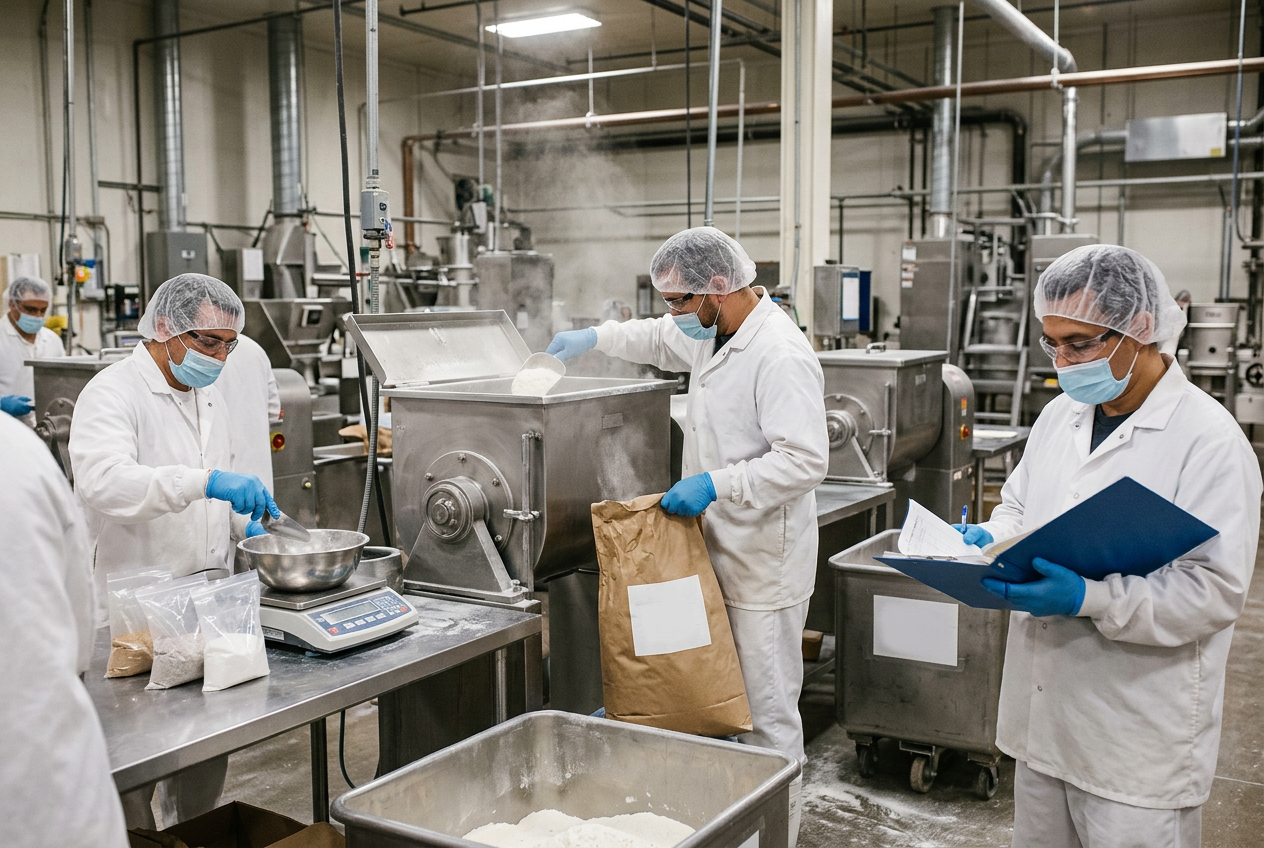
The blend can't ship until every customer-spec attribute is green — and the reviewer sees every OOS in one place.
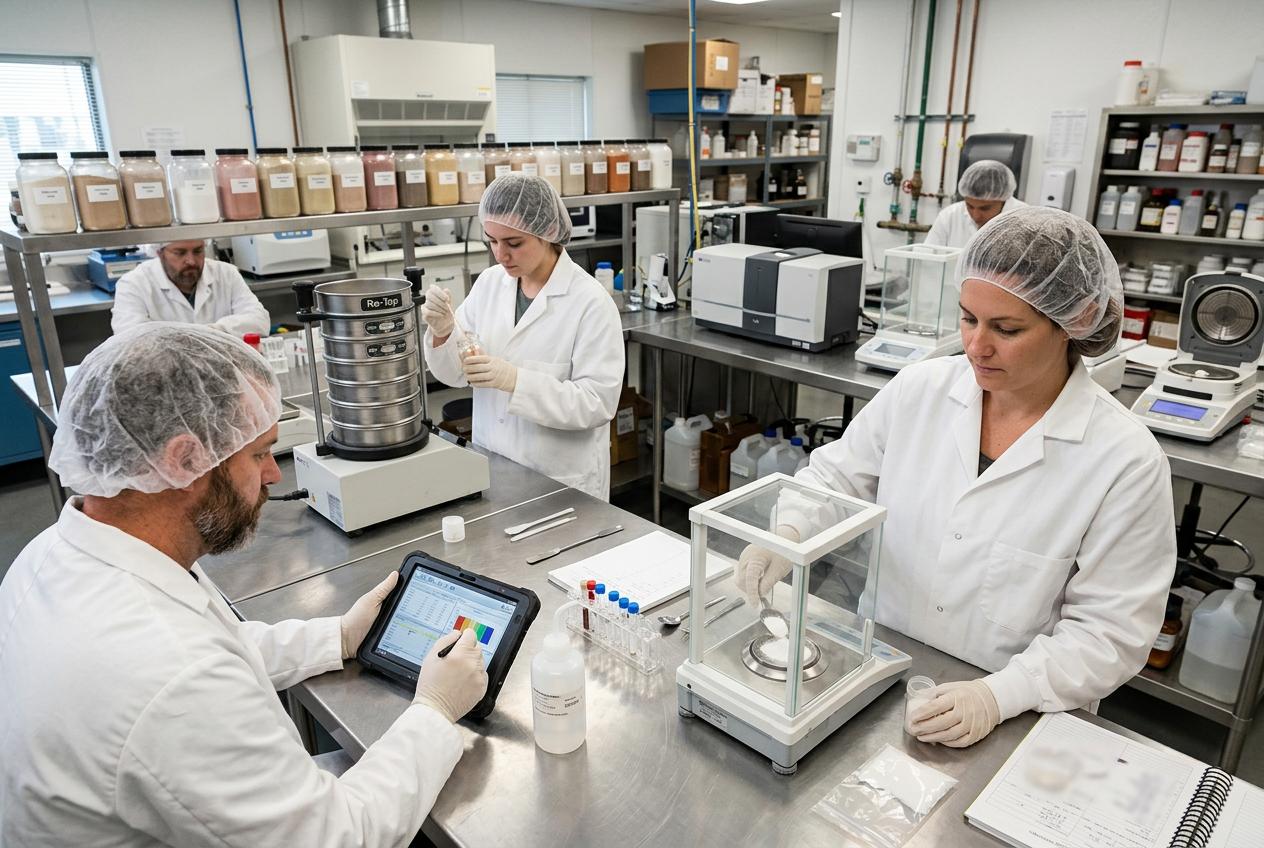
One finished blend lot, one customer-CoA in their format, one QA-signed bag — no retyping into Excel.
"If a supplier just flagged aflatoxin OOS — which regulated-manufacturer customers are exposed?"
Every pallet ships with the customer-CoA, GS1-128 SSCC, chain-of-custody marks and a bag manifest tied to the released blend lot. When a supplier flag, a customer complaint or an FSMA Preventive Controls event triggers a stop-sale, V5's lot + bag tree paints the affected bag ranges and destinations — forward from the finished blend and backward to every input powder, premix, flavour and packaging lot that built it. A CoA retraction with the recall-notice pack drafts itself.
A supplier flags an aflatoxin OOS on peanut-flour lot PF-8820. V5 walks the tree — the finished blend that used it, the bag and FIBC ranges dispatched, and every regulated-manufacturer customer exposed. Pull the lever to draft the customer-CoA retraction and recall notice instantly.
Blender PM, sifter verification, dust collection & Master Sanitation Schedule — on the same tablet as production.

Quality, FSMA Preventive Controls and certifying-body chain of custody run through every blend — not stapled to the record at the end.

Every quality feature in V5 — mapped to a B2B ingredients + dry-mix blender.
The same platform that runs pharmaceuticals and medical devices — set up for the way an ingredients house actually receives, dispenses, blends, tests, bags-off and releases a lot under 21 CFR Part 117, FSVP, GFSI (SQF / BRCGS / FSSC 22000) and certifying-body scheme rules.
Approved Supplier Program & FSVP
Configurable per powder, premix, flavour and pack. CoA + FSVP + kosher / halal / organic verified at receipt; expired qualification blocks goods-in automatically.
Gravimetric dispense & uniformity
Loss-in-weight feeders and gravimetric dispense verify majors, minors and micros to the gram. Blend uniformity samples pull automatically — an OOS uniformity opens a deviation.
Two-signature release
Production + QA review-and-release before any blend ships. Every gate signed with a validated e-signature — identity + meaning captured.
Deviation, complaint & customer feedback
One workflow from issue raised through root cause, action, verification and close. Linked to the affected blend, workstation, operator, supplier and customer — customer complaint routes to the correct account team.
Formula & CoA lockdown
Formulas are immutable, rev-locked and tied to the customer's current spec. Current-rev customer CoA template pinned per lot — the CoA engine refuses to render a superseded spec.
Supplier scorecards & re-qualification
On-time delivery, CoA quality, FSVP status, GFSI certification, deviation rate and audit findings rolled into a live supplier score. Expired qualifications block goods-in automatically.
Kosher / halal / organic / non-GMO chain of custody
Certification status carried lot-by-lot from receiving through blending, packaging and shipping — with mass-balance evidence and certifying-body scheme rules enforced at each step.
Auto customer-CoA in your customer's format
The CoA engine renders results into the customer's preferred template — their column order, method IDs, spec limits and letterhead — from released blend data at bag-off.
Retain samples & stability
Retain samples booked into the retain library per lot with location, disposition and expiry. Stability studies scheduled per blend and pack — appearance, moisture, aw, assay and micro pull-points tied to formulation.
Live on your blenders, feeders, sifters and bag-off lines — no rip-and-replace.
We connect at the level your engineers and QA team expect — OPC UA, Modbus, MQTT, REST, EDI, file drops, SQL. Most blenders are live on day one with the ribbon blenders, paddle mixers, gravimetric feeders, sifters, metal detectors, checkweighers and bag-off lines already in the plant.
Blending, dispense & sifting
OPC UA and Modbus links to Munson, Marion, Ross, Amixon ribbon and paddle blenders; K-Tron, Coperion, Schenck, Acrison loss-in-weight and gravimetric feeders; Sweco, Russell Finex, Kason sifters and screeners. Blend time, RPM and dispensed mass logged straight to the batch.
Magnets, metal detect & checkweigh
Bunting and Eriez magnets; Mettler-Toledo Safeline, Loma, Anritsu, Ishida metal detectors and checkweighers. Reject events, test-piece verifications and giveaway data streamed to the batch — a failed verification hard-stops the line.
Bag-off, FIBC fill & label
Concetti, Premier Tech, Haver & Boecker, Choice Bagging bag-off and FIBC fillers; Videojet, Domino, Markem-Imaje, Zebra thermal-transfer and print-and-apply labellers. Current-rev customer bag label and CoA reference pinned per lot at the line.
Lab instruments & LIMS
HPLC, FTIR, NIR, ICP-MS, LC-MS/MS, moisture analyzer, Karl Fischer, particle size, aw meter, colour spectrophotometer. Direct connectors for Waters, Agilent, Thermo Scientific, PerkinElmer, Mettler-Toledo, HunterLab and Malvern Panalytical.
ERP, WMS & customer portals
SAP, NetSuite, Microsoft Dynamics 365, Oracle, Infor, JustFood, Aptean. Customer EDI, ASN and customer-CoA delivery per customer preference — email, SFTP, portal upload or API.
BI & data warehouse
Power BI, Tableau, Looker, Snowflake, Databricks. Direct SQL access to your tenant — your data, your queries, your validated reports.
21 CFR Part 117, FSVP, GFSI & certifying bodies — at the data layer.
The records build themselves as the blend is executed. When the FDA FSMA inspector, an SQF / BRCGS / FSSC 22000 auditor or a kosher / halal / organic certifying body walks in, the evidence pack is one click — not a week of re-assembly.
Fixed-price, named team, one product family live before you pay for the next.
- Week 1–4·step 01Discovery & floor scan
We walk one product family with your team — formulas, customer spec library, CoA templates, allergen matrix, kosher / halal / organic certifications, existing ERP and WMS fields. Out: a fixed scope and price.
- Week 5–9·step 02Configure & integrate
Material master, formulas, per-customer specs, LIMS methods (moisture, aw, particle size, assay, micro), customer CoA templates, blender / feeder / sifter / metal-detector / bag-off integrations and ERP feeds loaded.
- Week 10–13·step 03Pilot & train
One product family live in pilot. Three-shift operator training on the floor with the actual UI — not slides. UAT signed by QA, production and operations.
- Week 14–16·step 04Go live & hyper-care
Cut over. Two weeks of hyper-care with your named delivery team on-site. KPIs published on the wall before we leave.
The first six questions on every dry-mix RFP.
How does V5 auto-generate a customer-CoA in the customer's preferred format?
How does V5 handle FSMA Preventive Controls and FSVP for imported ingredients?
How does V5 handle kosher, halal, organic and non-GMO chain of custody and mass balance?
Will V5 talk to our ribbon blenders, loss-in-weight feeders, sifters, metal detectors and bag-off lines?
We run tolls for multiple customers on one blender — how does V5 keep them separate?
What about IT — validated change control, SOC 2 and GFSI / certifying-body audit prep?
Book a 30-minute walkthrough with a dry-mix specialist.
We'll show a live self-building blend record, formula lockdown, gravimetric dispense verification, moisture / particle size / micro in the LIMS, two-signature release, auto customer-CoA generation in your customer's format at bag-off and a mock supplier-flag traceback — on a workspace seeded for a working ingredients + dry-mix plant.
Fixed-price go-live · No platform lock-in · Onboard in 10–16 weeks