

From incoming inspection to the operating room — one self-building Device History Record.
V5 Ultimate runs every step where 21 CFR 820, ISO 13485 and EU MDR apply — supplier qualification, incoming inspection, hard-gated assembly routings, in-process CMM checks, UDI capture at the workstation, sterilization load release and Part 806 correction traceback. The eDHR builds itself as the operator works. When the investigator arrives, the record is already complete.
Built for 21 CFR 820 / QSR, ISO 13485, and the EU MDR.
The same DHR — seen the way you run the plant.
For a Class II or Class III manufacturer, the small wins compound every lot. Finance sees higher first-pass yield and less scrap on expensive alloys. Operations sees the next line start on time. RA/QA sees a DHR the FDA investigator and Notified Body auditor will actually recognise.
Higher first-pass yield on expensive alloys — scrap squeezed, rework caught mid-build, and true cost per device finally on the page.
- Per-lot actual cost: raw materials, sub-assemblies, sterilization, labour and rework — visible in $, today.
- Lower titanium and PEEK scrap from earlier gating and faster CMM feedback.
- Fewer rework loops from operator errors caught at the workstation, not at final inspection.
- Most device manufacturers see V5 pay back inside year one and keep compounding.
From the supplier CoC to the surgeon's tray — one hard-gated thread.
Follow one build order. Every step below is a single screen in V5 — and the design-control, risk (ISO 14971) and calibration layer runs underneath them all.
Qualified supplier, CoC on file, AQL sample pulled — before the material touches the floor.
- CoC / CoA / 3.1 mill cert verified at receipt — no cert, no goods-in.
- Z1.4 sample size and accept/reject computed from lot size and inspection level.
- Every heat, lot and reel barcoded into stores with dimensional and material-test records attached.
- Expired supplier qualifications block receipts and email the supplier automatically.

The routing gates every step, the workstation shows the current-rev instructions — obsolete builds are physically impossible.
- Currently-effective SOP / work instruction served to the workstation — obsolete revs blocked at the door.
- Identity-verified e-signatures per 21 CFR Part 11.10 / 11.50 with meaning captured on every gate.
- Operator hard-blocked from a step they are not currently certified for — training matrix enforces at the cell.
- Torque-driver, laser-marker, tester and press readings streamed straight to the DHR — no re-key.

The lot can't ship until every acceptance activity is green — and the DHR reviewer sees every deviation in one place.
- All 820.80 acceptance activities configured as gates — no green, no release.
- Instrument integration for CMM (Zeiss, Hexagon, Mitutoyo), optical comparators, torque testers, seal-strength testers — results wired to the DHR.
- NCR / CAPA (820.90 / 820.100) linked to the affected lot, workstation and operator — no orphan deviations.
- Two-signature DHR review-and-release per 820.80(d) — preparer plus independent reviewer.

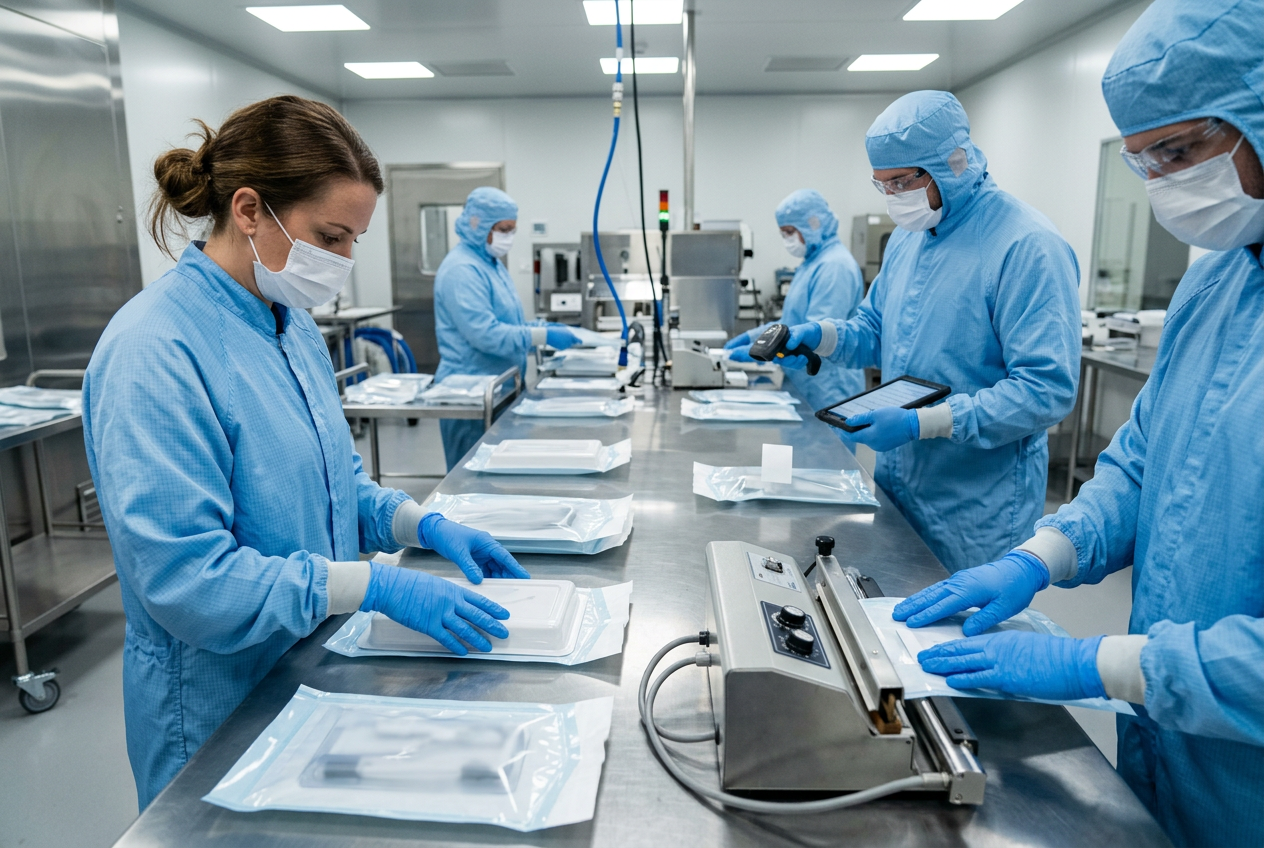
One finished lot, one sterilization cycle, one UDI — DI + PI captured at the workstation, reconciled to GUDID.
- Sterile-barrier packaging validated per ISO 11607-1 / 11607-2 — seal-strength trend live per line.
- Sterilization cycle release: EO (ISO 11135), gamma (ISO 11137), steam (ISO 17665), VH₂O₂ (ISO 22441) — parametric release supported.
- UDI-DI + UDI-PI printed and verified at the workstation — GS1 or HIBCC issuing agency, AIDC + human-readable.
- GUDID (FDA) and EUDAMED (EU MDR Article 27–29) submissions built from the same record — no double entry.
"If we corrected lot MD-24-0142 right now — which hospitals and patients are exposed?"
Every unit ships with a UDI-tagged label, a serialized packing slip and a validated shipping configuration. When a supplier NCR, complaint or MDR (21 CFR 803) triggers a 21 CFR Part 806 correction or removal, V5's UDI + DHR tree paints the affected serial ranges, distributors, hospitals and implanting surgeons — forward from the finished-device lot and backward to every heat, polymer lot, cassette and sterilization cycle that built it.
Titanium mill flags Ti-6Al-4V ELI heat 88214 for a chemistry OOS. V5 walks the tree — the finished-device lot it built, the UDI serial ranges dispatched, the distributors and hospitals that received it. Pull the lever to see the exposure.
Injection-mould PM, CMM calibration and torque-driver certification — on the same tablet as production.
- PM and validation schedules per moulder, CNC cell, CMM, laser marker and sterile-barrier sealer.
- Calibration cycles per ISO/IEC 17025-traceable standards — CMMs, torque drivers, force gauges, thermocouples.
- Cleanroom HVAC monitoring (ISO 14644) — particulate, differential pressure, temp and RH tied to the batch.
- Spares stock and vendor lead times in the same ledger as raw materials and sterile-barrier packaging.

Quality and post-market surveillance run through every lot — not stapled to the record at the end.
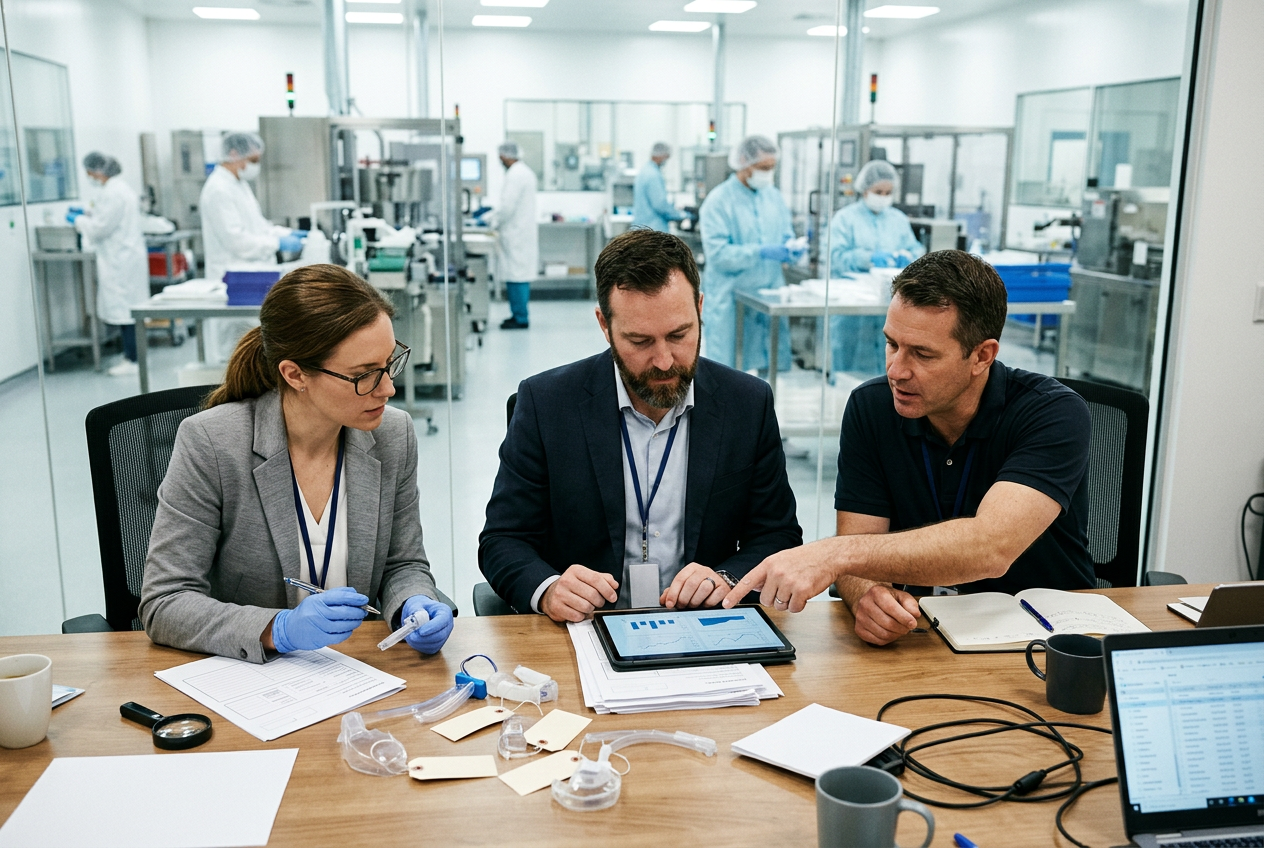
- Incoming inspection per raw material, sub-assembly and outsourced process — CoC / CoA match, AQL sample, dimensional.
- In-process gates — first-article, torque, CMM dimensional, seal strength, functional, visual under magnification.
- Finished-device release — RA/QA can't be skipped before a lot leaves the plant.
- Complaints (820.198), MDR (21 CFR 803), Part 806 correction / removal, EU MDR FSCA — one workflow.
- Deviations, NCR and CAPA (820.90 / 820.100) loop from raised → root cause → verification → close, tied to the DHR and DHF.
- Document control (820.40) and training matrix (820.25) — superseded SOPs and lapsed training hard-block the cell.
Every quality feature in V5 — mapped to a Class II / III site.
The same platform that runs pharma cleanrooms and radiopharmacies — set up for the way a medical-device manufacturer actually inspects, releases and audits a Device History Record.
Incoming inspection & 820.80
Configurable per raw material, sub-assembly and outsourced process. Z1.4 AQL sample size computed from lot size; a failed acceptance activity raises a hold automatically.
In-process gates & first-article
Scheduled QC checks on the build — first-article, CMM dimensional, torque, seal strength, functional, visual under magnification. Limits enforced; OOS opens an NCR.
DHR review-and-release
Two-signature review-and-release per 820.80(d) before any lot ships. Every gate signed with a 21 CFR Part 11-compliant e-signature — identity + meaning captured.
NCR, CAPA & complaints
One workflow from issue raised through root cause, action, verification and close. Linked to the affected lot, DHR, DHF, workstation, operator and supplier — with 820.100 / 820.198 evidence.
MDR (21 CFR 803) & FSCA
Complaint intake, medical-device-report timers (5 / 30 day), Part 806 correction / removal and EU MDR Article 89 field safety corrective actions — all tied to the affected UDI and DHR.
Design controls & DHF (820.30)
Design inputs, outputs, verification, validation and DMR held against every device family. Change control on the DHF forces a design-review sign-off before a new rev reaches production.
Supplier scorecards & re-qualification
On-time delivery, CoC quality, NCR rate and audit findings rolled into a live supplier score. Expired qualifications block goods-in automatically.
Calibration & instrument qualification
CMMs, torque drivers, force gauges, thermocouples, seal testers and micrometers on an ISO/IEC 17025-traceable calibration calendar — certificates attached, next-due enforced.
UDI, GUDID & EUDAMED
UDI-DI + UDI-PI generated, printed and verified at the workstation per 21 CFR 830. GUDID (FDA) and EUDAMED (EU MDR) submissions built from the same record — no double entry.
Live on your CMMs, moulders, laser markers and testers — no rip-and-replace.
We connect at the level your engineers and QA expect — OPC UA, Modbus, MQTT, REST, HL7, EDI, file drops, SQL. Most device manufacturers are live on day one with the CMMs, moulders, testers and ERP feeds already in the plant.
CMMs & optical comparators
Zeiss CALYPSO, Hexagon PC-DMIS, Mitutoyo MCOSMOS, Nikon iNEXIV. Dimensional results streamed straight to the DHR — no re-key.
Injection moulders & CNC cells
Arburg, Engel, Milacron, Sumitomo (SHI) Demag, Wittmann Battenfeld, Mazak, DMG Mori, Haas. Cycle data and downtime coded at the cell.
Torque, force & seal testers
Atlas Copco, Kistler, Mecmesin, Instron, TM Electronics. Torque, force and seal-strength readings wired to the in-process gate.
Laser markers & UDI printers
Trumpf, Videojet, Domino, Markem-Imaje, Zebra, SATO. UDI-DI + UDI-PI verified at the workstation with a barcode grader.
ERP, PLM & MDR reporting
SAP, NetSuite, Microsoft Dynamics 365, Oracle, Windchill, Teamcenter. FDA GUDID and EU EUDAMED submissions built from the same record.
BI & data warehouse
Power BI, Tableau, Looker, Snowflake, Databricks. Direct SQL access to your tenant — your data, your queries, your validated reports.
21 CFR 820 (QSR / QMSR), Part 11, 21 CFR 830 UDI, ISO 13485, ISO 14971, IEC 62304, EU MDR — at the data layer.
The records build themselves as the DHR is assembled. When the FDA investigator or Notified Body auditor walks in, the evidence pack is one click — not a week of re-assembly.
Fixed-price, named team, one product family live before you pay for the next.
- Week 1–3·step 01Discovery & floor scan
We walk one product family with your team — DHF, DMR, routings, suppliers, CMMs, moulders, testers, existing ERP fields. Out: a fixed scope and price.
- Week 4–7·step 02Configure & integrate
Device master, BOMs, routings, work instructions, acceptance activities, UDI templates, CMM / moulder / tester integrations and ERP feeds loaded. IQ / OQ on the bench.
- Week 8–11·step 03PQ, pilot & train
One line live in pilot. Three-shift operator training on the floor with the actual UI — not slides. PQ and UAT signed by RA/QA and operations.
- Week 12–14·step 04Go live & hyper-care
Cut over. Two weeks of hyper-care with your named delivery team on-site. KPIs published on the wall before we leave.
The first six questions on every medical-device RFP.
How does V5 satisfy 21 CFR 820 / the new QMSR (2026) and ISO 13485 in one system?
How does V5 handle UDI and GUDID / EUDAMED submissions?
Will V5 talk to our CMMs, injection moulders, torque drivers and laser markers?
How does V5 handle design controls (820.30), risk management (ISO 14971) and IEC 62304 software?
How does V5 handle Part 806 recalls and MDR (21 CFR 803) reporting?
What about IT — 21 CFR Part 11, SOC 2, validated change control?
Book a 30-minute walkthrough with a medical-device specialist.
We'll show a live self-building eDHR, a hard-gated assembly routing, a CMM in-process check, UDI capture and GUDID export, an EO sterilization load release and a mock Part 806 recall traceback — on a workspace seeded for a working Class II / III manufacturer.
Fixed-price go-live · No platform lock-in · Onboard in 8–14 weeks