
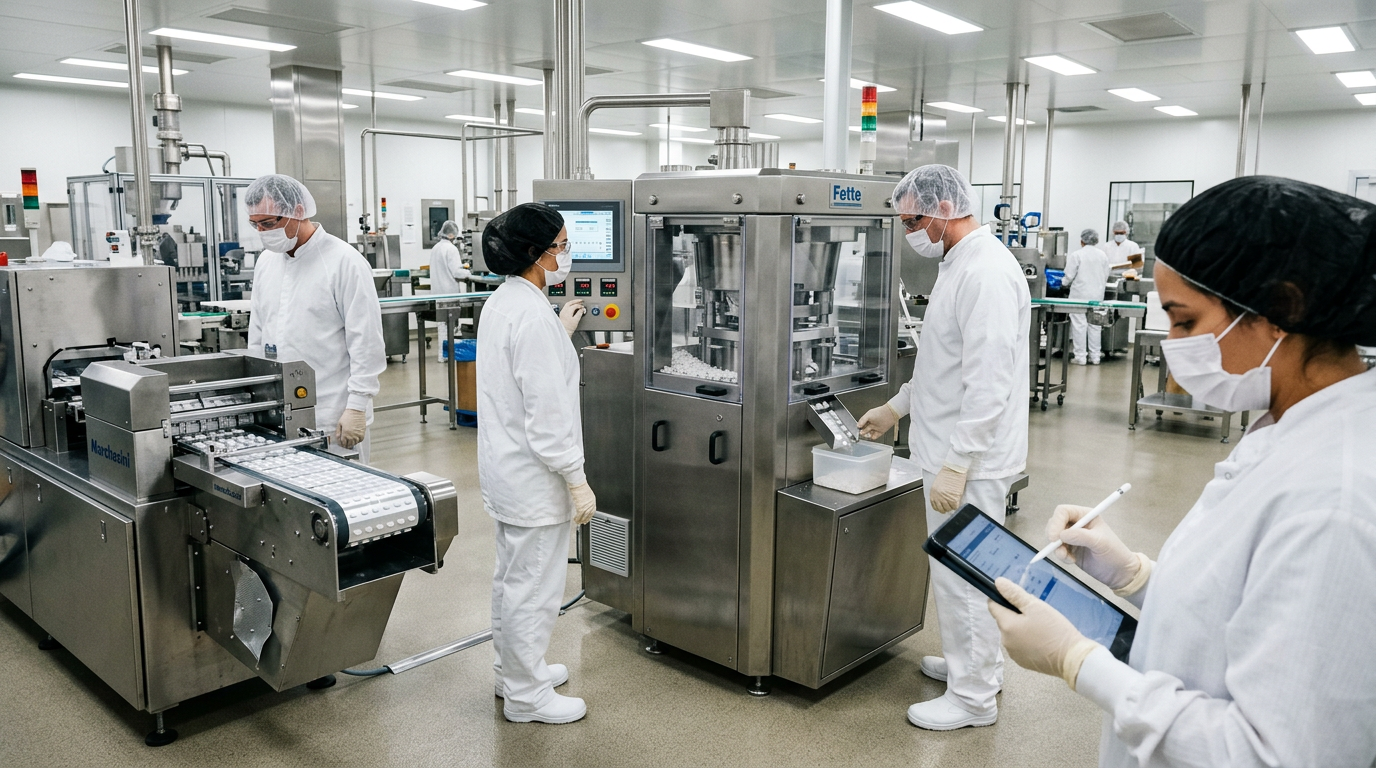
From API drum to patient pack — one self-building electronic Batch Manufacturing Record.
V5 Ultimate runs every step where 21 CFR 210/211, ICH Q7 and EU GMP apply — API supplier qualification, dispensing under LEV, granulation and compression against a locked Master Batch Record, in-process QC in the LIMS, DSCSA serialization and QP-signed release. The eBMR builds itself as the operator works. When the FDA investigator arrives, the record is already complete.
Built for 21 CFR 210/211 and ICH Q7 cGMP.
The same BMR — seen the way you run the plant.
For a cGMP pharmaceutical manufacturer, the small wins compound every batch. Finance sees higher yield and less API waste. Operations sees the next campaign start on time. QA sees a BMR the FDA investigator and EU inspector will actually recognise.
Higher yield on expensive API — waste squeezed, rework caught mid-batch, and true cost per pack finally on the page.
- Per-batch actual cost: API, excipients, primary pack, labour and rework — visible in $, today.
- Lower API and excipient waste from earlier gating and faster in-process feedback.
- Fewer rework loops from operator errors caught at the workstation, not at QP review.
- Most pharma manufacturers see V5 pay back inside year one and keep compounding.
From the API CoA to the patient pack — one two-signature thread.
Follow one batch. Every step below is a single screen in V5 — and the master-batch-record, validation and calibration layer runs underneath them all.
Qualified API, CoA reconciled, sampled per USP — before a gram is dispensed.
- CoA / CoC verified against internal spec at receipt — no CoA, no goods-in.
- USP <1> and <1097> sampling plans enforced; sample IDs tied to the LIMS work order.
- Every API drum, excipient sack and reel barcoded into stores with expiry, retest date and vendor lot.
- Dispensing under LEV / IBC with two-tier weight verification (preparer + witness) per 211.101.
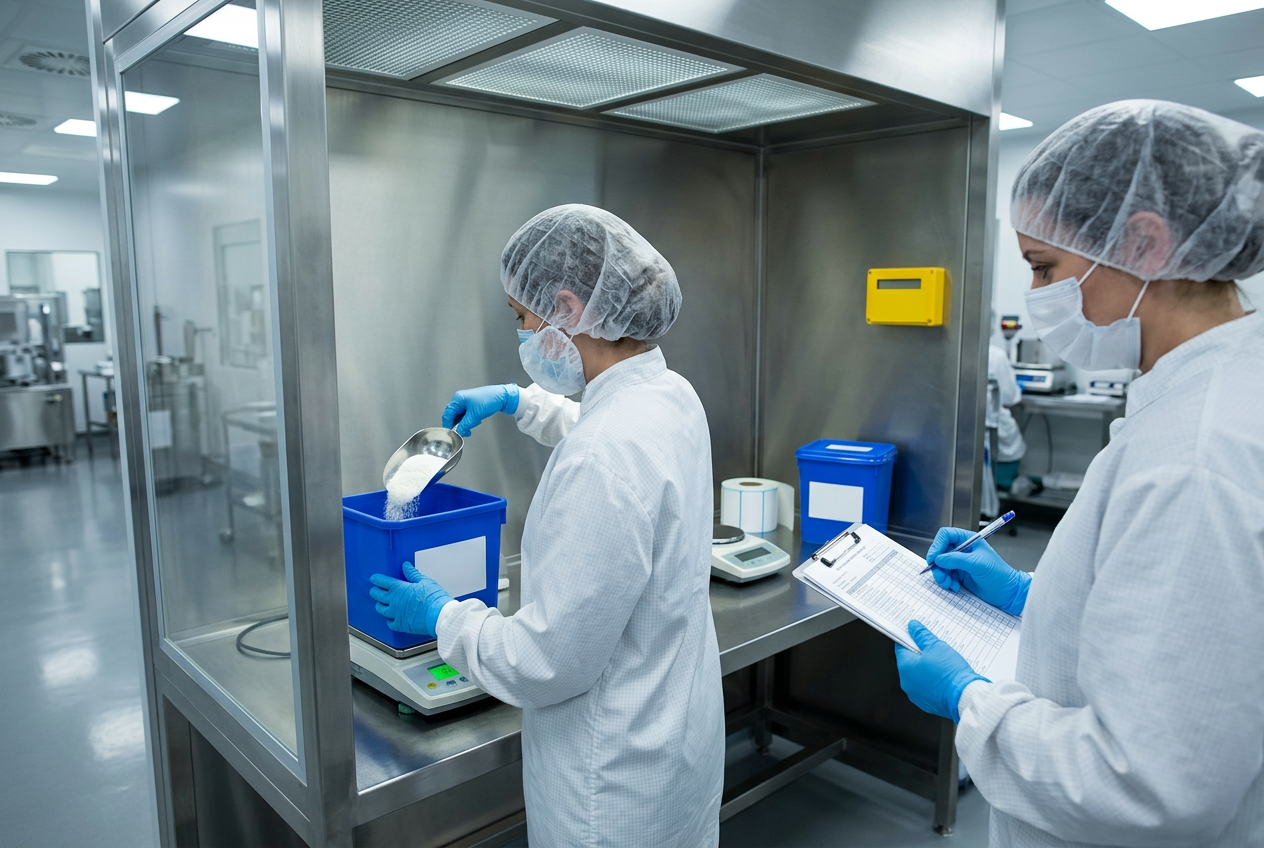
The MBR gates every step, the workstation shows the current-rev instructions — obsolete formulas are physically impossible.
- MBR approved by two independent signatories per 21 CFR 211.186 — snapshot into every BMR.
- Identity-verified e-signatures per 21 CFR Part 11.10 / 11.50 with meaning captured on every gate.
- Operator hard-blocked from a step they are not currently qualified for — training matrix enforced at the cell.
- Granulator, tablet press, coater, blender and IBC readings streamed straight to the BMR — no re-key.
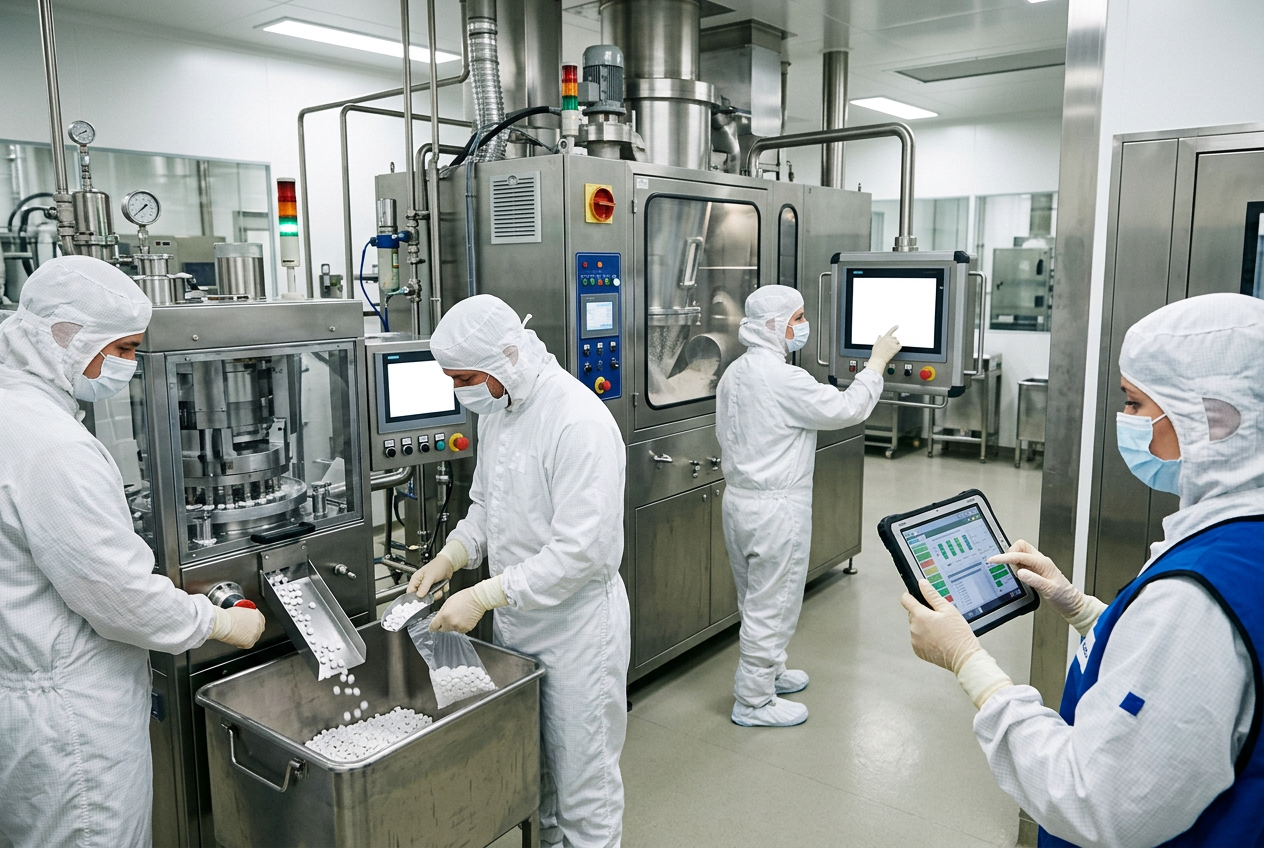
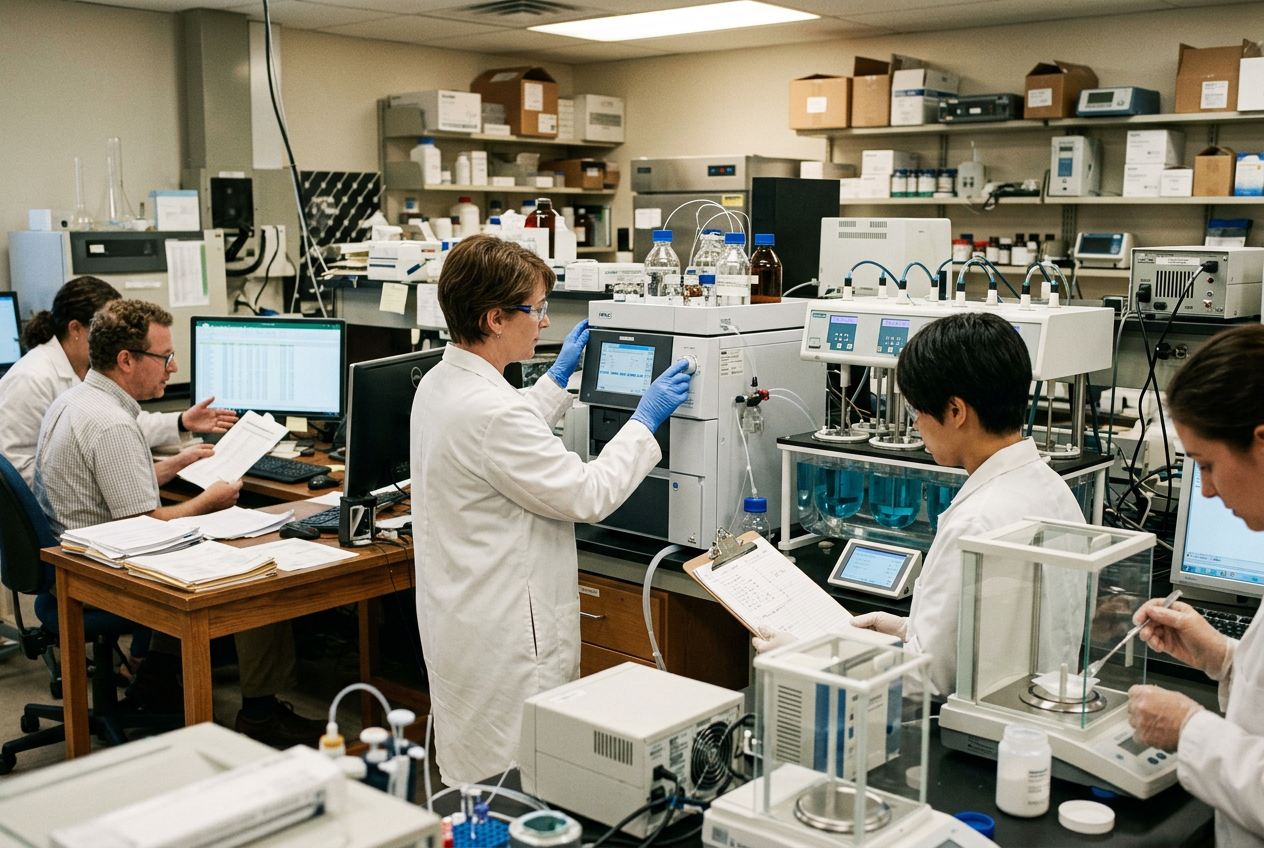
The batch can't ship until every USP method is green — and the BMR reviewer sees every deviation in one place.
- USP / EP / JP methods configured as gates — no green, no release.
- Instrument integration for HPLC (Empower, Chromeleon, OpenLab), dissolution testers, hardness / friability, Karl Fischer, NIR PAT — results wired to the BMR.
- Deviation / OOS / OOT (MHRA GxP data-integrity) linked to the affected lot, workstation and operator — no orphan events.
- QP or authorised person release per EU GMP Annex 16 and 21 CFR 211.194 — two independent signatures.
One finished lot, one serialized carton, one aggregated pallet — SNI captured at the line, EPCIS built for every trading partner.
- Blister and carton lines with 100% vision inspection, tamper-evident sealing and torque-verified closure.
- DSCSA serialization: GTIN + SN + lot + expiry printed and camera-verified with a grade-A / grade-B barcode.
- Parent-child aggregation from unit → carton → case → pallet — EPCIS 1.2 files built for wholesaler handoff.
- EU FMD 2D DataMatrix with unique identifier + tamper-evident device — repository upload built from the same record.

"If we recalled lot RX-24-0142 right now — which wholesalers and pharmacies are exposed?"
Every carton ships with a DSCSA-serialized SNI, a T3 (transaction info / history / statement) file and a validated shipping configuration. When an API OOS, complaint or FAR (21 CFR 314.81 / EU Vol 9A) triggers a Class I / II / III recall, V5's SNI + BMR tree paints the affected serial ranges, wholesalers, chain pharmacies and hospital DCs — forward from the finished-pack lot and backward to every API drum, excipient lot, blister film and purified water batch that built it.
API supplier flags Metformin HCl lot API-88214 for a nitrosamine impurity OOS. V5 walks the tree — the finished-pack lot it built, the serialized carton ranges dispatched, the wholesalers and pharmacy chains that received them. Pull the lever to see the exposure.
Tablet press PM, HPLC calibration and cleaning validation — on the same tablet as production.
- PM and validation schedules per tablet press, coater, granulator, blender and filling line.
- Calibration cycles per ISO/IEC 17025-traceable standards — balances, HPLCs, thermocouples, pressure gauges.
- Cleanroom HVAC monitoring (ISO 14644 / EU GMP Annex 1) — particulate, differential pressure, temp and RH tied to the batch.
- Cleaning validation swab / rinse results, hold-time studies and change-over sign-off enforced before the next campaign.
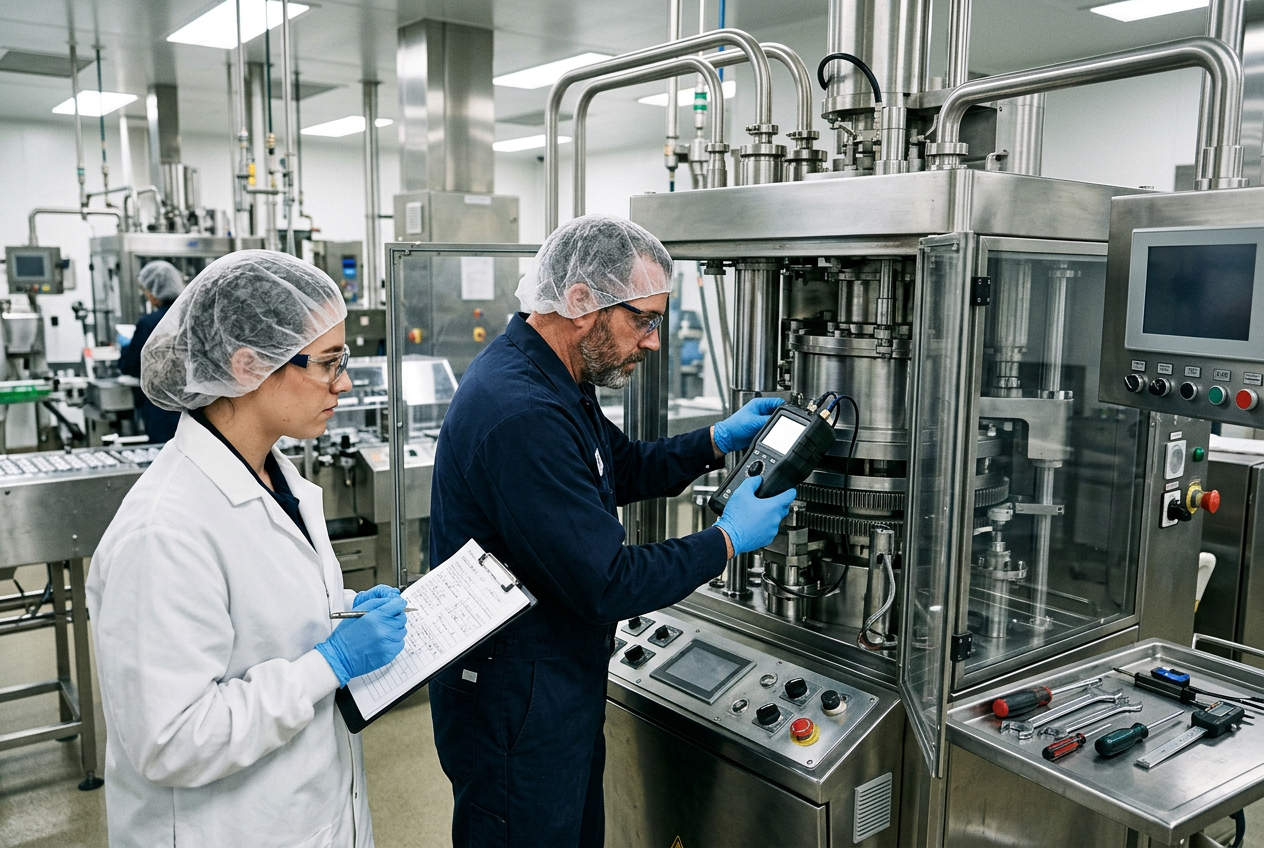
Quality and pharmacovigilance run through every batch — not stapled to the record at the end.
- Incoming inspection per API, excipient, primary and secondary pack — CoA / CoC match, USP sample, identity.
- In-process gates — LOD, blend uniformity, tablet weight / hardness / friability, coating uniformity, fill weight.
- QP or authorised person release — can't be skipped before a batch leaves the plant.
- Complaints, FAR (21 CFR 314.81), FMD verification exception and MHRA rapid alert — one workflow.
- Deviations, OOS and CAPA loop from raised → root cause → verification → close, tied to the BMR and API supplier scorecard.
- Document control (21 CFR 211.180 / EU GMP Chapter 4) and training matrix — superseded SOPs and lapsed training hard-block the cell.

Every quality feature in V5 — mapped to a 21 CFR 211 site.
The same platform that runs medical devices and radiopharmacies — set up for the way a pharmaceutical manufacturer actually dispenses, compresses, coats, tests, serializes and releases a batch under 21 CFR 210/211 and EU GMP.
Incoming inspection & USP sampling
Configurable per API, excipient and pack. USP <1097> sample plan computed from lot size; a failed identity or assay raises a hold automatically.
In-process gates & PAT
Scheduled QC checks — LOD, blend uniformity, tablet weight / hardness / friability, coating uniformity, fill weight. NIR PAT streamed straight to the BMR. Limits enforced; OOS opens an investigation.
QP / authorised person release
Two-signature review-and-release per 21 CFR 211.194 and EU GMP Annex 16 before any batch ships. Every gate signed with a Part 11-compliant e-signature — identity + meaning captured.
Deviation, OOS & CAPA
One workflow from issue raised through root cause, action, verification and close. Linked to the affected batch, BMR, workstation, operator and API supplier — MHRA GxP data-integrity aligned.
DSCSA & EU FMD serialization
GTIN + SN + lot + expiry printed and camera-verified per DSCSA (US) and EU FMD 2011/62/EU. Parent-child aggregation to case and pallet. EPCIS 1.2 files built for wholesaler handoff.
MBR / eBMR & change control
Master Batch Records approved by two signatories per 21 CFR 211.186, immutable and rev-locked. Change control on the MBR forces a QA sign-off before a new rev reaches production.
Supplier scorecards & re-qualification
On-time delivery, CoA quality, deviation rate and audit findings rolled into a live supplier score. Expired qualifications block goods-in automatically.
Calibration & instrument qualification
Balances, HPLCs, dissolution testers, hardness / friability, Karl Fischer, thermocouples on an ISO/IEC 17025-traceable calibration calendar — certificates attached, next-due enforced.
Cleaning validation & change-over
Swab / rinse limits per API and shared equipment, hold-time studies, campaign change-over sign-off. An expired cleaning validation refuses to release the next batch.
Live on your HPLCs, tablet presses, coaters and serialization printers — no rip-and-replace.
We connect at the level your engineers and QA expect — OPC UA, Modbus, MQTT, REST, HL7, EDI, file drops, SQL. Most pharma manufacturers are live on day one with the HPLCs, presses, coaters, blister lines and ERP feeds already in the plant.
HPLC, GC & CDS
Waters Empower, Thermo Chromeleon, Agilent OpenLab, Shimadzu LabSolutions. Chromatograms and assay results streamed straight to the BMR — no re-key.
Tablet presses, coaters & granulators
Fette, Korsch, IMA, Romaco, Bosch (Syntegon), Glatt, Freund-Vector, GEA. Cycle data, tablet weight and downtime coded at the cell.
Blister lines, cartoners & serialization
Uhlmann, Marchesini, IMA, Körber (Werum), Antares Vision, Systech. GS1-compliant SNI printing and camera verification at the line.
PAT & at-line testing
Sotax dissolution, Erweka, Bruker NIR, Foss NIR, Malvern particle size, Karl Fischer. Results wired to the in-process gate.
ERP, MES & DSCSA repositories
SAP, NetSuite, Microsoft Dynamics 365, Oracle, Körber PAS-X, TraceLink, rfxcel. EPCIS 1.2 files built and pushed to the trading-partner repository.
BI & data warehouse
Power BI, Tableau, Looker, Snowflake, Databricks. Direct SQL access to your tenant — your data, your queries, your validated reports.
21 CFR 210/211, Part 11, ICH Q7 / Q9 / Q10, EU GMP Annex 11, DSCSA — at the data layer.
The records build themselves as the BMR is executed. When the FDA investigator or EU inspector walks in, the evidence pack is one click — not a week of re-assembly.
Fixed-price, named team, one product family live before you pay for the next.
- Week 1–4·step 01Discovery & floor scan
We walk one product family with your team — MBRs, dispensing SOPs, tablet-press tooling, HPLC methods, DSCSA serialization set-up, existing ERP fields. Out: a fixed scope and price.
- Week 5–9·step 02Configure & integrate
Material master, MBRs, in-process gates, LIMS methods, cleaning-validation library, serialization templates, HPLC / press / coater / line integrations and ERP feeds loaded. IQ / OQ on the bench.
- Week 10–13·step 03PQ, pilot & train
One product family live in pilot. Three-shift operator training on the floor with the actual UI — not slides. PQ and UAT signed by QA and operations.
- Week 14–16·step 04Go live & hyper-care
Cut over. Two weeks of hyper-care with your named delivery team on-site. KPIs published on the wall before we leave.
The first six questions on every pharmaceutical RFP.
How does V5 satisfy 21 CFR 210/211, ICH Q7 / Q9 / Q10 and EU GMP in one system?
How does V5 handle DSCSA and EU FMD serialization and EPCIS reporting?
Will V5 talk to our HPLCs, tablet presses, coaters and blister lines?
How does V5 handle Master Batch Records, MBR change control and eBMR execution?
How does V5 handle recalls, FAR (21 CFR 314.81) and EU FMD verification failures?
What about IT — 21 CFR Part 11, GAMP 5, EU GMP Annex 11, SOC 2, validated change control?
Book a 30-minute walkthrough with a pharma specialist.
We'll show a live self-building eBMR, a locked MBR, dispensing under LEV, in-process HPLC assay in the LIMS, DSCSA serialization and aggregation, QP release and a mock recall traceback — on a workspace seeded for a working 21 CFR 211 site.
Fixed-price go-live · No platform lock-in · Onboard in 10–16 weeks