
Data capture · Kiosk · Devices
Shop floor data collection captured at source — not typed up on Tuesday.
Barcode scans, scale readings, operator checks and downtime reasons recorded at the station as work happens, each with who, what and when on one audit trail.
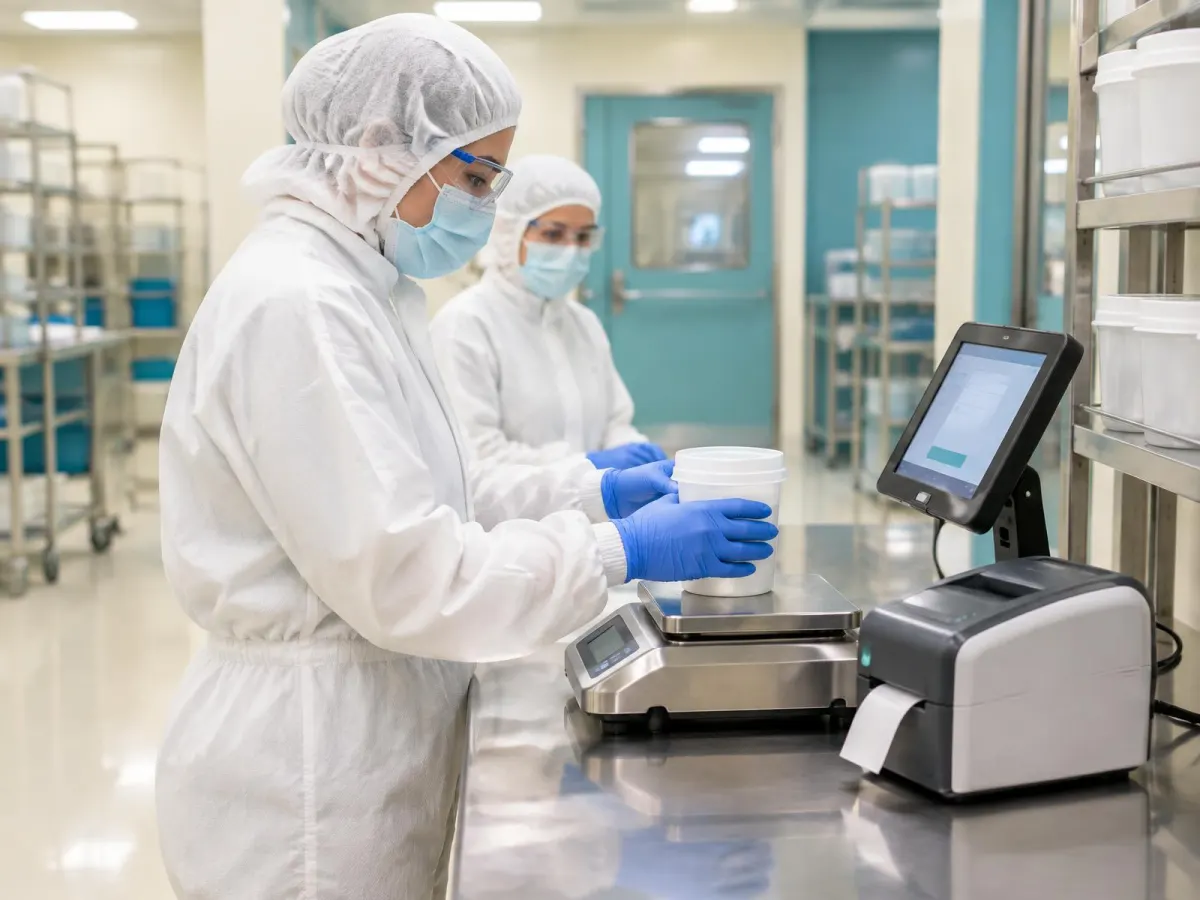
Captured at source
Scans, scale readings and checks recorded as they happen.
Downtime with a reason
Stops recorded with reasons for OEE review.
One audit trail
Every entry kept with who, what and when.
Barcode scan
Material lots and containers confirmed at the station.
Device compatibility is confirmed with your hardware during scoping.
Full product detailCommon problems, what's included, why teams choose it, and where commercial meets regulated.
You searched 'shop floor data collection software' because the data arrives late and wrong.
Production data transcribed from paper hours after the shift
Scale weights keyed by hand — and occasionally keyed wrong
Downtime reasons guessed at the end of the week
No idea what a line actually produced until the ERP posts
Counts, scrap and rework reconciled in a spreadsheet
Nothing links a data point to who took it and when
What capture looks like when the floor owns it.
Scales, scanners and printers
Direct device capture through V5 Device Bridge — weights read from the balance, not typed, with the instrument ID on the record.
Labour and downtime
Start/stop, crew, reason-coded downtime and changeover captured live and rolled into OEE without a separate log.
Offline resilience
Capture continues if the network drops; records queue locally and reconcile with full timestamps when connectivity returns.
Live dashboards
Counts, yields, OEE and exceptions visible on the floor and in the office from the same record the operator touched.
Attributable and durable
Every value carries who, when, from which device, and cannot be silently edited — a hash-chained trail behind it.
What changes when data is captured where it happens.
- Transcription errors go to zero on device-captured values
- Downtime reasons become real data instead of end-of-week recollection
- Yield and scrap reconcile at close, not three days later
- Supervisors act on the shift they are in, not the one that ended
- Every number on the report traces to an operator, device and timestamp
Why captured-at-source matters to your auditor.
ALCOA+ / MHRA data integrity
Attributable, legible, contemporaneous, original and accurate — contemporaneous is the one paper transcription always fails.
21 CFR Part 11
Electronic records and signatures with a secure, computer-generated, time-stamped audit trail.
ISO 22400
Standard KPI definitions for OEE, availability, performance and quality so your numbers are comparable.
ISA-95
A clean Level 3 execution layer between Level 2 automation and Level 4 ERP, with defined data flows.
Building medical devices? See the device history record page.
Shop floor data collection software, answered.
What hardware do we need?
Any modern tablet, industrial panel PC or thin client with a browser. Barcode scanners work as keyboard-wedge or USB; scales and serial instruments connect through V5 Device Bridge.
Can it read our balances directly?
Yes. V5 Device Bridge runs on a local Windows or macOS machine and streams instrument reads straight into the record, with the balance ID and calibration status attached.
What happens if the network drops mid-batch?
Capture continues locally and syncs on reconnect. Timestamps reflect when the action happened, not when it uploaded, and the reconciliation is auditable.
Does it replace our ERP data entry?
It replaces the manual re-keying. Consumption, production, scrap and labour post to ERP from the captured record instead of being entered twice.
Can we capture downtime and OEE?
Yes — reason-coded downtime, availability, performance and quality roll into ISO 22400-aligned OEE from the same execution record.
How quickly can a line be live?
Timelines depend on scope — sites, lines, integrations and validation — and are set in your Order or Statement of Work. There is no standard number of weeks.
Capabilities vary by plan and setup. Confirm specifics with our team before relying on them.
Stop typing up yesterday.
Free trial. Capture the floor at the floor, with an audit trail behind it.