V5 Ultimate
Cannabis · How V5 Runs

How V5 Ultimate runs a cannabis operator, end to end.

Eleven seed-to-sale touchpoints — plant tag to a state-licensed dispensary — sharing one immutable ledger. Mapped to Metrc / BioTrack, state testing panels, Health Canada Cannabis Regulations, EU GMP Annex 7 for medicinal cannabis, USDA 7 CFR 990 for hemp, and 21 CFR Part 11.

Start free trial
State T&TMetrcBioTrackHealth CanadaEU GMP Annex 77 CFR 990 hemp21 CFR Part 11
ONE IMMUTABLE LEDGERState T&T · Metrc · BioTrack · Health Canada · EU GMP Annex 7 · 7 CFR 990 · Part 1101Plant tagclone to harvest02Harvestwet weight03Extractparams logged04Infuseedibles / topicals05State CoApotency + pesticides06Packagechild-resistant07T&T shipmanifestThe evidence chainEvery action signs the ledger — nothing is re-keyed at the end.
Executive summary

One ledger, every touchpoint — plant tag to state-mandated CoA to dispensary.

V5 Ultimate runs a cannabis operator as one connected system. Plant-tag-anchored cultivation, kiosk-led extraction and infusion, state-mandated testing, compliant per-state labelling, and the state track-and-trace push all write to the same immutable, identity-verified ledger.

The pay-off is operational: state-system variance disappears, batch records reviewed by exception in 20–30 min instead of hours, and a recall that resolves as a query — forward and backward from any node.

This playbook walks you through 11 seed-to-sale touchpoints and the 17 QMS and operations modules that wrap them, grouped into 8 readable parts.

11
Seed-to-sale touchpoints
8
Thematic parts
30+
Regulatory anchors
Part I

Foundations

Why seed-to-sale traceability is the spine, and the ten-node map.

01

Why seed-to-sale traceability is the product

Cannabis is the most heavily traced consumer product in North America. Every plant is tagged at birth. Every gram is accounted for in a state system. A licence is conditional on that account being right.

Floor actionscan · weigh · e-sigactor + tsSTEP 01Append-only rowDB trigger writes oncesha256STEP 02Batch record snapshotfrozen at releaseWO boundSTEP 03PDF renderfrom snapshot onlydeterministicSTEP 04Inspector packexported on demand21 CFR 11STEP 05ALCOA+ lineageAttributable · Legible · Contemporaneous · Original · Accurate · + Complete · Consistent · Enduring · AvailableOne origin event. No re-keying. No reconciliation.
ALCOA+ in one picture: one origin event, replayable downstream.

There is no federal cannabis cGMP in the US. There are ~38 state programs, each with its own track-and-trace mandate (Metrc, BioTrack, Leaf Data Systems), its own testing panel (potency, pesticides, heavy metals, mycotoxins, microbials, residual solvents, water activity, foreign matter), its own labelling rule, and its own packaging-and-childproofing standard. In Canada, Health Canada's Cannabis Regulations are federal and unified. In the EU, medicinal cannabis is EU-GMP — Annex 7 for the herbal substance, Annex 1 where sterile dosage forms are produced.

The hazards that drive enforcement are unambiguous: inventory variance vs. the state system, failed CoA released to retail, off-label THC content, missing childproofing, distribution into a state where the product isn't licensed.

V5 Ultimate treats every plant tag, every harvest, every CoA, every label print and every state-system push as part of the same immutable ledger. Variance is a query, not a quarterly nightmare.

Regulatory anchors
  • State cannabis regsEach state's medical / adult-use program — 38 distinct codes
  • Cannabis Regulations SOR/2018-144 (Canada)Federal cannabis regulation in Canada
  • EU GMP Annex 7Manufacture of herbal medicinal products
  • USDA 7 CFR 990Domestic Hemp Production Program
02

The end-to-end traceability chain at a glance

Ten touchpoints, one record. Read left-to-right. Every node writes to the same immutable ledger and pushes to the state track-and-trace system.

  1. 01
    Cultivate
  2. 02
    Harvest
  3. 03
    Dry / cure
  4. 04
    Formula lock
  5. 05
    WO release
  6. 06
    Extract / infuse
  7. 07
    QC (state)
  8. 08
    NCR / CAPA
  9. 09
    Package
  10. 10
    QA release
One immutable ledger underneath. Every node writes; nothing is re-keyed.

Every node carries forward plant tag, harvest batch, extraction batch, product batch, operator and equipment from the node before it. Nothing is re-keyed; nothing is reconciled by hand to Metrc / BioTrack.

Part II

Cultivation

Plant tagging, room and zone control, nutrient and pesticide logs.

03

Touchpoint 1 — Cultivation under tag

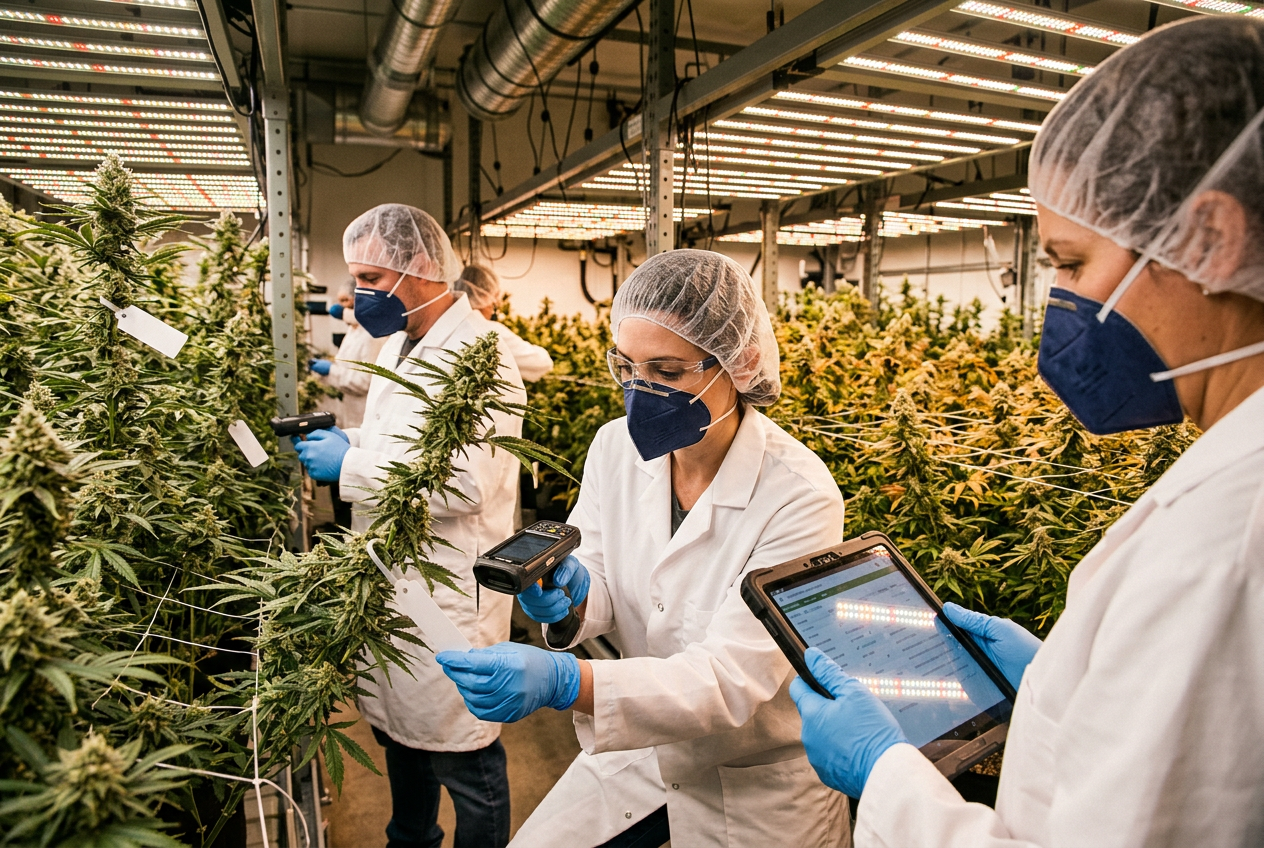
Every plant gets a unique tag at clone or seedling. From that moment its room, its nutrient feed, its IPM treatment and its environmental data are bound to it.

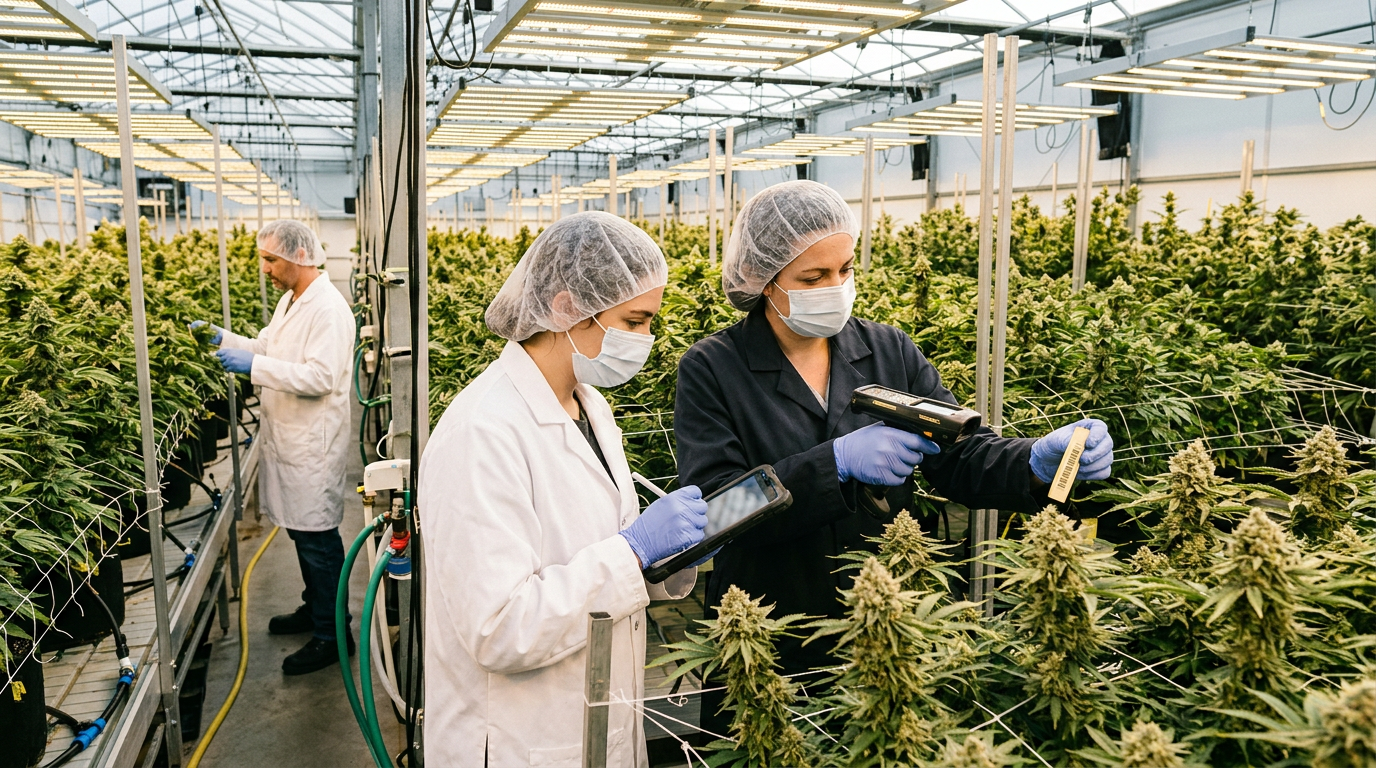
V5 holds every plant tag with strain, source, mother lineage, room assignment, growth stage, and movement history. Nutrient and IPM applications are kiosk-logged with product (with the state-approved pesticide list as a hard gate), concentration, applicator, REI, and PPE.

Environmental controllers (temperature, humidity, CO2, light schedule, VPD) stream into the room record. Variance from setpoint opens a deviation; sustained variance opens a CAPA.

  • Plant tag = primary key from clone through sale
  • State-approved pesticide list enforced at application — off-list = block
  • Environmental stream bound to room and to plant
  • Movement history (room-to-room) as signed events
Regulatory anchors
  • Metrc / BioTrackState track-and-trace — plant-tag lifecycle
  • State pesticide listState-published approved pesticide list for cannabis
04

Touchpoint 2 — Harvest and weigh-in

Plants leave the canopy and enter the harvest batch. Wet weight, waste, transfer to drying — every gram is on the ledger and on the state record.

The harvester scans the plant tag, the harvest batch and the destination drying room. Wet weight is on the scale stream; waste (stem, large fan leaves) is weighed separately and tagged for destruction per state rules. V5 pushes the harvest event to Metrc / BioTrack in real time.

  • Scale-stream wet weight — no key-in
  • Waste tagged for state-witnessed destruction
  • State system push at harvest event
Regulatory anchors
  • State track-and-traceHarvest event capture and waste-destruction protocol
05

Touchpoint 3 — Drying, curing, trim

Drying rooms are zoned, environmentally controlled, and tagged to the harvest batch. Trim weights reconcile to wet weight automatically.

V5 holds drying-room attributes: temperature band, RH band, photoperiod, sanitation status. Trim is kiosk-led with operator scan and bin weight; loss is reconciled against wet weight with a configurable tolerance. Out-of-tolerance opens an inventory deviation.

  • Drying-room environmental stream bound to harvest batch
  • Trim reconciliation with configurable tolerance
  • Operator e-sig on each trim bin
Regulatory anchors
  • State inventory rulesWet-to-dry reconciliation tolerance and reporting
Part III

Extraction & infusion

Approved formula lock, kiosk-led extraction, distillation, infusion.

06

Touchpoint 4 — Controlled formula for extracts and infused products

The formula is the approved recipe — and, where infused products go into food channels, the food safety plan input. In V5 it's a versioned, signed, machine-readable record.

Each formula holds: input cannabis batches (with current potency CoAs), non-cannabis ingredient BOM, routing with step-by-step instructions, in-process control plan (potency, terpenes, residual solvent, water activity for edibles), packaging routing, child-resistant closure spec, and the locked label artwork per state.

Effectivity is two-signature: a formulator signs the change, a QA lead signs that the change is within the state-approved scope. New work orders pick up the new revision; in-flight work orders keep the snapshot they were released against.

  • Input batches typed by CoA — potency drift forces formula recalculation
  • Residual-solvent limits per state inside the formula
  • Label artwork per state locked to formula revision
  • Child-resistant closure spec bound to the SKU
Regulatory anchors
  • State potency / labelling rulesTHC / CBD per package; per serving for edibles
  • 21 CFR 117Preventive Controls — for cannabis-infused food where applicable
07

Touchpoint 5 — Work-order release as a snapshot

Releasing a work order takes a snapshot of the formula and input CoAs. From that moment the batch carries its own copy — frozen forever.

Formula / recipe master v3.2BOM · Routing · IPCSpec · LabelEFFECTIVE · 2-SIGSNAPon releaseWO-2026-0418Bound to Formula / recipe master v3.2Frozen at releaseRELEASED · sha256:a4f9…runs even ifFormula / recipe master revisesBatch record (this batch)Filled by kiosk+ IPC + dev + sigsIMMUTABLEFormula / recipe master v3.3 (later revision)does NOT affect WO-2026-0418
The WO carries a frozen copy of Formula / recipe master v3.2. Later revisions don't disturb this batch.

If the formula is revised mid-shift, the work order keeps the snapshot it was released against. The auditor sees exactly the formulation this batch was built to, with the sha256 of the snapshot recorded against release.

Regulatory anchors
  • 21 CFR Part 11Electronic records and signatures — snapshot integrity
08

Touchpoint 6 — Kiosk-led extraction, distillation, infusion

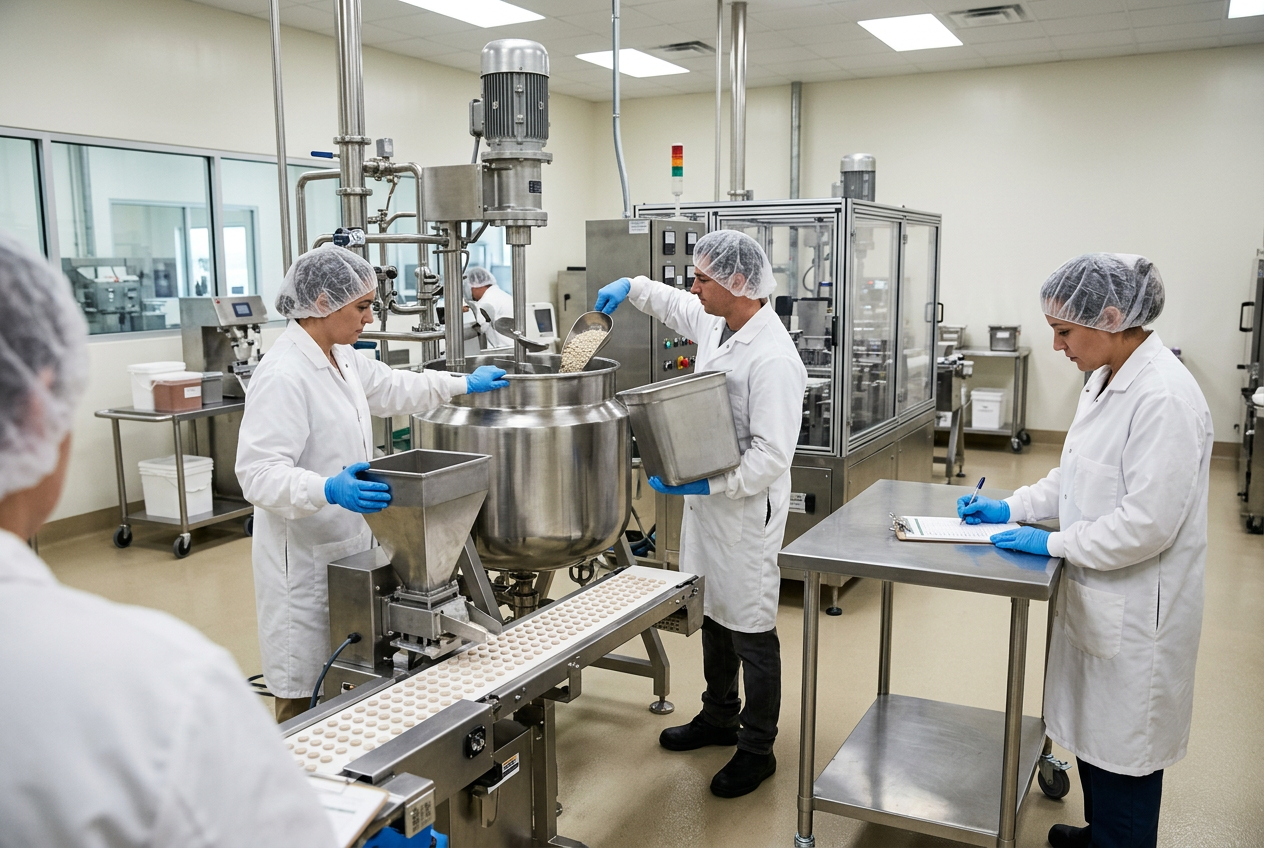
The kiosk is the floor's single pane of glass. Every BHO, CO2 or ethanol run; every wiped-film pass; every gummy or beverage batch — signed, timestamped, and bound to input cannabis lots.

Extraction parameters (pressure, temperature, solvent volume, run time) stream into the work order. Distillation passes are recorded with column temperature and yield. Infusion (edibles, beverages) is kiosk-led with operator scan, scale stream and homogenisation verification.

Allergen / dietary changeovers for edibles are explicit, signed gates — gummies move from gluten-containing to gluten-free with a documented changeover and sanitation verification.

  • Extraction parameter stream captured per run
  • Scale-stream dispense in infusion — no key-in
  • Allergen changeover gate for edibles
Regulatory anchors
  • State manufacturing rulesExtraction method approval, ventilation, fire-code conformance
  • EU GMP Annex 7Herbal medicinal products — applicable to medicinal cannabis extract
09

Touchpoint 7 — In-process and finished-product QC (state-mandated panel)

Sampling plans run on a schedule, not a reminder. Results flow back to the same work order automatically — and to the state system.

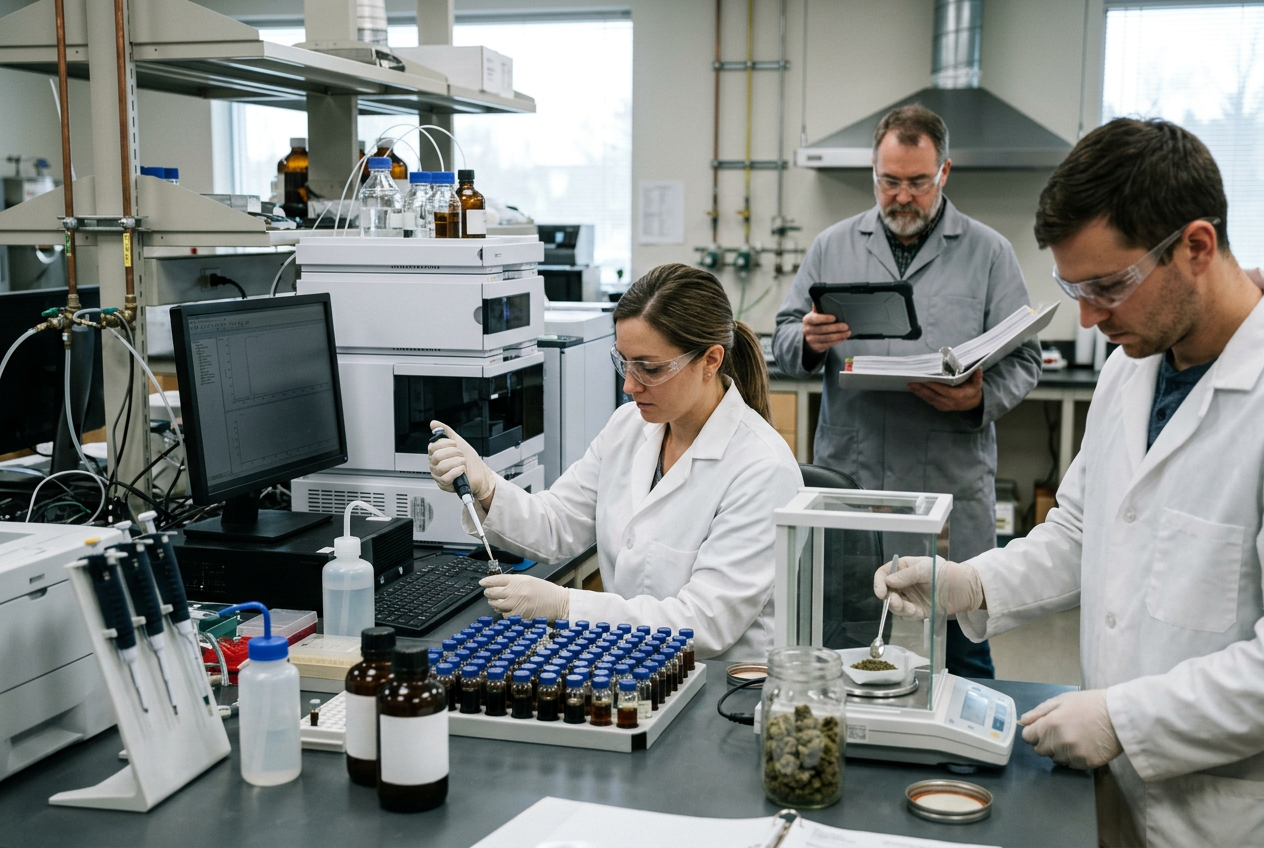
State-mandated CoA panel — potency (cannabinoids), terpenes (where required), pesticides per state list, heavy metals (As / Cd / Pb / Hg), mycotoxins (aflatoxins, ochratoxin), microbial (yeast / mould / coliform / E. coli / Salmonella), residual solvents (per state limits), water activity for edibles, foreign matter — runs at the state-mandated point in the workflow. OOS auto-opens a deviation, holds the lot, and notifies QA.

Regulatory anchors
  • State testing panelPer-state panel and limits — strict, varies by jurisdiction
  • 21 CFR 117 Subpart CHazard analysis — for ingestible products in food channels
Part IV

Quality events

Failed CoA, contamination, deviations, recalls — one queue.

10

Touchpoint 8 — Deviations, holds and CAPA in one queue

Every hold lands in the same queue — failed CoA, pesticide hit, inventory variance, sanitation fail, customer complaint.

A single register categorises by event type. Inventory variance vs. the state system is a first-class object: the system reconciles V5 movements against Metrc / BioTrack daily and opens a variance deviation on threshold breach.

Regulatory anchors
  • State recall / hold rulesDisposition workflow for failed-CoA inventory
Part V

Pack to customer

Compliant labelling per state, track-and-trace push, recall in seconds.

11

Touchpoint 9 — State-compliant packaging and labelling

The label is a regulated document. V5 prints from the formula, the CoA and the state's label rule — never from a Word document.

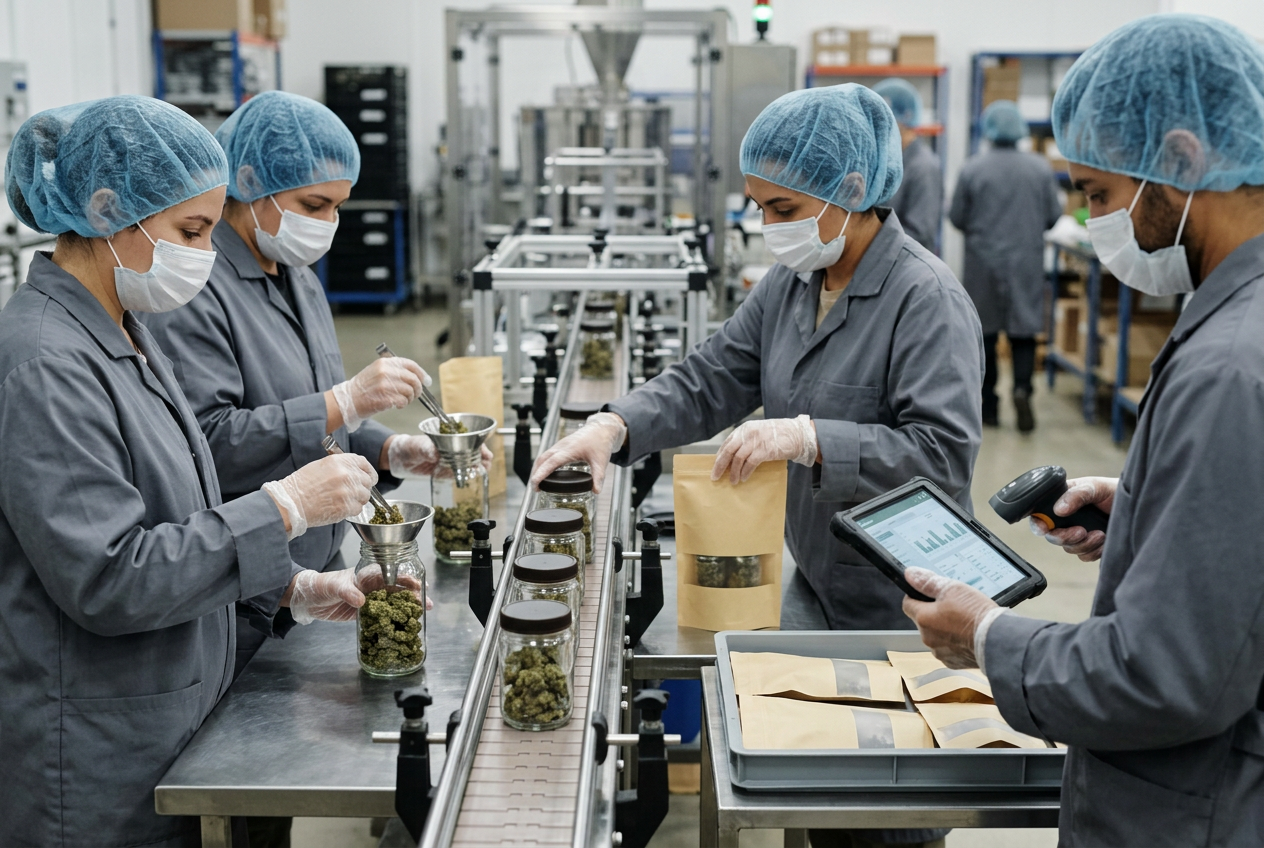
Each state SKU carries: THC / CBD per package and per serving, ingredients, allergens (for edibles), pesticide / heavy-metals / microbial CoA reference, manufacturer licence #, distributor licence #, child-resistant packaging certification, state-mandated warnings (pregnancy, driving, addiction), QR code to the CoA. V5 prints from the formula and CoA — no manual edits at packaging.

Distribution gates by state: if the SKU isn't licensed in the destination state, the shipment cannot release. Track-and-trace push (manifest) is automatic.

  • THC / CBD on label calculated from formula + CoA — cannot drift
  • CoA QR-coded on every package
  • Child-resistant packaging validated at fill
  • Distribution into non-licensed state blocked at shipment
Regulatory anchors
  • State packaging-and-labelling rulesChildproofing, warnings, per-serving limits, QR-to-CoA
  • Cannabis Regulations Part 7 (Canada)Packaging and labelling (Canada)
12

Touchpoint 10 — QA release with review-by-exception

QA reviews the exceptions, not the entire batch record. The ledger already proves the routine steps happened.

Review-by-exception is only safe if the record is complete and immutable. V5's batch record is built from the ledger as the line runs. The QA reviewer's queue surfaces only items the system can't auto-clear. Release requires two qualified e-signatures, both identity-verified, both bound to the snapshot.

Regulatory anchors
  • 21 CFR Part 11.50 / 11.70Signed records and signature-to-record linking
13

Touchpoint 11 — Distribution and recall in seconds

Recall is a query, not a project. Forward from a cultivation tag, backward from a unit on a dispensary shelf.

Recall / withdrawal lookback timelineFrom trigger to drafted regulator report — measured in minutes, not weeksT+0sRecall triggerQA flips lotSTEP 01T+15sBackward traceHarvest · extract · runSTEP 02T+50s100% units foundUnit · pallet · dispensarySTEP 03T+2mDispensary pushPortal + state systemSTEP 04T+8mState recall docAuto from ledgerSTEP 05Bidirectional from any node — unit ⇄ case ⇄ pallet ⇄ batch ⇄ lot ⇄ supplier
One ledger, one query. Forward and backward from any node.

Every unit is shipped against a state-system manifest that carries the lot code. When a recall trigger fires — failed retest, customer adverse event, pesticide false-negative discovery — V5 walks the ledger in both directions in seconds: every unit made from this harvest batch, every dispensary it shipped to.

The state-system recall submission and the press-release draft assemble from the same ledger.

Regulatory anchors
  • State recall rulesPer-state recall classification and reporting
  • Cannabis Regulations Part 9 (Canada)Recall and recall simulations
Part VI

Quality system

QMS, documents, training, management review, state inspections.

14

Quality system — state-licence-bound QMS as a live object

V5 holds the QMS as a structured, signed, live record — sized to the operator's licence type.

Quality manual, SOPs by licence type (cultivation / extraction / manufacturing / distribution), CAPA, change management, management review — all structured workspaces, not Word documents.

Regulatory anchors
  • ISO 9001:2015Quality management systems
  • EU GMP Part I / IIFor medicinal cannabis programs
15

Document control — controlled, versioned, two-signature

Every SOP, work instruction, label artwork and validation report is a controlled record.

Draft → Review → Approved → Effective → Periodic Review → Superseded / Retired. Two qualified signatures effect every release. Operators see only the effective revision; superseded revisions are retained per state record-retention rules (typically 2–7 years).

Regulatory anchors
  • State recordkeeping rulesRetention periods — typically 2–7 years
16

Training and competency — kiosk-gated, badge-aware

If you're not trained on the kiosk step — and your state-mandated employee badge is current — the kiosk won't let you advance it.

V5 maintains a training matrix per role × line × hazard. State employee-badge expiries are bounded; an expired badge locks the operator out of the kiosk.

Regulatory anchors
  • State employee-badge rulesWhere state requires individual operator licensure
17

Management review — assembled continuously, signed quarterly

Management review is not a 4-week scramble. V5 assembles it continuously from the ledger.

Management Review — continuous compilationEvery batch, IPC, OOS, deviation and complaint feeds the review as it happensJanbatch · IPCFebbatch · IPCMarbatch · IPCAprbatch · IPCMaybatch · IPCJunbatch · IPCJulbatch · IPCAugbatch · IPCSepbatch · IPCOctbatch · IPCNovbatch · IPCDecbatch · IPCManagement ReviewTrends · CpK · OOS · CAPAStability · Complaints · PVISO 9001:2015 §9.3CpK trend chartOOS / CAPA registerStability projectionSigned review PDF
Management Review assembles continuously — not a 4-week scramble at year end.

Every batch's quality signals, every CAPA, every state-system variance, every supplier / cultivator scorecard, every customer complaint — all stream into the management-review workspace as they happen.

Regulatory anchors
  • ISO 9001:2015 §9.3Management review
18

Internal audits, state inspections, Health Canada inspections

Audits land in the same queue as deviations. Findings drive CAPAs; CAPAs drive effectiveness checks.

V5's audit module schedules internal audits and state inspections. When the regulator arrives, the request list — Metrc / BioTrack reconciliation, last three months of CoAs, pesticide log, training, calibration — is a query, assembled and printable in minutes.

Regulatory anchors
  • State inspection rulesInspection scope and frequency by licence type
Part VII

Risk & operations

Pesticide and heavy-metals control, sanitation, equipment, EMP, complaints.

19

Risk and hazard analysis

For edibles, ingestibles and topicals, hazard analysis is HACCP-aligned. Cultivation hazards (IPM, pesticide drift) get the same structured treatment.

Hazards are identified by category (biological, chemical, physical, regulatory). Each gets a severity × likelihood score, a documented decision on whether a control is required, the monitoring procedure and frequency, the corrective action, and verification.

Regulatory anchors
  • 21 CFR 117 Subpart CHazard analysis — for ingestible products
  • Codex CXC 1-1969HACCP — for edibles and beverages
20

Pesticide and heavy-metals control — the make-or-break for cannabis

A pesticide hit is the most common reason cannabis products are recalled. V5 holds the programme as a live object.

Approved pesticide list per state, IPM SOPs, applicator training, sprayer-calibration records, REI enforcement, finished-product testing schedule, supplier-control side, response-on-positive plan (hold, vector-survey, intensified testing, disposition) — all assembled into one programme with a calendar and an audit trail.

Regulatory anchors
  • State pesticide listState-published approved pesticide list
  • FIFRA §24(c)Special Local Need pesticide registration on cannabis (state-by-state)
21

Sanitation programme — scheduled, verified

Sanitation is a documented, scheduled, verified programme — not a cleaning crew's judgement call.

V5 holds sanitation procedures per zone × equipment × cannabis state, with frequency, agent, concentration, contact time and verification (visual + ATP + microbial swab on a defined cadence). Sanitation events are kiosk-led; results bind to the equipment record.

Regulatory anchors
  • 21 CFR 117.35Sanitary operations — for cannabis ingestibles
  • EU GMP Annex 7Sanitation in herbal manufacturing
22

Equipment and calibration

Every instrument that monitors a critical control has a calibration schedule and an out-of-tolerance procedure.

Extraction pressure / temperature, distillation columns, dispense scales, HPLC, GC, LC-MS/MS for pesticide testing, water-activity meters — each is a tracked asset with calibration interval, certificate, tolerance, and an out-of-tolerance impact assessment that triggers a back-look.

Regulatory anchors
  • ISO 9001:2015 §7.1.5Monitoring and measuring resources — calibration
23

Environmental monitoring — cultivation, drying, manufacturing

For ingestible products and where cultivation hygiene matters, EMP is structured by zone.

Sample sites, frequency, indicator and pathogen testing, and corrective actions on a positive (intensified cleaning, re-test, hold) are all scheduled and tracked.

Regulatory anchors
  • 21 CFR 117.130(c)Environmental monitoring as a preventive control
24

Complaints — every complaint links to a lot

An adverse event from a consumer, a packaging defect, a potency complaint — each is a complaint tied to a lot on intake.

Intake captures lot, dispensary, observed issue, severity, consumer info. V5 binds the complaint to the batch, surfaces adjacent batches, and trips a deviation if pattern crosses a threshold.

Regulatory anchors
  • State adverse-event reportingWhere state requires consumer-event reporting
Part VIII

Compliance & onboarding

Part 11 evidence, customer surface, onboarding, regulatory matrix.

25

21 CFR Part 11 alignment — a property of the ledger

Part 11 isn't a module. It's a property of how V5 writes every record.

Every signed event carries the actor's verified identity, signature meaning, time, and a sha256 of the record. The signature row is append-only.

Regulatory anchors
  • 21 CFR Part 11Electronic records and signatures — alignment for state records
26

Customer experience — dispensary portal, CoA on demand

Dispensaries and B2B customers query the ledger through a scoped portal.

CoAs per lot, potency lookup, recall status, manifest history — all on the portal. Audit-trail of who downloaded what is automatic.

27

Onboarding and support — weeks, not months

V5 ships pre-configured for a typical cannabis operator: Metrc / BioTrack integration templates, state rule packs, GFSI-aligned QMS shell.

A typical operator onboards in 4–8 weeks: master data import, plant-tag migration, kiosk training, parallel-run validation, cutover. The validation pack (URS → IQ → OQ → PQ) is built in.

28

Regulatory matrix — every clause, every touchpoint

Where every clause lands in the V5 product surface.

Abbreviated mapping. Each link opens the full readiness guide.

RegulationScopeTouchpointsGuide
State cannabis regsPer-state cGMP, testing, labelling, T&TAllRead →
Metrc / BioTrackState track-and-trace integration03, 04, 05, 11, 13Read →
Cannabis Regs SOR/2018-144Health Canada — federal cannabis regulationAll
EU GMP Annex 7Manufacture of herbal medicinal products (medicinal cannabis)08, 14Read →
USDA 7 CFR 990Domestic Hemp Production Program03, 04
21 CFR 117Preventive Controls — for cannabis ingestibles06, 09, 19, 21
Codex CXC 1-1969HACCP — edibles and beverages19
ISO 9001:2015Quality management systems14, 17
21 CFR Part 11Electronic records / signatures alignment07, 12, 25Read →

See the playbook running on your floor.

Free trial, no credit card, onboard in days, not months.