
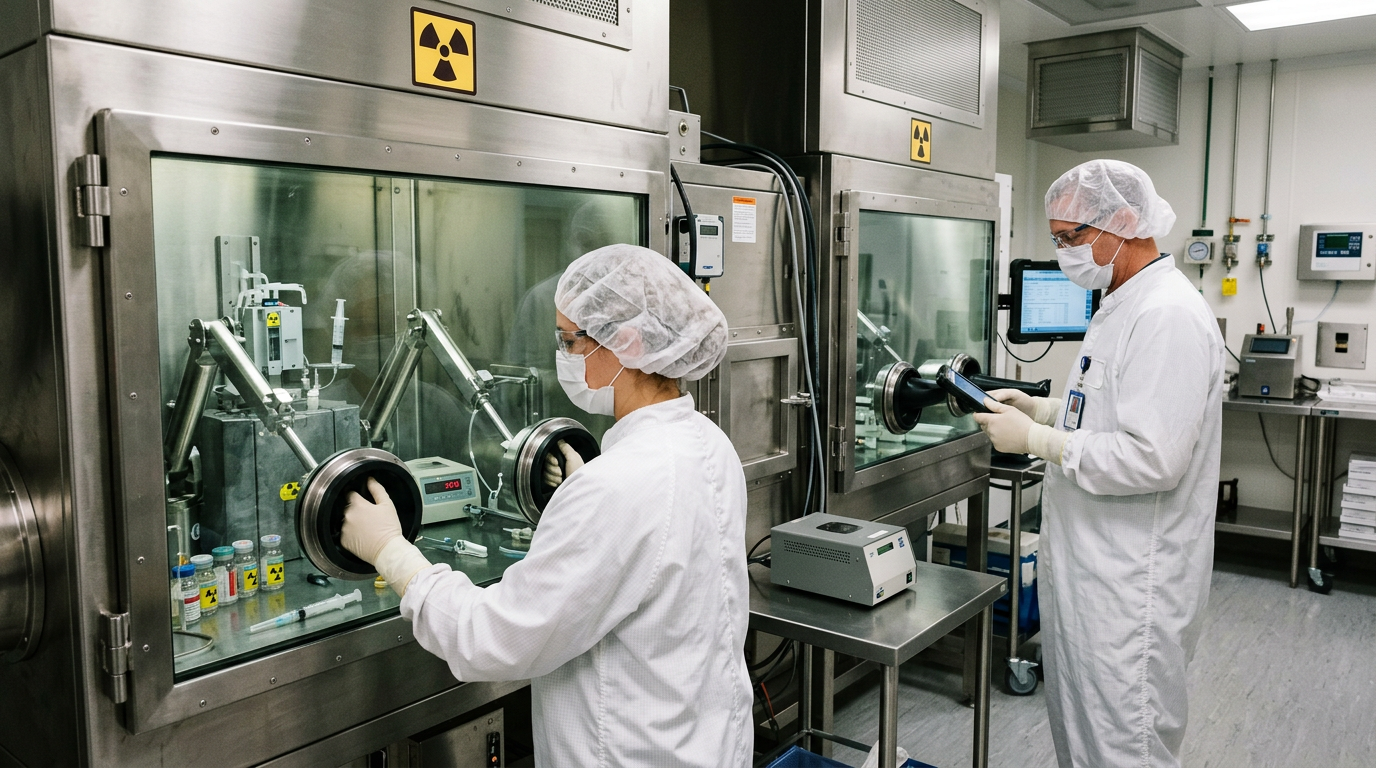
From the cyclotron to the patient syringe — one decay-corrected system.
V5 Ultimate runs every step where the clock is part of the spec — precursor receipt, cyclotron target, synthesis module, QC, patient unit-dose dispense at injection time, Type A dispatch and retroactive sterility close-out. Activity decayed on every read. Conditional release under 212.70(d), enforced. One immutable BMR per batch.
Built for 21 CFR 212 (PET), 21 CFR 210/211, USP <823>, and NRC / state radioactive materials licensing.
The same batch record — seen the way you run the pharmacy.
For a busy PET or therapy site, the small wins compound every synthesis. Finance sees more patient doses per curie and less wasted activity. Operations sees the next synthesis start on time. QA sees a BMR the FDA and NRC investigator will actually recognise.
More patient doses per synthesis — decay loss squeezed, wasted activity captured, and revenue per curie finally on the page.
- Per-batch actual cost: precursors, cassettes, target time, labour and rework — visible in $, today.
- Live revenue per curie by isotope, customer and imaging centre — the room you didn't know you had.
- Fewer end-of-day decay write-offs from earlier release and better dispense sequencing.
- Most radiopharmacies see V5 pay back well inside year one and keep compounding.
From the precursor COA to the patient injection — one decay-corrected thread.
Follow one production morning. Every step below is a single screen in V5 — and the license, dosimetry and calibration layer runs underneath them all.
Qualified vendor, COA on file, license room checked — before the courier hands it over.
- COA, DMF and vendor status verified at receipt — no COA, no goods-in.
- License possession limits enforced by isotope, room and total activity.
- Every vial, kit and cassette barcoded into the shielded store with survey and wipe results attached.
- Expired vendor qualifications block receipts and email the supplier automatically.
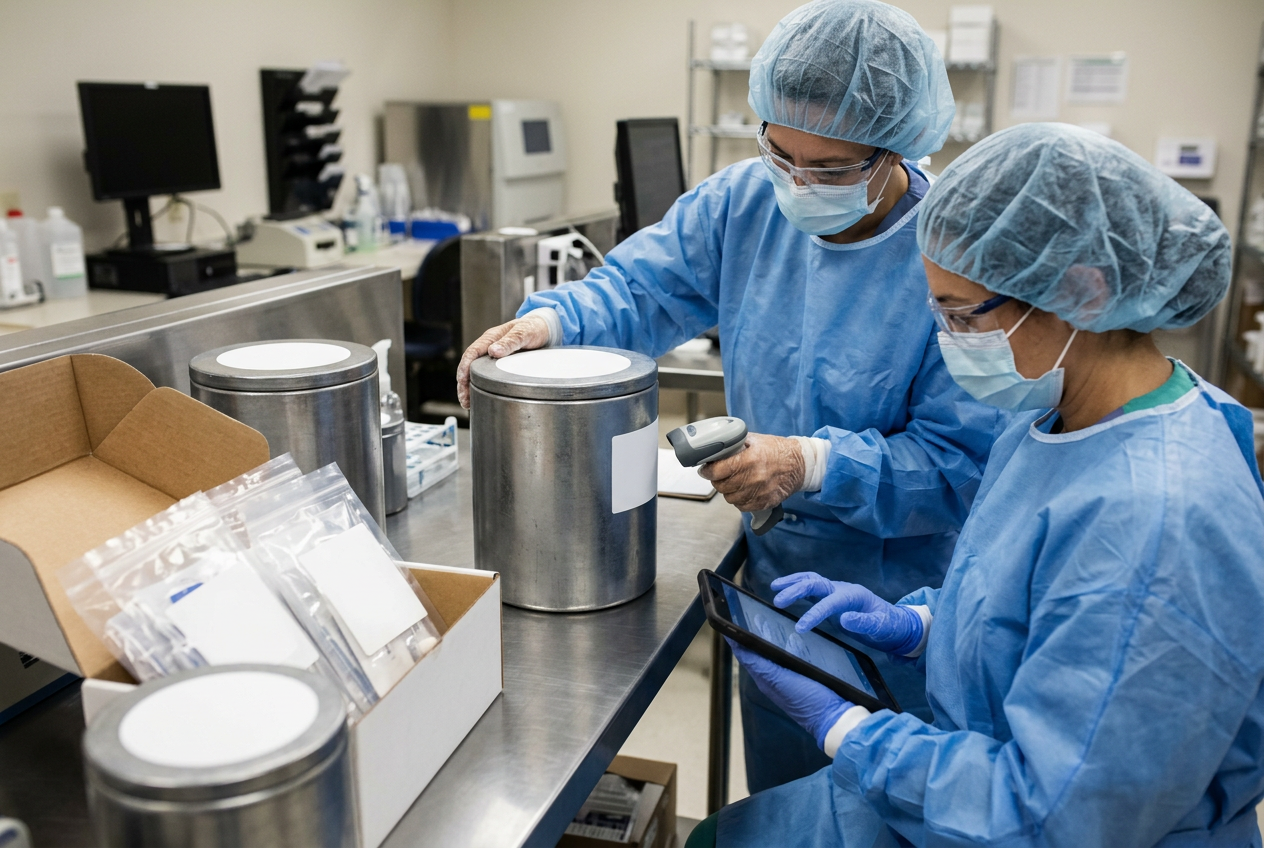
The schedule fires the target, the synthesis module runs the recipe — every EOB activity captured live.
- Schedule built around cyclotron availability, target changeouts and hot-cell decontamination.
- Direct integration with GE Tracerlab, Sofie ELIXYS, IBA Synthera, Trasis AllInOne and comparable modules.
- EOB activity captured from the module — decay-corrected forward to calibration time automatically.
- Live synthesis yield, purity and side-product trending — drift caught at run three, not run thirty.
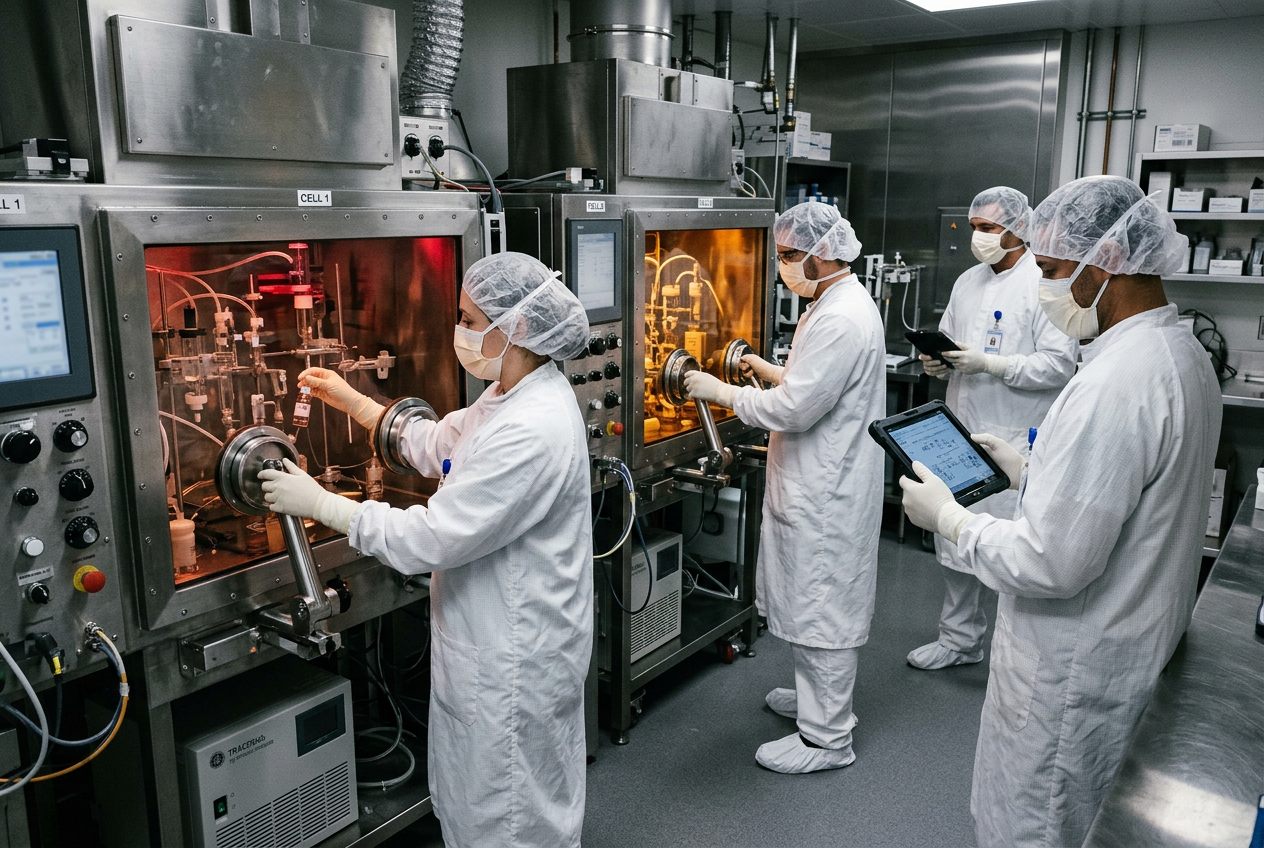
The dose can't ship until every QC gate is green — and conditional release forces the retroactive close-out.
- All 212.71 acceptance criteria configured as gates — no green, no release.
- Instrument integration for HPLC, radio-TLC, GC, LAL, dose calibrator, MCA — results wired to the batch.
- Conditional release under 212.70(d) with forced 14-day sterility close-out — no orphan doses.
- Two-signature review-and-release per 211.186 / 211.188 — preparer plus independent reviewer.

One synthesis, many patient doses — each decay-corrected to injection time.
- Decay correction from EOB or calibration time to injection time — Pb-212, Ac-225, Lu-177, F-18, Ga-68, Tc-99m, I-131.
- Dose calibrator readings streamed live — Capintec, Biodex, Comecer, Sun Nuclear.
- Prescription cross-check with tolerance band — out-of-spec dispense blocked at the cell.
- Patient / order / referring-site mapping — dose record ties one syringe to one order.
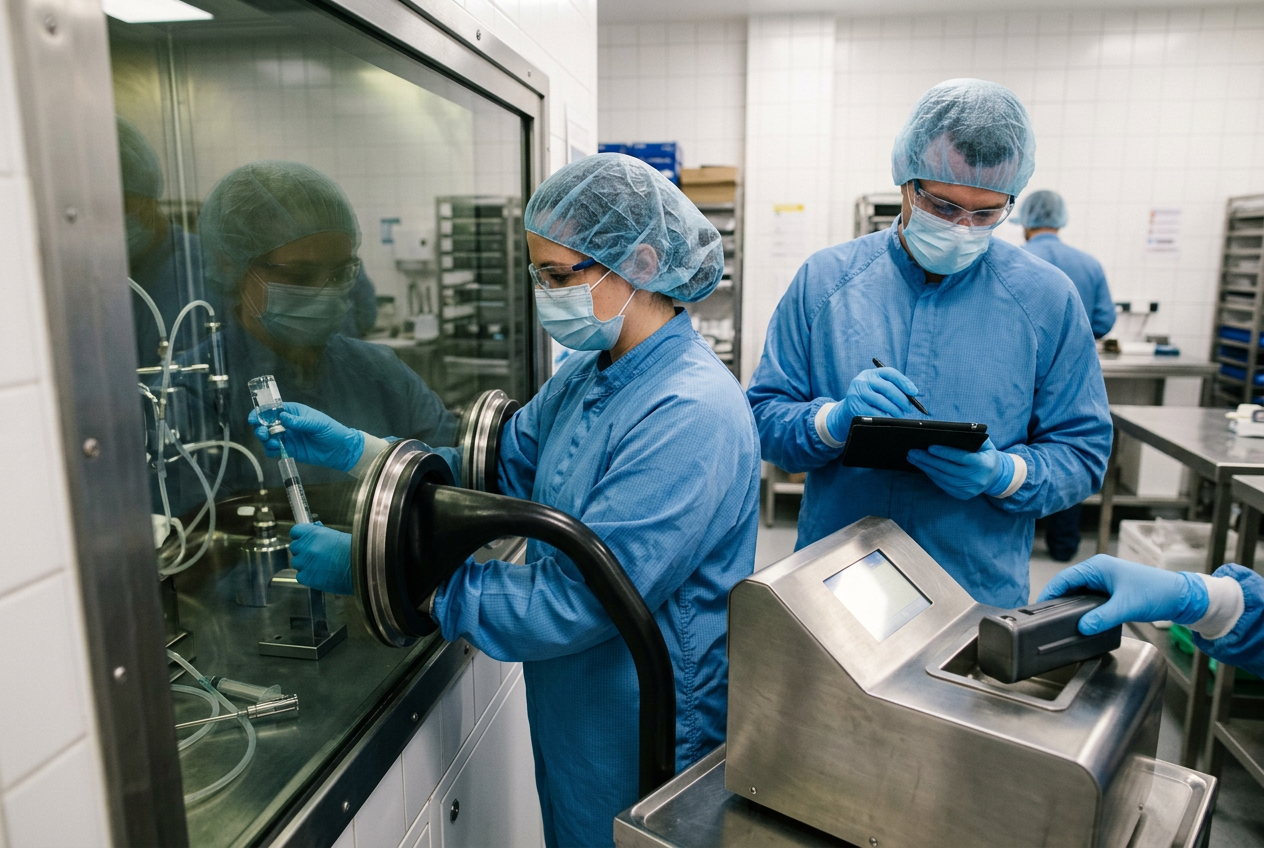
"If we recalled batch F18-24-0142 right now — which patients are exposed?"
Every syringe ships in a 49 CFR 173 Type A pig with a courier manifest, TI index, activity at ship-time and expiry-at-arrival already computed. When a deviation triggers a recall, V5's dose tree paints the affected batches, syringes, imaging centres and patient orders — forward from the synthesis and backward to every precursor lot and cassette that built it.
Precursor supplier flags Mannose triflate lot MT-8821. V5 walks the tree — the [¹⁸F]FDG synthesis it built, the dose lots it filled, the imaging centres and patient orders that received it. Pull the lever to see the exposure.
Cyclotron PM, TLD cycles and dose-calibrator constancy — on the same tablet as production.
- PM and qualification schedules per cyclotron target, hot cell, dose calibrator and HPLC.
- Constancy, linearity, accuracy and geometry checks scheduled and evidenced against ANSI N42.13 / NRC guidance.
- Operator TLD / ring badge cycle tracking, ALARA reporting and quarterly RSO review.
- Spares stock and vendor lead times in the same ledger as precursors and cassettes.
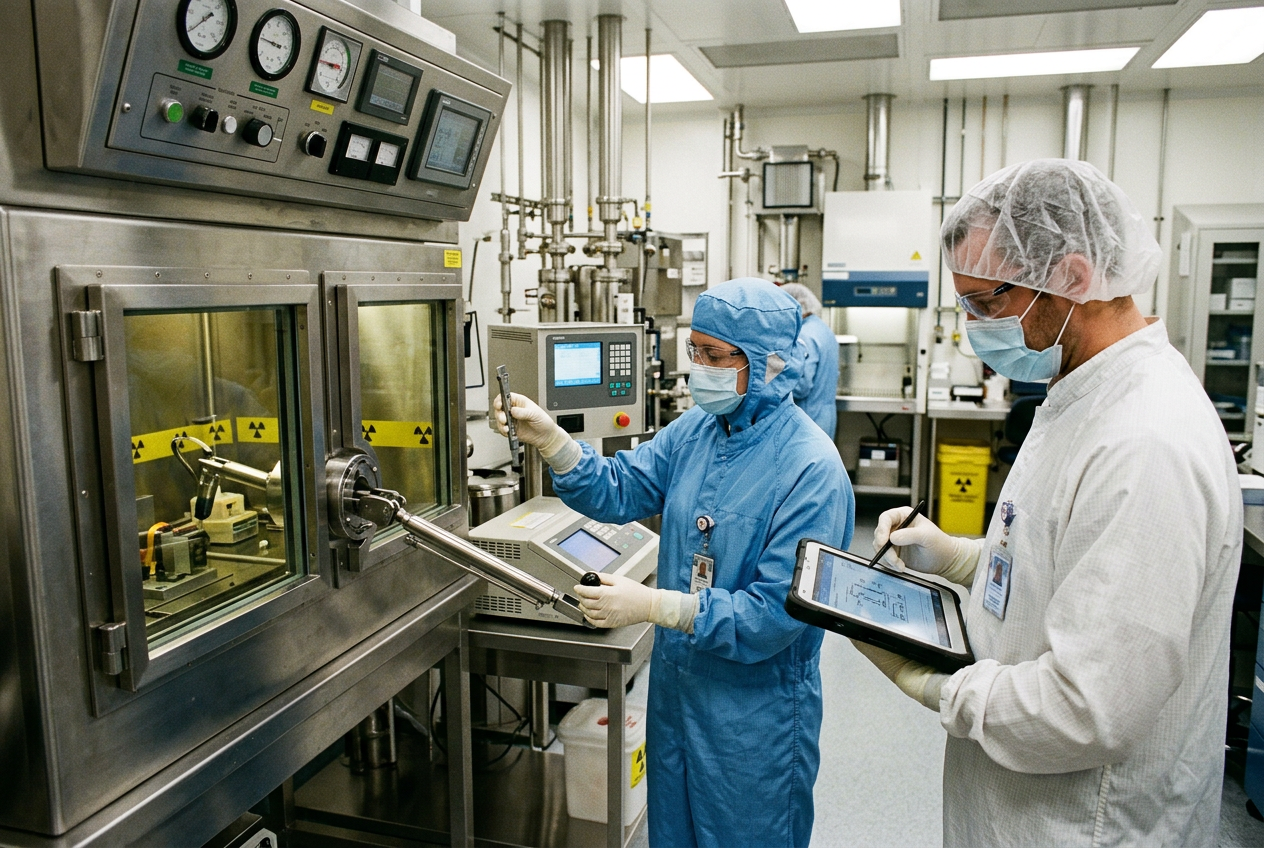
Quality and radiation safety run through every batch — not stapled to the record at the end.
- Incoming checks per precursor, kit and cassette — COA match, seal, activity, wipe-test.
- In-process gates — synthesis yield, radiochemical purity, GC solvents, LAL endotoxin, pH, appearance.
- Finished-dose release — QP / QA can't be skipped before a syringe leaves the cell.
- Surveys, wipe-tests, TLD reads and decay-in-storage waste all logged against the batch, room and operator.
- Deviations, OOS and CAPA loop from raised → root cause → verification → close, tied to the batch and instrument.
- Document control and training matrix — superseded SOPs and lapsed dosimetry hard-block the hot cell.
Every quality feature in V5 — mapped to a hot lab.
The same platform that runs pharma cleanrooms and medical-device assembly — set up for the way a PET or therapy radiopharmacy actually checks, releases and audits its dose.
Incoming inspection checklists
Configurable per precursor, kit and cassette. The receiver can't close the goods-in until every check is signed — and a failed check raises a hold automatically.
In-process gates & 212.71 acceptance
Scheduled QC checks on the batch — radiochemical purity, radionuclidic identity, residual solvents, LAL endotoxin, pH, filter integrity. Limits enforced; out-of-spec opens a deviation.
Batch release & conditional release
Two-signature review-and-release per 211.186 / 211.188 before any dose ships. PET conditional release under 212.70(d) with a system-enforced 14-day retroactive sterility close-out.
Deviations, OOS & CAPA
One workflow from issue raised to root cause, action, verification and close. Linked to the batch, module, hot cell, operator and vendor involved.
Surveys, wipe-tests & dosimetry
Room surveys, wipe-tests, TLD reads and ring-badge cycles tracked against the room, operator and quarter — ALARA reports assemble themselves for the RSO.
Document control & training
Two-person e-sig approval, version control, hybrid numbering. The hot cell hard-blocks any operator on a superseded SOP or with overdue dosimetry / training.
Vendor scorecards & re-qualification
On-time delivery, COA quality, complaint rate and audit findings rolled into a live vendor score. Expired qualifications block goods-in automatically.
Calibration & instrument qualification
Dose calibrators, well counters, HPLCs, GCs, MCAs and pH meters on a calibration and constancy calendar — with certificates attached and next-due enforced.
Recall & imaging-centre complaints
Complaint in, dose traced, root cause and response back to the imaging centre — closed-loop, with the batch record updated for the next inspection.
Live on the cyclotron, synthesis modules and QC instruments — no rip-and-replace.
We connect at the level your engineers and QA expect — OPC UA, Modbus, MQTT, REST, HL7, DICOM, EDI, file drops, SQL. Most radiopharmacies are live on day one with the cyclotron, synthesis modules, dose calibrators and HPLCs already in the plant.
Cyclotrons
IBA Cyclone, GE PETtrace, Sumitomo, ACSI, Best Medical. Target load, beam-on, EOB activity and yield streamed to the batch record.
Synthesis modules
GE Tracerlab / FASTlab, Sofie ELIXYS, IBA Synthera, Trasis AllInOne, Comecer Taddeo. Recipes, synthesis logs and purity trend into V5 automatically.
Dose calibrators & well counters
Capintec, Biodex, Comecer, Sun Nuclear, MIRION. Live activity reads, constancy, linearity and geometry checks tied to instrument and batch.
QC instruments — HPLC, GC, radio-TLC, LAL
Agilent, Waters, Shimadzu, Eckert & Ziegler, Charles River Endosafe. Results wired to the acceptance gate — no manual re-key.
ERP, LIS & imaging-centre orders
SAP, NetSuite, Microsoft Dynamics 365, Oracle. HL7 / DICOM / REST for imaging-centre orders and dose confirmations.
BI & data warehouse
Power BI, Tableau, Looker, Snowflake, Databricks. Direct SQL access to your tenant — your data, your queries, your validated reports.
21 CFR 212, 210/211, USP <823> & <797>, 10 CFR 35, 49 CFR 173 — at the data layer.
The records build themselves as the batch synthesises. When the FDA investigator or NRC inspector walks in, the evidence pack is one click — not a week of re-assembly.
Fixed-price, named team, one hot cell live before you pay for the next.
- Week 1–3·step 01Discovery & floor scan
We walk one hot lab with your team — isotopes, precursors, modules, cyclotron, dose calibrators, HPLC, existing ERP fields. Out: a fixed scope and price.
- Week 4–7·step 02Configure & integrate
Isotope master, formulas, BOMs, QC gates, label templates, cyclotron / module / dose-calibrator integrations and ERP feeds loaded. IQ / OQ on the bench.
- Week 8–11·step 03PQ, pilot & train
One hot cell live in pilot. Three-shift operator training on the floor with the actual UI — not slides. PQ and UAT signed by QA, RSO and operations.
- Week 12–14·step 04Go live & hyper-care
Cut over. Two weeks of hyper-care with your named delivery team on-site. KPIs published on the wall before we leave.
The first six questions on every radiopharma RFP.
How does V5 handle decay correction across EOB, calibration time and injection time?
How does V5 support 21 CFR 212.70(d) conditional release?
Will V5 talk to our cyclotron, synthesis modules and QC instruments?
How does V5 handle NRC / state license limits and radiation safety records?
Can operators actually use it in a three-shift hot lab?
What about IT — 21 CFR Part 11, SOC 2, validated change control?
Book a 30-minute walkthrough with a radiopharma specialist.
We'll show a live decay-corrected BMR, an F-18 conditional release with retroactive sterility close-out, a Lu-177 therapy dispense, a Type A dispatch pack and a mock NRC inspection — on a workspace seeded for a working radiopharmacy.
Fixed-price go-live · No platform lock-in · Onboard in 8–14 weeks