
Every procedure reviewed on time, with a recorded outcome.
Each document carries the cycle your procedure sets. Owners see what is due and sign no change, revise or retire.
7-day free trial, no card required. Periodic review is part of document control, in Professional and Enterprise.

Nothing slips past its date.
Owners see which documents are coming due under the cycle your procedure sets.
A real outcome, signed.
Each review ends in no change, revise or retire, recorded with the reviewer's signature.
Revisions start from the review.
A 'revise' outcome leads into a controlled change, so the history stays connected.
Follow one review
Review what changed since last time
Try it: open the cleaning SOP due on 20 Oct, read what happened since its last review, then decide: no change, or revise.
- Linked deviations
- 1 · cleaning agent dilution
- Equipment changes
- New filler on Line 2
- Related documents
- 2 revised since
- Prepared by AI
- Change list · check it
- Decision
- No change · rev C stays in force
- Next review
- Set by your cycle
- Record
- Review kept on the document
- Decision
- Revise
- Change opened
- CR-0231 · rev D draft
- Rev C
- Stays in force until rev D
The reviewer decides. AI only prepares the change list for checking.
Worked example. Your review cycle is set by your procedure; 41 of 44 reviewed this year.
How periodic review works: due dates, outcomes and history
Tap a step below to see what happens.Choose a step below to see what happens.
Step 1 of 3
- SOP-CL-03 · CleaningDue 20 Oct · owner L. Haddad
- WI-RC-02 · ReceivingDue 4 Nov
- SOP-LC-01 · Line clearanceOverdue 3 days
- Cycle2 years · example rule
Cycles come from your procedure, not V5 defaults.
See what is coming due, and who owns it
- Each document carries the review cycle your procedure sets.
- Owners and quality see what is coming due and what is overdue.
Whether an overdue review restricts any work is not claimed; reminder channels depend on your set-up.
More on due: full record and set-up
Also on this record
- Reviewed this year
- 41 of 44
An overdue review stays visible until it is recorded.
- Owner has left
- Reassign the owner under your procedure; the history keeps who reviewed before.
- Cycle length
- The two-year cycle here is only an example. Your procedure decides.
Quality Management Buyer Guide
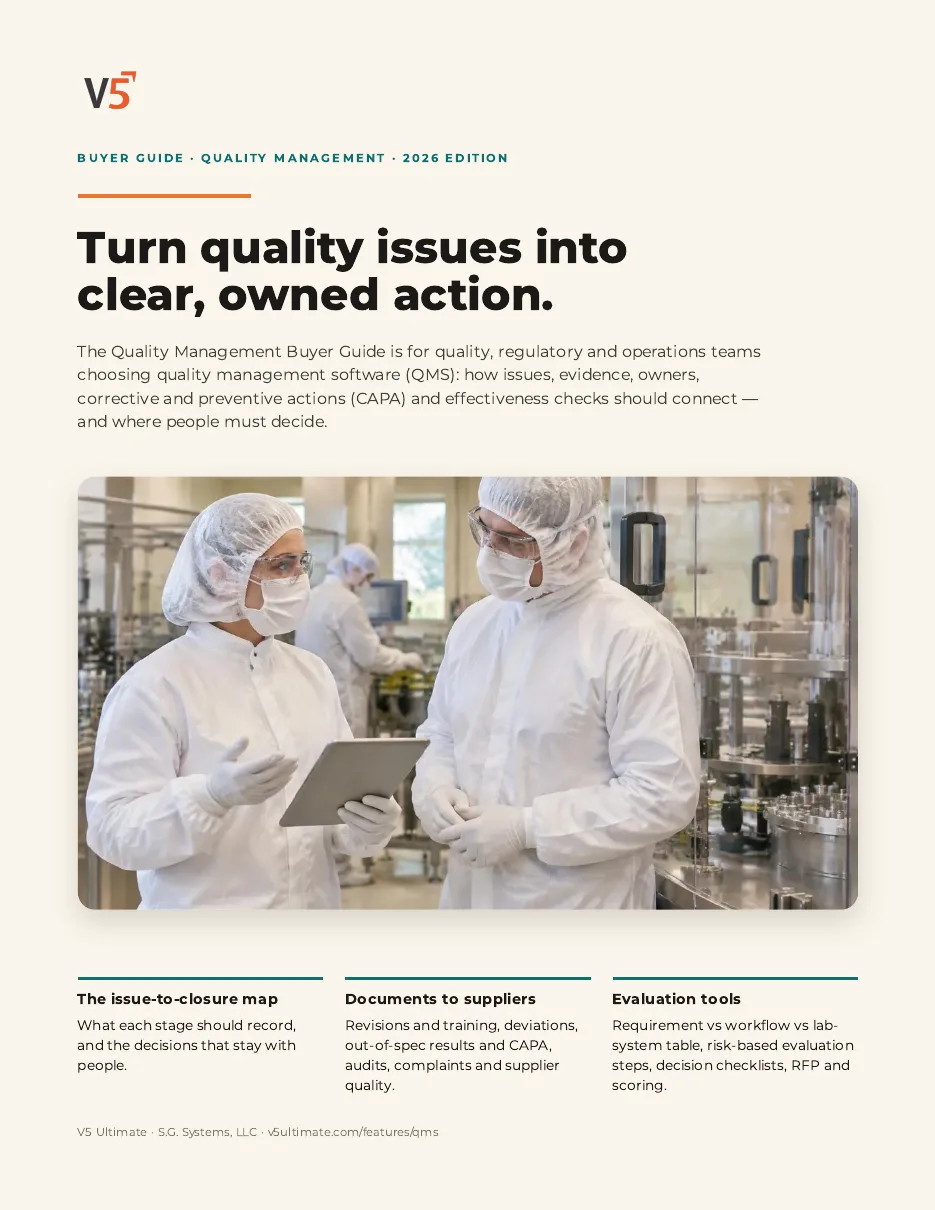
For quality, regulatory and operations teams choosing quality management software. Use it with or without V5.
- 1Check revisions, effective dates and training.
- 2Keep each change tied to its reason.
- 3Test review with one of your own SOPs.
See what's inside
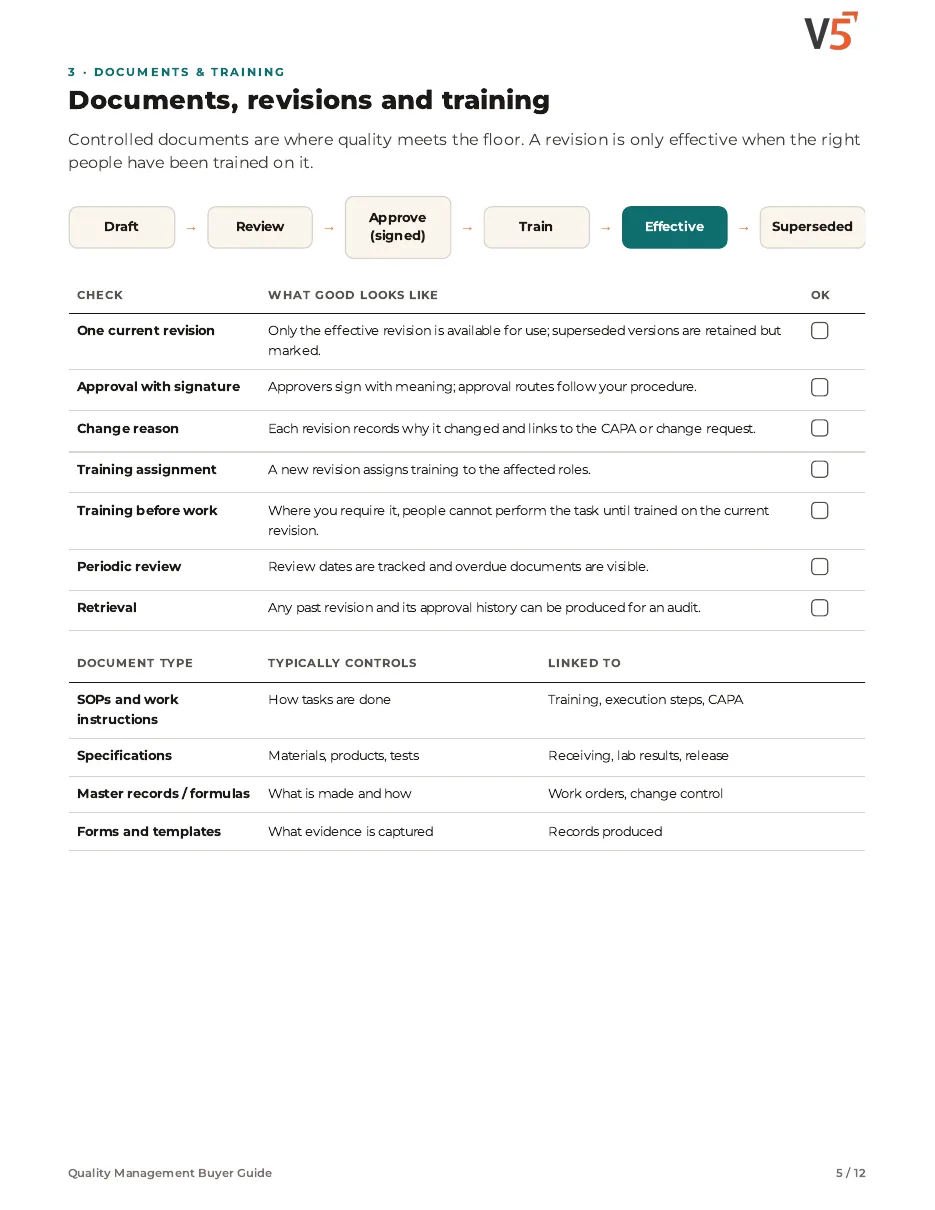
- What to check for drafts, approvals, effective dates and read-and-understood records when documents are reviewed or revised.
- How reviews and revisions connect to deviations, CAPA and training, so changes keep their reason.
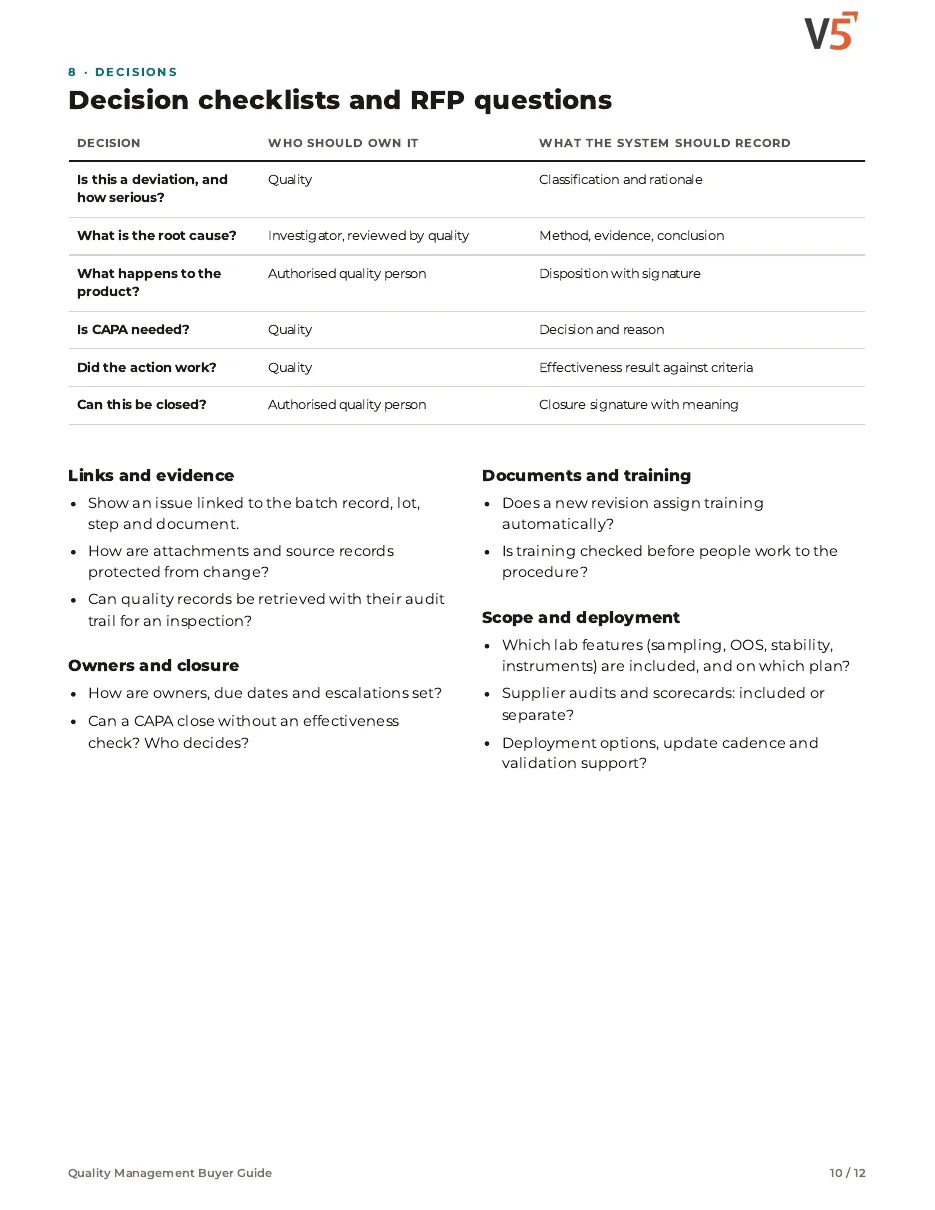
- Decision checklists, RFP questions and a scored sheet to test periodic review with one of your own SOPs.
Chapters: why quality systems stall · from issue to closure · documents, revisions and training · deviations, out-of-spec results and CAPA effectiveness · audits, complaints, supplier quality and traceability · requirement, workflow or lab system · risk-based evaluation and validation · decision checklists and RFP questions · scored evaluation · where V5 fits and sources.
We ask for your name and email so we can handle this request. The PDF downloads in your browser. Privacy policy
Reviews that feed real changes
A review that finds a needed change opens it in document control, so nothing is lost between the review and the revision.
What's included
What periodic review uses, and which plan each item needs. Compare plans
Review and record
From due date to signed outcome.
Document control · Electronic signatures · Audit log (view)
Explore periodic review
Review and record
From due date to signed outcome.
Document control · Electronic signatures · Audit log (view)
- Document controlProfessional and EnterpriseReview cycles, outcomes and revisions on each document.
- Electronic signaturesProfessional and EnterpriseSigned outcomes with meaning.
- Audit log (view)Who reviewed what and when.
- Training and competenceProfessional and EnterpriseTraining on the revision a review leads to.
- Audit-readiness scoringEnterpriseLive readiness index across Part 11, GxP and ISO areas.
Review cycles and outcomes are decided by people under your procedures.
Try it on the procedures due this quarter.
Start your free trialOr (you can edit the question before sending) or .